




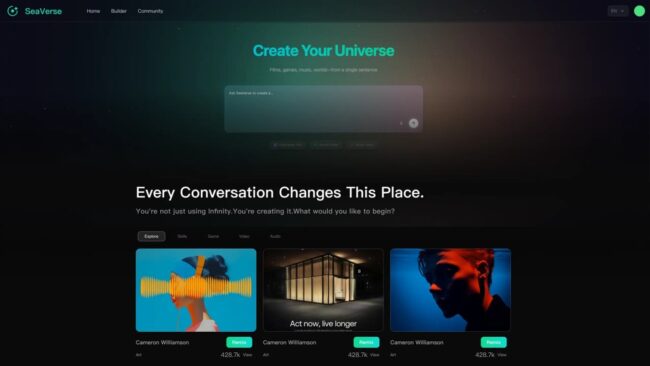
SeaVerse has launched what it calls the world’s first fully AI-native creation and deployment platform, positioning the product as a unified workspace that integrates generative AI across text, image, video, code, and agents under one interface. Announced on January 10, 2026, the platform is built around the company’s “All in AI Native” philosophy, which promises to eliminate friction between idea generation and product deployment—a claim that, if realized at scale, could reset expectations for productivity tooling in AI-first environments.
Rather than competing on model performance or raw compute, SeaVerse is making a strategic bet on workflow integration and user experience. The platform moves beyond isolated tools by enabling users to generate, preview, publish, and iterate within a single loop, accelerating prototyping and deployment cycles across industries ranging from gaming to e-commerce to interactive media.
Is SeaVerse’s “All in AI Native” model the next logical evolution of AI product development platforms?
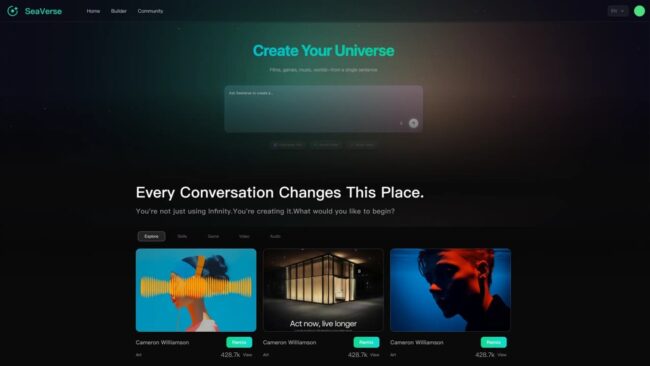
The central shift SeaVerse is attempting is not just technical—it is architectural. While most generative AI tools operate as plugins, APIs, or standalone applications layered onto legacy design stacks, SeaVerse proposes a fundamentally different structure: an AI-native loop where prompt input leads directly to deployable, interactive products without intermediate tooling, server setup, or manual deployment steps.
This creates a new category of AI development environment. Unlike platform-as-a-service (PaaS) models that prioritize backend scalability or cloud-native devops solutions built for conventional software teams, SeaVerse’s proposition is designed for individual creators and small teams who want to move from creative concept to application-grade output with minimal technical overhead.
The core mechanism hinges on four capabilities: multimodal asset generation (text, image, audio, code), auto-packaging of assets into runnable product formats, one-click deployment to the web, and built-in collaborative iteration. In essence, SeaVerse aims to collapse the build–test–deploy cycle into a near-seamless experience.
How does SeaVerse compare with existing platforms offering multimodal AI generation?
SeaVerse is entering a crowded but fragmented landscape. Tools like Runway ML, Pika Labs, Leonardo.Ai, and even Adobe’s Firefly offer powerful generative capabilities, but each remains siloed in function or asset type. Others, like Unity’s Muse or NVIDIA’s Omniverse integrations, offer more complex pipelines for developers—but require steep learning curves or ecosystem lock-in.
SeaVerse’s competitive bet is horizontal simplicity: rather than offering best-in-class outputs in each modality, it offers instant interoperability. Type a prompt like “a futuristic 3D racing game,” and the platform will simultaneously generate scene assets, soundtrack, interactive logic, and previewable gameplay—all bundled into a shareable instance, ready for collaboration and publishing. The promise is breadth and cohesion over peak fidelity in any one domain.
This could appeal to education markets, indie game developers, corporate prototyping teams, and social content creators looking for fast, functional MVPs with low technical entry points.
What does the one-click deployment model signal about the platform’s backend architecture?
SeaVerse’s one-click deployment capability is not just a UX flourish—it reflects an opinionated backend architecture optimized for AI-native product lifecycles. By abstracting away the need for servers, domains, or container orchestration, the company is targeting the “maker” demographic: those with ideas, not infrastructure.
Each generated product is deployed to the cloud with a live link, removing friction associated with typical dev-to-deploy bottlenecks. This architecture appears to leverage lightweight containerization or serverless compute wrappers, although SeaVerse has not disclosed specifics about its cloud infrastructure partners, compliance stack, or data storage protocols.
For enterprise adoption, this abstraction could raise questions around governance, security, and long-term maintenance—especially if deployed in regulated sectors or large team environments. But for creative prototyping, hackathons, or internal innovation labs, it offers a speed advantage difficult to match with conventional stacks.
Could SeaVerse’s collaborative iteration loop redefine team-based AI workflows?
One of the more quietly disruptive features is SeaVerse’s real-time collaborative environment. Once a product is published, collaborators can comment, edit, and re-deploy iterations directly within the same workspace—akin to how Google Docs redefined word processing or how Figma changed interface design.
This could address one of the more persistent pain points in AI-enabled creation: the inability for teams to iterate across models, assets, and deployment targets without leaving the ecosystem. By embedding commenting, versioning, and contribution directly into the product instance, SeaVerse is shifting from tool to workspace—potentially challenging incumbents like Notion, Framer, or even Meta’s Builder Bot conceptually, if not immediately.
The implicit suggestion is that future product teams could operate as “AI-native squads,” reducing dependencies on external engineering cycles and accelerating go-to-market timelines for concept-stage ideas.
What are the potential execution risks and adoption challenges SeaVerse faces in scaling?
SeaVerse is articulating a bold vision, but several execution risks loom. First is interoperability. While its all-in-one model may appeal to beginners and fast movers, more advanced users will demand hooks into existing tools, open standards, and customizable backends. Without these, SeaVerse risks becoming a walled garden that scales poorly for production-grade use cases.
Second is performance parity. If the platform’s generated outputs lag significantly in quality compared to best-in-class point solutions in image, video, or code generation, professional users may migrate back to modular stacks.
Third, monetization. SeaVerse has not disclosed whether its business model will rely on freemium tiers, enterprise licenses, or pay-per-deployment credits. The economics of serving real-time generation, deployment, and hosting at scale—especially for game-level assets and interactive applications—could be difficult to sustain without aggressive pricing or backend efficiency.
Finally, platform fatigue is real. In a market saturated with AI tools, startups that do not quickly carve out defensible niches or foster developer ecosystems risk rapid churn. SeaVerse’s “one prompt to product” value proposition will need to demonstrate not just novelty, but reliability over time.
Why does this launch matter for the broader AI-native tooling landscape in 2026?
SeaVerse’s debut reflects a broader trend in the generative AI ecosystem: the shift from discrete toolchains to integrated platforms. As AI capabilities normalize, the next wave of competition will hinge less on model breakthroughs and more on how those models are packaged into usable workflows.
“All in AI Native” is not just a slogan—it is a directional thesis about where AI tooling is heading. Whether SeaVerse becomes the Figma of AI creation or merely sparks a feature wave across incumbents, its core idea—that creation, deployment, and iteration should be unified—will likely influence how platforms are designed in the coming years.
In a sense, SeaVerse is not just building a product. It is trying to rewire the product development loop itself.
What are the key takeaways from SeaVerse’s AI-native platform launch and strategy?
- SeaVerse launched a unified AI-native creation and deployment platform that eliminates the need for fragmented toolchains.
- The “All in AI Native” model allows users to generate, preview, deploy, and iterate within one workspace from a single prompt.
- The platform emphasizes multimodal generation across text, code, image, video, and audio, bundled into shareable, runnable product instances.
- One-click publishing abstracts infrastructure complexities, targeting creators and small teams who want fast prototyping without backend setup.
- Built-in collaborative features enable teams to comment and iterate in real time, creating a workspace-like environment akin to Figma or Notion.
- The platform’s horizontal integration strategy could pressure point solution providers to improve interoperability or simplify user onboarding.
- Execution risks include output quality, developer ecosystem buy-in, and long-term economic sustainability of deployment infrastructure.
- SeaVerse’s launch signals a shift toward AI-native productivity platforms as a new competitive frontier in 2026.
Discover more from Business-News-Today.com
Subscribe to get the latest posts sent to your email.

