




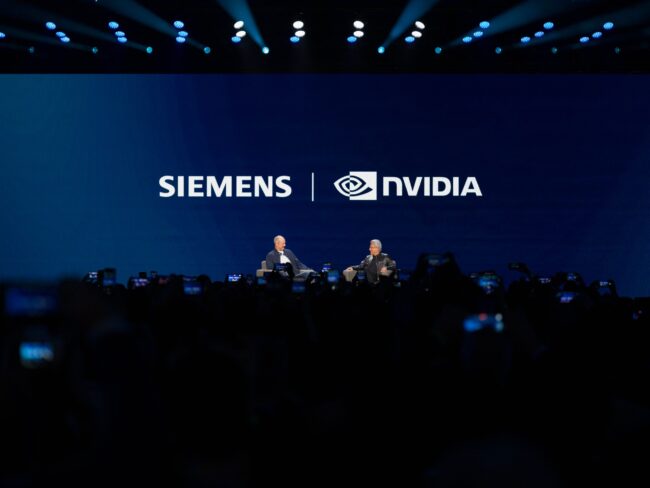
Siemens AG (FRA: SIE) and NVIDIA Corporation (NASDAQ: NVDA) have announced a major expansion of their strategic alliance to jointly develop what they are calling the “Industrial AI Operating System,” a full-stack solution spanning AI-native design, simulation, adaptive manufacturing, and physical automation across sectors. The move signals a long-term convergence of Siemens’ automation and digital twin leadership with NVIDIA’s generative AI, simulation, and accelerated computing capabilities.
Announced at CES 2026, the joint effort aims to bring generative AI into every phase of the industrial lifecycle, starting with a flagship deployment at the Siemens Electronics Factory in Erlangen, Germany. The partnership also outlines joint blueprints for AI-native semiconductor design, AI factory infrastructure, and end-to-end digital twin orchestration.
How does the Siemens–NVIDIA Industrial AI Operating System reshape the global industrial software landscape?
Siemens AG and NVIDIA Corporation are attempting to solve one of the hardest problems in applied AI — how to bring generative intelligence from the cloud into real-world production environments. At its core, the expanded alliance represents more than product integrations. It is an ambitious operating framework intended to rewrite how industrial systems are built, managed, and optimized in real time using AI-first logic.

The two companies are co-developing a portfolio that includes AI-native electronic design automation, generative physics simulations, and intelligent automation blueprints for AI-powered factories. While this is not the first collaboration between the two firms, this version adds a new layer of vertical integration by linking NVIDIA’s compute and modeling stack to Siemens’ operational expertise, software-defined automation, and extensive industry customer base.
From Siemens’ side, the strategy reflects its commitment to owning the digital backbone of industry, from low-voltage electrification to high-performance simulation. From NVIDIA’s side, the move validates the shift from general-purpose AI toward verticalized, domain-specific AI factories that build and operate physical systems, not just train language models.
The industrial OS concept will be anchored by Siemens’ Xcelerator platform and NVIDIA’s Omniverse ecosystem, with data interoperability, closed-loop feedback, and generative AI capabilities embedded throughout.
What is the strategic value of Erlangen’s AI factory for proving this full-stack AI model?
The Siemens Electronics Factory in Erlangen is being positioned as the world’s first blueprint for an AI-native, adaptive manufacturing site. It will be equipped with a continuously learning “AI Brain” that links digital twins to operational control systems in real time. This site will serve as a reference implementation of the Industrial AI OS and includes the full application stack from simulation to shopfloor execution.
What makes this significant is not just the use of AI in design or predictive maintenance, which is already commonplace, but the aspiration to create dynamic, self-optimizing physical environments. These AI factories are expected to rapidly simulate, test, and deploy new process configurations through NVIDIA-powered generative simulations and Siemens’ control systems, minimizing the lag between planning and execution.
Several global industrial giants, including Foxconn, HD Hyundai, KION Group, and PepsiCo, are already evaluating components of the platform. This indicates early interest in AI-led operational redesign.
How are Siemens and NVIDIA targeting EDA and AI chip design as a vertical of their own?
As generative AI accelerates demand for customized silicon, Siemens and NVIDIA are betting that the next leap in semiconductor competitiveness will come from rethinking how chips are designed and verified. Their expanded partnership will apply Industrial AI OS principles to semiconductor design workflows, a domain that has historically been both time-consuming and compute-intensive.
Siemens plans to integrate NVIDIA’s CUDA-X acceleration stack and PhysicsNeMo foundation models into its EDA suite. The companies are targeting two- to ten-fold improvements in layout, verification, and process simulation. The integration is designed to unlock faster iterations, lower power consumption, and better yield for AI chip design and packaging.
This approach reframes EDA not just as a pre-manufacturing process but as part of a continuous design-to-fabrication loop that uses AI both upstream and downstream. The impact could be significant for chipmakers such as TSMC and Samsung, as well as infrastructure providers who rely on co-optimized hardware and software stacks.
Will the AI factory blueprint create a new standard for industrial infrastructure development?
Beyond software and simulation, the Siemens and NVIDIA partnership includes physical infrastructure planning for future AI-native factories. These next-generation plants are expected to manage higher compute density, cooling needs, and automation complexity while maintaining energy efficiency and operational resilience.
The blueprint will combine NVIDIA’s accelerated compute, Omniverse-based simulation, and AI infrastructure expertise with Siemens’ power grid integration, industrial controls, and digital twin orchestration. This holistic design model could become a template for future industrial zones, semiconductor fabrication plants, and logistics hubs.
If adopted at scale, it could pressure other infrastructure firms including ABB, Rockwell Automation, Schneider Electric, and Honeywell to either align with similar AI-first ecosystems or risk falling behind as industrial clients move from hardware procurement to full-stack intelligence platforms.
How are Siemens and NVIDIA integrating each other’s offerings to de-risk execution?
Unlike traditional tech alliances that remain conceptual, Siemens AG and NVIDIA Corporation are committing to deploying each other’s technologies internally. Siemens will assess and accelerate its own workloads using NVIDIA’s stack, while NVIDIA will implement Siemens automation and AI systems across its own factories and data infrastructure.
This bi-directional deployment model allows each partner to serve as a live testbed for integration and performance, addressing real-world edge cases before broader commercial rollout. The approach also strengthens credibility with enterprise buyers who demand proven ROI and operational resilience before adopting next-generation technologies.
While many industrial players talk about AI at the edge, this collaboration goes further by embedding generative intelligence into the control logic, factory planning, and even chip-level co-design.
How is investor sentiment reacting to Siemens and NVIDIA’s expanded alignment?
NVIDIA Corporation (NASDAQ: NVDA) continues to enjoy strong institutional sentiment, supported by its dominant AI training position and expansion into vertical markets including automotive, robotics, and now industrial software. The Siemens partnership enhances its credibility in the industrial sector and supports its long-term addressable market expansion thesis.
Siemens AG (FRA: SIE), meanwhile, is positioning itself as a convergence leader between hardware and software in industrial digitalization. The NVIDIA alignment supports its broader effort to deepen AI capabilities across its software and automation offerings. While Siemens’ stock has not exhibited the same AI-driven momentum as NVIDIA, its strategic positioning and balance sheet strength make it a stable institutional play for long-term industrial tech transformation.
Investors and analysts are expected to watch closely for execution benchmarks, particularly in Erlangen and with customer deployments over the next 12 to 18 months.
What risks remain in operationalizing a universal industrial AI stack?
Despite the strength of the alliance, execution risks remain. Creating a unified, real-time industrial AI stack requires deep integration across diverse environments, many of which still rely on air-gapped systems or legacy infrastructure for reasons of security and reliability.
Adoption will likely occur in waves, with highly automated industries such as semiconductors, automotive, and electronics moving faster than sectors like construction, chemicals, or public infrastructure.
Additionally, regulatory frameworks for AI in critical infrastructure remain fragmented. Closed-loop automation and AI-based decision-making systems are likely to face scrutiny in markets where safety, accountability, and transparency are key concerns.
Cultural resistance and operational conservatism also represent barriers to AI-first adoption in some traditional manufacturing enterprises.
Key takeaways on Siemens and NVIDIA’s Industrial AI Operating System and CES 2026 partnership
- Siemens AG and NVIDIA Corporation have expanded their alliance to develop a full-stack Industrial AI Operating System, announced at CES 2026.
- The partnership targets AI-native design, simulation, adaptive manufacturing, and next-generation AI factory infrastructure.
- Siemens’ Erlangen Electronics Factory will serve as the pilot site, acting as a global reference model for AI-driven industrial operations.
- The companies are applying the same AI-first logic to semiconductor design, with Siemens integrating NVIDIA’s CUDA-X and PhysicsNeMo across its EDA tools.
- A repeatable AI factory blueprint will combine NVIDIA’s compute infrastructure with Siemens’ grid integration and automation expertise.
- Both firms will implement each other’s technologies internally to refine use cases and accelerate external scaling.
- Customers such as Foxconn, Hyundai, KION, and PepsiCo are already evaluating components of the platform.
- Challenges remain in retrofitting legacy systems, navigating industrial AI regulation, and scaling across less digitized sectors.
Discover more from Business-News-Today.com
Subscribe to get the latest posts sent to your email.

