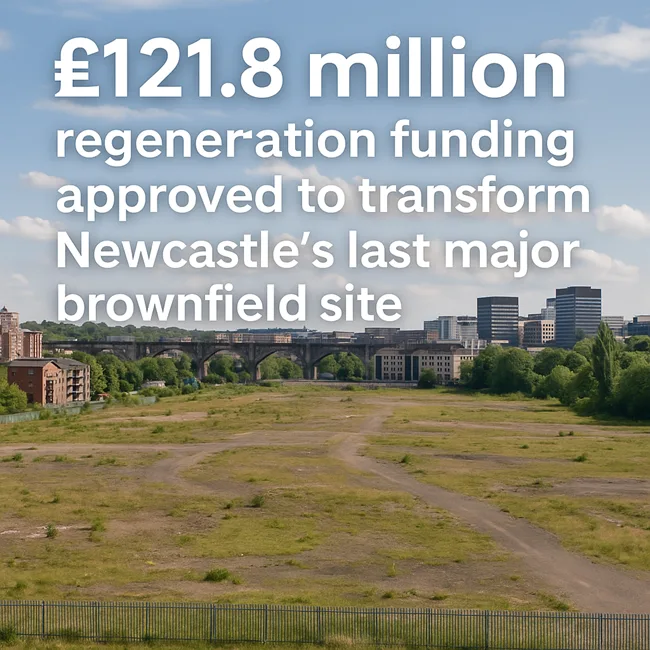
The regeneration of Newcastle’s last significant brownfield site has moved closer to reality, with the UK government approving a £121.8 million funding package to transform the Forth Yards district into a new urban neighbourhood. The project, centered on the Quayside West site, is expected to unlock up to 2,500 homes alongside public realm improvements, commercial space, and infrastructure that will connect the area more directly to Newcastle Central Station and the city centre.
The funding package, developed by Homes England in partnership with Newcastle City Council, the North East Mayor and Combined Authority, and Network Rail, has been described as a landmark step in repurposing land that has remained derelict for decades despite its prime location on the banks of the River Tyne.
How will the £121.8 million regeneration package unlock long-stalled development at Forth Yards in Newcastle?
The approved business case allows remediation, groundworks, and infrastructure activity to begin, addressing long-standing barriers to investment in the Forth Yards site. Despite being a prime parcel of land adjacent to Newcastle Central Station, the land has been left underused for nearly 20 years, with issues such as contamination and complex land ownership slowing progress.
By tackling these obstacles, the funding will create a development-ready platform that can support large-scale housing delivery. Homes England has indicated that procurement for a private sector delivery partner will begin in the coming months, ensuring that construction momentum follows swiftly once the land is prepared.
Public ownership of Quayside West, a parcel capable of accommodating around 1,100 homes, was secured in 2024 when Homes England acquired the land. This has since been folded into the wider regeneration plan for Forth Yards, which is projected to deliver a sustainable, mixed-use district.
What does the regeneration plan mean for housing supply, urban design, and community creation in Newcastle?
Housing and Planning Minister Matthew Pennycook emphasized that the government’s “brownfield first” approach aims to make it easier to build on previously used land, reducing pressure on greenfield sites while boosting housing supply and community regeneration.
North East Mayor Kim McGuinness framed the project as an opportunity to correct decades of underuse. She said the land’s proximity to the Tyne and the central station made its neglect “a huge waste of potential” and argued that the redevelopment would not create a disconnected estate but a “thriving community with transport links, shops, and green spaces.”
Local officials see the site as a chance to reimagine urban living in Newcastle. Instead of isolated residential blocks, the plan envisions a balanced neighbourhood integrating housing, commercial opportunities, and public space. Newcastle City Council leader Karen Kilgour noted that the redevelopment could take up to 15 years to complete, ultimately adding “a whole new part of the city to the west” while generating both jobs and economic activity.
Why is Forth Yards considered a strategic priority for newcastle’s economy and regional planning?
The Forth Yards site has been prioritized by Newcastle City Council and the North East Combined Authority because of its scale and central location. The project is seen as vital to expanding the city’s housing supply while reinforcing Newcastle’s role as a regional economic hub.
Institutional observers have pointed out that regeneration at this scale not only increases housing stock but also strengthens the city’s attractiveness for investment. Proximity to major rail infrastructure adds weight to the vision of creating a western gateway that connects the station to the Quayside, aligning with wider regional growth ambitions.
Homes England Chair Pat Ritchie highlighted the agency’s role in addressing the “complex challenges that have held back this strategically important site for decades,” while Network Rail emphasized the opportunity to integrate landlocked parcels such as Forth Goods Yard into the overall scheme.
How does this project align with the government’s national housing targets and regional regeneration commitments?
The Forth Yards development ties directly into the UK government’s mission of delivering 1.5 million new homes during the current parliamentary term. By targeting brownfield land, the project embodies the administration’s push to unlock neglected sites in urban centres where infrastructure already exists.
Recent moves such as the creation of Platform4, a new property company focused on regenerating rail-led land, signal a coordinated attempt to transform strategically located brownfield areas. Forth Yards, with its combination of public ownership, regional partnership, and strong institutional backing, is among the first to benefit from this integrated approach.
Homes England’s Strategic Place Partnership with the North East Combined Authority further embeds the site into national and regional planning frameworks, ensuring that the redevelopment contributes not only to Newcastle’s urban fabric but also to broader housing and regeneration objectives across the North East.
What is the timeline for development and when can residents expect the first homes at Forth Yards?
The regeneration of Forth Yards is expected to unfold over a 15-year horizon. In the short term, remediation and infrastructure work will be prioritized to prepare the land for development.
Network Rail Property is already preparing a planning submission for the first phase, which could see up to 600 homes built at Forth Goods Yard. With procurement for private sector partners scheduled to begin soon, officials are aiming to accelerate early phases of housing delivery to demonstrate momentum.
While large-scale completion will take more than a decade, institutional sentiment suggests that early visible progress will be key to attracting additional investment and reassuring residents that the site is finally moving beyond years of inertia.
What does institutional sentiment suggest about the long-term viability of the regeneration project?
Institutional investors and analysts generally view large-scale brownfield regeneration positively, provided that funding and planning barriers are addressed. The approval of the £121.8 million package is seen as a catalyst that de-risks the project and sets a clear path for development.
From an economic perspective, the scale of the project is expected to generate hundreds of jobs during construction and in the longer-term support commercial activity in the new district. Housing supply expansion is also expected to ease upward pressure on prices and rents in Newcastle, aligning with broader affordability goals.
Sentiment among regional stakeholders is optimistic, with the combination of public ownership, strategic partnerships, and strong institutional backing considered critical safeguards for delivery. Analysts suggest that while market cycles may influence the pace of private investment, the long-term fundamentals of the site remain sound due to its location and connectivity.
Can Forth Yards become the blueprint for brownfield-led housing growth across the UK?
The Forth Yards project is being watched as a potential model for how large brownfield sites can be unlocked through coordinated government, regional, and private sector action. By combining direct public funding, strategic partnerships, and transport integration, it demonstrates a pathway for tackling long-neglected urban land at scale.
If successful, the regeneration could serve as a reference point for other UK cities with derelict land adjacent to key transport hubs. With housing demand continuing to outstrip supply nationwide, the project highlights how underused central land can be repurposed not only to provide homes but also to deliver long-term economic and community benefits.
Discover more from Business-News-Today.com
Subscribe to get the latest posts sent to your email.