

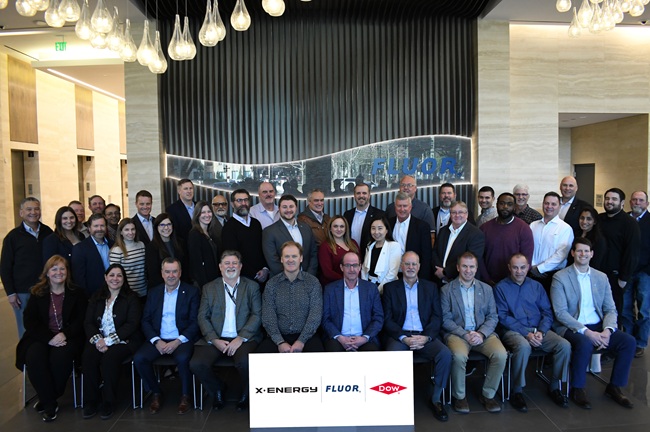
Fluor Corporation (NYSE: FLR) signs FEL-2 engineering contract with X-energy for the proposed 320-megawatt small modular reactor project at Dow’s Seadrift, Texas industrial facility — bringing North America’s most closely watched advanced nuclear deployment one meaningful step closer to a construction decision. The agreement, announced on 6 April 2026, covers front-end project definition, feasibility assessment, cost control, and risk mitigation work, with the contract value undisclosed but set for recognition in Fluor’s Q1 2026 results. For Fluor, the win extends the company’s nuclear engineering pedigree into the fastest-growing segment of the power sector and arrives at a moment when its Energy Solutions backlog needs restoring. For X-energy and Dow (NYSE: DOW), it signals that the project is maturing from regulatory and conceptual groundwork into disciplined execution planning.
Why is Fluor Corporation the engineering partner for X-energy’s advanced SMR project in Texas?
Fluor’s selection for the FEL-2 phase is not incidental. The company has roughly eight decades of nuclear engineering experience, spanning light water reactor construction, decommissioning, and government nuclear site management through its Mission Solutions segment. That depth matters in a project where the technology is novel but execution expectations are not. The XE-100, X-energy’s high-temperature gas-cooled reactor, uses TRISO-X pebble fuel and passive safety architecture that differs fundamentally from conventional pressurized water reactor designs. Bringing an engineering contractor of Fluor’s scale into the FEL-2 phase sends a signal to regulators, financiers, and Dow’s internal investment committee that the project team is assembling with serious execution intent.
Front-end loading Stage 2 is where the cost and schedule profile of a megaproject is substantively shaped. FEL-2 outputs — detailed project definition, risk registers, capital cost estimates, and contracting strategy — are typically what an industrial client like Dow uses to make a formal final investment decision. The fact that the contract value is undisclosed but will be recognized in Q1 2026 suggests it is a scoped, fee-based engineering engagement rather than a lump-sum commitment, which is structurally appropriate at this stage of a first-of-kind nuclear deployment.
What is the X-energy XE-100 reactor and why is Seadrift its proving ground?
The Xe-100 is a Generation IV high-temperature gas-cooled reactor capable of producing 80 megawatts of electricity per unit and a corresponding output of industrial process steam. The Seadrift project proposes a four-unit configuration delivering 320 megawatts of combined electrical and thermal capacity to replace aging fossil-fuel infrastructure at Dow’s second-largest Texas facility. The site spans 4,700 acres and produces over four billion pounds of materials annually, including polyethylene for food packaging, wire insulation, solar cell membranes, and pharmaceutical packaging. It is an energy-intensive manufacturing complex that has historically relied on natural gas-fired cogeneration, and that infrastructure is approaching end-of-life.
X-energy was selected by the U.S. Department of Energy under the Advanced Reactor Demonstration Program in 2020 to develop, license, and commercialize the Xe-100 alongside a TRISO-X fuel fabrication facility now under development in Oak Ridge, Tennessee. The DOE cost-share support reduces the financial exposure for both X-energy and Dow but does not eliminate the need for rigorous project definition — which is precisely what the Fluor FEL-2 engagement is designed to deliver.
The NRC accepted the Long Mott Energy construction permit application for review in May 2025 and announced an 18-month concurrent environmental and safety review timeline in June 2025, citing the quality of the submission and the depth of pre-application engagement since 2018. That review clock is now running, and the Fluor contract aligns Seadrift’s engineering maturity with the expected regulatory timeline.
How significant is it that an industrial site will host North America’s first grid-scale advanced reactor?
The Seadrift deployment, if it proceeds to construction and commissioning, would be the first grid-scale advanced nuclear reactor built to serve an industrial facility anywhere in North America. That distinction matters well beyond the boundaries of the Dow site. Industrial heat and power decarbonization is one of the most technically difficult and capital-intensive challenges facing the net-zero transition. Electrification alone cannot replace high-temperature process steam in heavy manufacturing. Advanced nuclear reactors operating at higher temperatures than conventional light water designs are among the few technologies that can supply both electricity and industrial heat at the scale and reliability that chemical, petrochemical, and materials manufacturers require.
Seadrift is therefore functioning as a proof-of-concept for an entirely new market for nuclear energy. A successful deployment, on schedule and within cost parameters, would demonstrate a replicable model for industrial decarbonization that could unlock demand at chemical plants, steel mills, and other hard-to-abate industrial facilities globally. X-energy has already extended its technology pipeline well beyond Seadrift, having signed agreements with Energy Northwest for up to 12 Xe-100 reactors in Washington state, announced a partnership with Talen Energy to explore deployments in the 13-state PJM electricity market, and filed a draft registration statement with the SEC as part of a potential IPO process.
What execution risks remain between the FEL-2 contract and a construction decision at Seadrift?
The pipeline from FEL-2 to construction is not a straight line. Several interdependent conditions remain unresolved. The NRC review, now expected to conclude approximately late 2026, must produce a construction permit before any ground is broken. Dow’s formal final investment decision is explicitly conditional on the project demonstrating an ability to deliver within Dow’s financial return thresholds — a condition that Dow has stated publicly and that the FEL-2 cost-definition work is intended to substantiate.
HALEU fuel supply is another constraint. The Xe-100 requires high-assay low-enriched uranium, which remains a limited-availability commodity. TRISO-X received an initial DOE allocation in April 2025, but the fuel supply chain for a full first core load depends on the Oak Ridge fabrication facility reaching production readiness on schedule. Any slippage in fuel availability could affect commissioning timelines regardless of construction progress.
There is also the broader question of first-of-kind cost execution. The global nuclear industry has a well-documented record of cost overruns and schedule extensions on new reactor builds, even using proven technology. The Xe-100’s passive safety design and modular architecture are intended to reduce this risk, but Seadrift will be the first deployment of this specific technology at commercial scale. No historical project benchmarks exist. That is precisely why FEL-2 exists — to build the cost and risk model rigorously before a construction commitment is made.
How does the Fluor-X-energy contract fit into Fluor’s own strategic and financial position?
Fluor’s Energy Solutions segment has been under pressure. The company’s total backlog contracted by approximately 10% year-on-year to around $28.2 billion, with the Energy Solutions segment specifically recording a decline in new awards. Fluor extended its adjusted EBITDA guidance timeline by four quarters in its most recent reporting period, a signal that award activity across core segments has been slower than previously anticipated.
Against that backdrop, the X-energy contract, while scoped rather than transformative in isolation, is strategically meaningful. Nuclear is a growth vertical for Fluor. The company separately signed a limited notice to proceed with TeraWulf for a large-scale data center project in Kentucky and announced a Bucharest office expansion to support European nuclear development. The pattern suggests Fluor is deliberately tilting its business development toward high-complexity, high-margin engineering engagements in nuclear and advanced energy infrastructure — areas where its technical depth provides a competitive moat against lower-cost engineering competitors.
Fluor shares were trading around $47.50 on 6 April 2026, having recovered substantially from a 52-week low of $29.20 but sitting well below the 52-week high of $57.50. The stock is up approximately 27% over the past year, though down modestly over the past month, reflecting broader market volatility. The consensus analyst price target stands at $53.50, implying further upside from current levels but contingent on a recovery in the award environment. A Buy consensus from six analysts covering the stock indicates that institutional confidence in the medium-term recovery thesis remains intact, even as near-term backlog dynamics remain subdued.
What does the SMR industrial deployment trend mean for nuclear sector competition going forward?
The Seadrift project sits within a fast-expanding competitive landscape for advanced nuclear deployment. X-energy is competing for industrial and utility customers alongside NuScale Power, which has faced setbacks after the cancellation of its UAMPS Carbon Free Power Project in Idaho, and Kairos Power, which is pursuing its own DOE demonstration project. TerraPower, backed by Bill Gates, is advancing its Natrium sodium-cooled fast reactor at a Wyoming coal site. Each of these developers is pursuing a different technology pathway, customer segment, and commercialization strategy.
X-energy’s decision to anchor its first commercial deployment at an industrial site rather than a grid utility gives it a differentiated positioning. Industrial buyers often have more predictable energy demand profiles, longer-term contractual relationships, and stronger balance sheets than many utility offtakers. If Seadrift succeeds, it validates a customer acquisition model that could be replicated across the energy-intensive manufacturing sector without requiring restructured utility rate cases or public commission approvals.
Fluor’s role in this ecosystem extends beyond the Seadrift contract. An engineering firm that successfully executes FEL-2 for a first-of-kind SMR deployment positions itself as the preferred contractor for the next deployment, and the one after that. The replication economics of modular nuclear favor the contractor that builds institutional knowledge on the first unit.
Key takeaways on what the Fluor-X-energy FEL-2 contract means for advanced nuclear, industrial decarbonization, and engineering sector dynamics
- Fluor Corporation has entered the front-end engineering phase for the Seadrift XE-100 project, moving the 320-megawatt SMR deployment from regulatory groundwork into cost and risk definition.
- The FEL-2 contract is a prerequisite for Dow’s final investment decision, which remains conditional on the project meeting the company’s financial return targets.
- The U.S. Nuclear Regulatory Commission’s concurrent environmental and safety review, launched in June 2025, is expected to conclude roughly late 2026, aligning the regulatory timeline with the engineering maturation now underway.
- If completed, the Long Mott Generating Station at Seadrift will be the first grid-scale advanced nuclear reactor deployed at an industrial facility in North America, establishing a replicable model for industrial decarbonization.
- X-energy’s technology pipeline is expanding rapidly, with agreements covering potential deployments in Washington state, the PJM power market, and a draft SEC IPO filing indicating the company is preparing for a public market listing.
- Fluor is using the nuclear vertical to anchor growth in its Energy Solutions segment at a time when its overall backlog has contracted and its EBITDA guidance timeline has been extended.
- Fluor shares are trading near $47.50, approximately 17% below the 52-week high, with a consensus analyst target of $53.50 suggesting meaningful upside if the award environment improves.
- First-of-kind execution risk remains the central challenge: no commercial Xe-100 deployment benchmark exists, and HALEU fuel supply chain readiness at the Oak Ridge TRISO-X facility is a critical path dependency.
- Industrial SMR deployments represent a structurally distinct market from utility nuclear, with more predictable demand, stronger counterparty balance sheets, and no requirement for public utility commission approval.
- Fluor’s participation in Seadrift positions it as the benchmark contractor for subsequent XE-100 deployments, where replication of modular units favors the engineering firm that absorbed first-unit learning costs.
Discover more from Business-News-Today.com
Subscribe to get the latest posts sent to your email.