


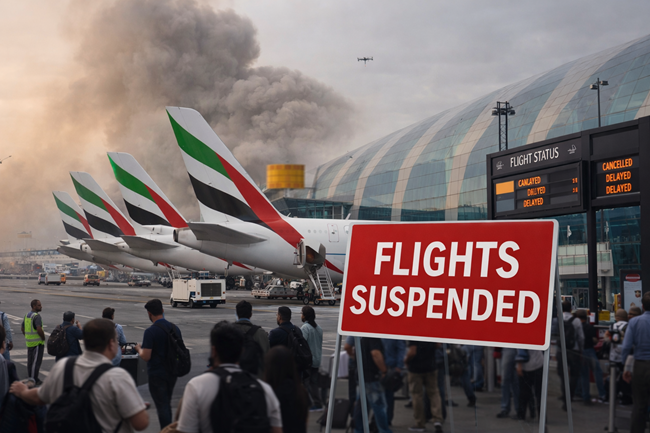
Emirates, the largest airline in the Middle East, announced on Saturday, March 7, 2026 that all flights to and from Dubai International Airport had been suspended until further notice following an aerial interception in the vicinity of the world’s busiest international airport. The airline issued the advisory on its official account on the social media platform X, urging passengers not to travel to the airport. The suspension lasted approximately 30 minutes before Emirates announced a partial resumption of afternoon services, but the episode represented the second significant operational disruption at Dubai International Airport in under two weeks, underscoring the continued vulnerability of Gulf aviation infrastructure to ongoing Iranian missile and drone strikes.
The immediate trigger for the March 7, 2026 suspension was an interception of an incoming aerial threat near Dubai International Airport. The Dubai Media Office, the official government communications department of Dubai, confirmed that debris from a successful interception had fallen in the area and that the incident had been contained without injuries. A witness speaking to the AFP news agency described a loud explosion followed by a visible cloud of smoke near the airfield. The international flight tracking platform Flightradar24 showed multiple inbound aircraft entering holding patterns above the airport at the time of the interception.
The Dubai Media Office subsequently denied social media reports claiming a direct strike on airport infrastructure, though photographs and videos shared publicly showed a column of dark smoke rising in the vicinity of the airfield. Despite the official characterisation of the incident as minor, Emirates confirmed it had suspended all city check-in points across Dubai until further notice and directed all passengers to avoid the airport until receiving confirmed flight updates through official Emirates channels.
The interception was part of a broader and sustained campaign of Iranian missile and drone strikes targeting United Arab Emirates territory in retaliation for United States and Israeli military operations against Iran under Operation Epic Fury, which began on February 28, 2026. The Emirati Ministry of Defence confirmed on March 7, 2026 that its air defence systems were actively responding to missile and drone threats originating from Iran, attributing the sounds of explosions heard across various parts of Dubai to the interception of ballistic missiles and drones. The Islamic Revolutionary Guards Corps Navy, according to the Iranian state-affiliated Tasnim News Agency, separately launched a drone strike targeting al-Dhafra Air Base in the United Arab Emirates, with Tasnim claiming hits on a United States satellite communication centre and associated radar infrastructure at that base.
What triggered the Emirates flight suspension at Dubai International Airport on March 7, 2026, and why did operations resume so quickly?
Approximately 30 minutes after the initial suspension was announced, Emirates issued a follow-up advisory confirming that flight operations were resuming. The airline directed passengers holding confirmed bookings for afternoon flights on March 7, 2026 to proceed to Dubai International Airport. The resumption also extended to passengers transiting through Dubai, provided their connecting flights were confirmed as operating. Emirates deleted its initial suspension post on X to prevent ongoing confusion among passengers. The airline urged all passengers to check the status of their specific flight and seat availability through official Emirates channels before proceeding to the airport. The budget carrier flydubai, which also operates from Dubai International Airport, confirmed separately that its own operations had similarly resumed.
The speed of the resumption reflected both the airline’s commercial imperative to restore capacity and the Dubai government’s consistent institutional position that the city remained operational. The Dubai Media Office’s initial statement, which characterised the interception as minor and denied reports of an airport incident, was consistent with the broader official communication strategy of maintaining the narrative of Dubai’s resilience and operational continuity throughout the conflict.
How has Dubai International Airport’s operational history been affected since the outbreak of the US-Israel-Iran conflict in late February 2026?
Dubai International Airport, which serves as the world’s leading hub for international passenger traffic and handled approximately 92 million international passengers in 2024, was closed to commercial operations in the immediate aftermath of the conflict’s outbreak on February 28, 2026. On that first day, four airport employees were injured and a terminal was damaged, with the operator Dubai Airports describing the situation as quickly brought under control. The cumulative disruption across the Middle East region resulted in the cancellation of more than 11,000 flights within the first week alone, displacing hundreds of thousands of passengers at airports globally.
Subsequent Iranian strikes caused damage to Abu Dhabi Airport, the Palm Jumeirah development, and the Burj Al Arab hotel. Drone debris caused a fire at the United States consulate in Dubai on Tuesday, March 3, 2026. Emirates began operating a limited number of repatriation and priority flights from Monday, March 2, 2026, and formally resumed commercial operations on March 5, 2026. A spokesperson for Emirates told the Reuters news agency on Friday, March 6, 2026 that the airline expected to return to 100 percent of its global network capacity within the coming days, a projection that was overtaken by events within 24 hours as the March 7, 2026 interception forced another suspension.
Why does a suspension of Emirates flights at Dubai International Airport carry disproportionate consequences for global aviation networks?
Dubai International Airport occupies a structurally critical position within global aviation. As the leading airport globally for international passenger traffic, it serves as the principal transit route for a substantial portion of intercontinental journeys connecting southern Asia, sub-Saharan Africa, East Africa, and Australasia to Europe and North America. Emirates alone operates a fleet of more than 250 wide-body aircraft serving more than 140 destinations across six continents. Any suspension of Emirates operations at Dubai International Airport therefore produces cascading disruptions far beyond the Middle East region, displacing transiting passengers onto alternative routings through Istanbul, Frankfurt, Singapore, and other global hubs at a time when several of those alternative airports were also experiencing indirect disruption from the regional conflict.
The operational volatility during this period was documented in real time through international flight tracking data. The record of Emirates flight EK501, operating from Mumbai to Dubai on March 3, 2026, illustrated the conditions in effect: the Airbus A380-800 aircraft was forced to initiate a U-turn back toward Mumbai as a fresh wave of Iranian attacks prompted the activation of Gulf air defence systems, before reversing course again and completing its landing in Dubai approximately one hour behind schedule. That pattern repeated across multiple inbound services from South Asia, Southeast Asia, and East Africa throughout the week.
What passenger relief options has Emirates made available to travellers affected by the Dubai International Airport disruptions in March 2026?
Emirates confirmed that passengers with confirmed bookings for travel between February 28 and March 31, 2026 could rebook their journey on an alternative flight to their intended destination for travel on or before April 30, 2026. Passengers who had booked directly with Emirates were directed to the airline’s online support services, while those who had booked through a travel agent were instructed to contact their respective agent. A full refund option was available through the Emirates website for direct bookings, with travel agent bookings to be managed through the agent. The airline advised all affected passengers to verify their contact details through its online booking management platform to ensure receipt of real-time service updates. City check-in points across Dubai remained temporarily closed as of the initial suspension announcement.
What is the regional diplomatic and military context surrounding the suspension of Emirates flights at Dubai International Airport?
The wider regional picture on March 7, 2026 encompassed simultaneous missile and drone incidents across multiple Gulf Cooperation Council territories. Saudi Arabia’s Ministry of Defence reported intercepting two ballistic missiles targeting Prince Sultan Air Base in al-Kharj and destroying six drones directed at the Shaybah oilfield. Bahrain’s Ministry of Interior issued public warnings on multiple occasions during the morning of March 7, 2026 urging citizens and residents to seek shelter as air raid sirens sounded in the capital Manama. An explosion and air raid alert were also reported in Jerusalem following an Iranian missile threat to Israeli territory.
Qatar’s Civil Aviation Authority announced the partial resumption of air navigation through designated navigational contingency routes with limited operational capacity in coordination with the Qatari Armed Forces, while Qatar Airways confirmed its scheduled commercial operations remained suspended pending the full reopening of Qatari airspace. Etihad Airways was separately in the process of restoring limited flight activity from Abu Dhabi International Airport.
The Arab League announced on March 7, 2026 that the Foreign Ministers of its member states would convene an emergency meeting on Sunday, March 8, 2026, via videoconference, to discuss Iranian attacks on the territories of several Arab countries. The meeting was formally requested by the governments of Kuwait, Saudi Arabia, Qatar, Oman, Jordan, and Egypt, according to the bloc’s assistant secretary general, Hossam Zaki, who confirmed the announcement to the AFP news agency.
What this Emirates flight suspension means for Dubai aviation, Gulf security, and global air travel
- Emirates suspended all flights to and from Dubai International Airport on March 7, 2026 following an aerial interception near the airport, with operations partially resuming within approximately 30 minutes after the airline confirmed afternoon services would proceed for passengers with confirmed bookings.
- The Dubai Media Office confirmed a minor incident involving intercepted missile or drone debris near the airport but denied reports of a direct strike on airport infrastructure, while the Emirati Ministry of Defence acknowledged that air defence systems were actively engaged against Iranian missile and drone threats at the time.
- The March 7, 2026 suspension was the latest operational disruption at Dubai International Airport since the conflict’s outbreak on February 28, 2026, during which more than 11,000 Middle East flights were cancelled and four Dubai International Airport employees were injured on the opening day of hostilities.
- Emirates had been progressively rebuilding its schedule since March 2, 2026, with a spokesperson indicating on March 6, 2026 that the airline expected a full return to 100 percent of its network capacity within days, a timeline disrupted by the March 7, 2026 interception incident.
- The simultaneous disruption of Dubai International Airport, Hamad International Airport in Doha, and Abu Dhabi International Airport eliminated three of the four principal Gulf aviation transit hubs concurrently, with Arab League Foreign Ministers scheduled to convene an emergency videoconference on March 8, 2026 to address Iranian attacks across multiple Arab state territories.
Discover more from Business-News-Today.com
Subscribe to get the latest posts sent to your email.