Fermi Inc., operating as Fermi America and listed on Nasdaq and the London Stock Exchange under the ticker FRMI, has secured final approval from the Texas Commission on Environmental Quality for a 6 gigawatt clean air permit tied to its 11 gigawatt Project Matador private power campus in Amarillo, Texas. The approval removes one of the longest lead-time regulatory barriers for large-scale generation projects in the United States and materially advances Fermi America’s ambition to deliver behind-the-meter power infrastructure for hyperscale artificial intelligence and industrial customers.
The permit does not simply authorize emissions. It effectively moves Project Matador from a conceptual and site-preparation phase into execution, capital deployment, and tenant finalisation, at a moment when grid congestion and power scarcity are becoming binding constraints for data center expansion across the country.
Why securing a Texas Commission on Environmental Quality air permit changes execution risk for private power infrastructure at scale
Air permitting remains one of the most unpredictable choke points in U.S. energy infrastructure, particularly for projects measured in gigawatts rather than megawatts. By receiving final approval from the Texas Commission on Environmental Quality, Fermi America has cleared a process that can take several years and often derails projects through delays, litigation, or scope reduction.
For Project Matador, the permit validates compliance with both Texas environmental law and the federal Clean Air Act, allowing construction to move from civil and site preparation into vertical generation build-out. That distinction matters because capital markets, equipment suppliers, and anchor tenants typically remain cautious until regulatory certainty is achieved. With the permit in hand, Fermi America can credibly shift discussions from conditional planning to firm delivery timelines.
Texas is uniquely positioned in this regard. Unlike states where grid interconnection queues, emissions constraints, and local opposition create overlapping uncertainty, Texas offers a regulatory environment that permits large private generation projects so long as they remain isolated from public grid rate exposure. Project Matador’s behind-the-meter structure is central to that regulatory alignment.

How the behind-the-meter model reframes the AI power debate without shifting costs onto public utilities
One of the quiet but strategically important aspects of Project Matador is its insistence on remaining off the public utility balance sheet. By developing a private grid that does not rely on rate-based recovery, Fermi America avoids the political and regulatory backlash increasingly directed at hyperscale data centers accused of driving up consumer electricity costs.
For policymakers, this distinction matters. State regulators face growing pressure to reconcile explosive data center demand with grid reliability obligations for households and small businesses. Private generation campuses that self-fund capacity expansion allow states like Texas to support economic development without forcing utilities to socialize infrastructure upgrades.
For hyperscalers and industrial tenants, the model offers predictability. Dedicated generation capacity reduces exposure to curtailment risk, congestion pricing, and transmission delays. In an environment where grid interconnection queues can exceed five years in some regions, behind-the-meter supply is becoming less of an optimization strategy and more of a prerequisite for expansion.
What Fermi America’s early procurement of natural gas assets signals about execution discipline
Beyond regulatory progress, Fermi America’s advance procurement of more than 2 gigawatts of long-lead-time natural gas generation equipment significantly reduces schedule risk. The company has already secured Siemens Energy SGT-800 gas turbines, six of which are reportedly staged in the port of Houston awaiting deployment to the Amarillo campus.
This matters because the global turbine market remains tight. Large frame and aeroderivative gas turbines face extended delivery timelines as utilities, LNG exporters, and industrial users compete for limited manufacturing slots. Projects that have not locked in equipment are increasingly exposed to multi-year delays.
By contrast, Fermi America’s early asset acquisition shifts execution risk away from equipment availability and toward construction, integration, and financing. For potential tenants evaluating power delivery certainty, that distinction materially improves credibility.
Why Project Matador’s scale reflects a structural shift in U.S. electricity demand planning
An 11 gigawatt private power campus would have been difficult to justify a decade ago. Today, it reflects a fundamental shift in demand drivers. Artificial intelligence workloads, advanced manufacturing, defense systems, and reshored industrial capacity are creating sustained, non-cyclical load growth that traditional grid planning processes struggle to accommodate.
Unlike legacy industrial loads, AI infrastructure requires dense, continuous power with minimal tolerance for interruption. Data center operators increasingly prefer co-located generation rather than relying on transmission-dependent supply chains that introduce both latency and reliability risks.
Project Matador is designed as a platform rather than a single-tenant facility. Its scale allows phased deployment, diversified customer intake, and integration of multiple generation technologies over time. That modularity may prove critical as demand forecasts continue to move upward rather than stabilise.
How Texas positions itself as a private energy capital while other states fall behind
The Texas Commission on Environmental Quality approval underscores a broader policy divergence between Texas and other major U.S. markets. While states like Virginia, California, and parts of the Midwest grapple with moratoria, community opposition, and grid saturation, Texas continues to attract large-scale private energy investment.
This is not purely ideological. Texas benefits from abundant natural gas supply, a permissive regulatory structure for private generation, and a political consensus that prioritises energy security and industrial growth. By enabling projects like Project Matador, the state reinforces its position as a destination for energy-intensive industries.
For Fermi America, operating within this policy environment reduces jurisdictional risk. For competitors considering similar private grid models, Texas increasingly looks less like an option and more like the default choice.
What the air permit approval reveals about natural gas’s evolving role in AI-era power strategies
Despite frequent rhetoric around renewable-only data centers, Project Matador’s reliance on natural gas reflects market realities. Gas remains the only dispatchable, scalable power source capable of supporting multi-gigawatt loads without extensive storage infrastructure.
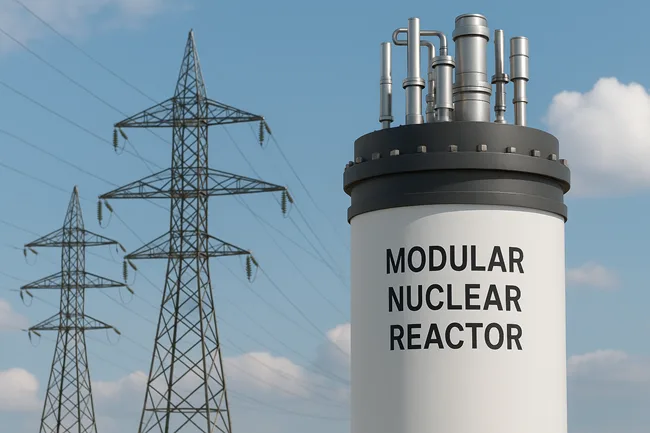
The permit approval does not preclude future diversification. Fermi America has indicated long-term plans to integrate additional generation types, including nuclear, solar, and battery energy storage. However, gas provides the anchor capacity that enables rapid deployment while other technologies mature.
This hybrid strategy aligns with broader industry trends. Even companies with aggressive carbon targets are increasingly acknowledging that gas will remain a bridge technology for AI infrastructure through at least the next decade.
Capital formation and tenant negotiations enter a decisive phase after permitting clarity
With air permitting resolved, Project Matador now enters what may be its most consequential phase: project finance structuring and tenant commitments. Regulatory certainty allows lenders, equity partners, and customers to move beyond hypothetical scenarios and engage on firm terms.
Financing an 11 gigawatt campus will require staged capital deployment, likely combining project-level debt, equity partnerships, and long-term offtake agreements. The behind-the-meter model simplifies revenue structures but places greater emphasis on tenant credit quality and contract duration.
For hyperscalers facing power scarcity elsewhere, the trade-off may be acceptable. Securing guaranteed capacity at scale could outweigh the premium associated with private generation.
How capital markets are likely to reprice Fermi Inc. as regulatory certainty gives way to delivery discipline
As a publicly listed company, Fermi Inc. now faces a different scrutiny regime. Vision and ambition have attracted attention, but markets will increasingly focus on execution milestones, capital discipline, and contract conversion.
The air permit approval materially de-risks the project from a regulatory standpoint, but it also raises expectations. Investors will look for evidence of tenant signings, construction progress, and financing close timelines. Delays at this stage would be more difficult to attribute to external factors.
If Fermi America can translate regulatory success into commercial traction, Project Matador could become a reference model for private power development globally. If not, the scale that makes it compelling could also magnify execution missteps.
What happens next if Project Matador succeeds or stalls at this stage of development
Success would validate the private grid model as a scalable solution to AI-driven power scarcity, likely prompting replication across other regions with favourable regulatory environments. It would also strengthen Texas’s role as a global energy infrastructure hub.
Failure or prolonged delay, however, would reinforce scepticism around giga-scale private power projects and push hyperscalers back toward incremental grid-connected solutions, despite their limitations.
At this inflection point, regulatory clearance has removed excuses. What remains is delivery.
Key takeaways: What Fermi America’s Texas air permit means for private power, AI infrastructure, and energy markets
- The Texas Commission on Environmental Quality air permit removes one of the most significant execution risks facing large-scale private power projects in the United States.
- Project Matador now transitions from regulatory navigation to capital deployment, construction, and tenant conversion.
- Fermi America’s behind-the-meter model avoids shifting AI-driven power costs onto public utility ratepayers.
- Early procurement of gas turbines materially reduces schedule risk in a constrained global equipment market.
- Texas continues to consolidate its position as the preferred jurisdiction for energy-intensive infrastructure.
- Natural gas remains the anchor technology for AI-scale power despite long-term diversification goals.
- Investor focus will shift rapidly from vision to execution milestones and commercial traction.
- Project Matador’s success could redefine how hyperscalers approach power sourcing globally.
- Failure at this stage would amplify scepticism around giga-scale private grids.
Discover more from Business-News-Today.com
Subscribe to get the latest posts sent to your email.