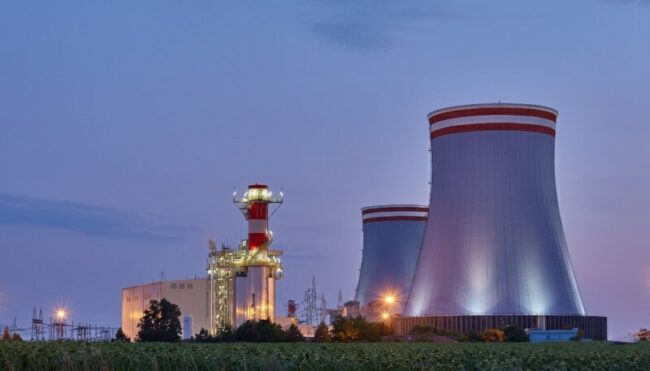
Fermi America, Inc. (NASDAQ: FRMI), a private energy developer operating in partnership with the Texas Tech University System, has signed a non-binding Memorandum of Understanding with Hungary-based MVM EGI Zrt. to co-develop what could become one of the largest hybrid dry–wet cooling systems in the world. The cooling infrastructure will support Fermi America’s 11-gigawatt Project Matador campus in the Texas Panhandle, which is set to include both gas-fired and nuclear generation assets.
This partnership is framed not only as an engineering milestone but as a regional commitment to sustainable water use. With water conservation becoming a critical issue in West Texas, the cooling system is being designed from the outset to sharply reduce evaporation and eliminate open water loss. The cooling towers will use primarily air-based indirect hybrid systems that allow for closed-loop circulation. The companies stated that the hybrid design will reduce evaporative water losses by more than 80 percent compared to conventional all-wet cooling towers.
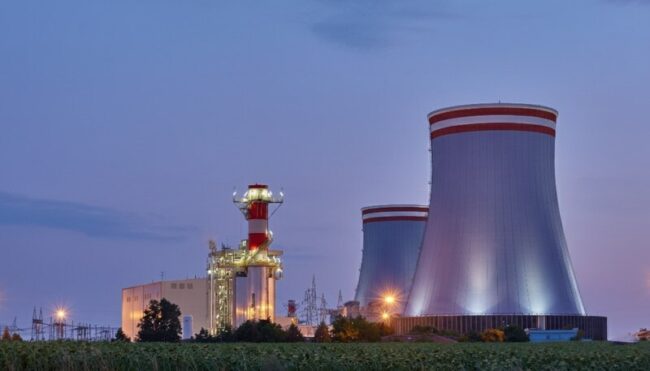
How the MVM cooling system will support Fermi America’s dual-fuel campus expansion
Fermi America’s Project Matador is a phased energy infrastructure buildout that will ultimately combine six gigawatts of combined-cycle natural gas power generation with four Westinghouse AP1000 nuclear reactors. These units will be brought online over the next nine years and connected via a private transmission network that spans over one hundred miles. At full scale, the campus will produce enough electricity to power major industrial users, including data centers, semiconductor fabs, and manufacturing complexes.
Under the new MOU, MVM EGI and Fermi America will jointly begin engineering and feasibility studies for a series of large-scale indirect hybrid cooling towers. MVM EGI is known globally for its proprietary dry–wet cooling technology, developed under the legacy of Professors László Heller and László Forgó. The Heller–Forgó system, which bears their name, is widely recognized as a breakthrough in reducing water use in power plant operations. The towers to be deployed at Project Matador will stand approximately 450 feet tall and are expected to be adapted for the specific climatic and geological conditions of West Texas.
The initial scope of work will include site-specific performance modeling, tower configuration planning, and evaluation of height, load, and space constraints. Additional studies will explore integration of recycled water, reclaimed industrial water, and non-evaporative retention solutions such as solar-covered ponds. The system is also expected to draw on underground reservoirs to further minimize freshwater withdrawals from the Ogallala Aquifer.
Why water-saving design is central to Project Matador’s long-term credibility
Fermi America executives emphasized that the cooling system is not a retrofit but a core feature of the project’s baseline engineering design. The use of indirect air-dominant hybrid cooling towers aligns with prior commitments the developer made to minimize groundwater depletion. According to Chief Executive Officer Toby Neugebauer, the firm views water stewardship as integral to its identity as a West Texas-rooted operation. Neugebauer stated that Fermi America is not an external developer arriving with a top-down approach, but rather a local stakeholder that grew up on the same land where the project is being built.
his emphasis on regional alignment is backed by the company’s long-term relationship with the Texas Tech University System, which granted Fermi America a 99-year lease for the Project Matador site. As part of that agreement, Fermi committed to protect the water table and contribute to local economic development through both educational and infrastructure partnerships. The hybrid cooling strategy reinforces this commitment by incorporating water use reduction into every stage of the campus’s development schedule.
Construction of the first cooling tower is expected to begin in January 2026. The full system is scheduled to be completed by 2034, matching the staggered commissioning timeline of the gas and nuclear facilities. The MOU outlines sequential milestones, including definition of thermal performance criteria, concept validation, and final design delivery. While non-binding, the agreement is seen as a strong signal of mutual intent between the two engineering partners.
What MVM EGI brings to the U.S. energy infrastructure table
MVM EGI Zrt., part of Hungary’s MVM Group, has more than fifty years of experience in the design and deployment of dry–wet cooling systems for high-capacity power generation. The company’s technologies have been implemented in power plants across Europe, Asia, and the Middle East. According to Chief Executive Officer Péter Kárpáti, the collaboration with Fermi America will represent one of the largest dry–wet cooling deployments in North America and will serve as a reference project for future hybrid systems in water-sensitive environments.
Kárpáti emphasized that the design is engineered to deliver efficient thermal regulation while using dramatically less water than conventional wet towers. This is particularly important in the Texas Panhandle, where power generation is increasingly constrained by water access. By combining air-based cooling with minimal water recirculation in a closed loop, the MVM towers are expected to deliver robust cooling capacity even during peak summer demand, without overburdening the aquifer.
The joint team will also assess opportunities to integrate solar energy into the cooling system’s auxiliary operations, including powering the fans and circulation pumps. The companies are exploring modular tower designs that can be manufactured in sections and transported to the site to speed up construction timelines and reduce local disruption.
How this deal positions Fermi America in the future of industrial energy development
Project Matador represents one of the most ambitious private energy developments in the United States, with a total capacity comparable to major public utilities. Unlike traditional utilities, however, Fermi America’s business model focuses on direct power delivery to industrial clients through private wires. This approach allows it to bypass regional transmission operators and deliver dedicated baseload power to high-demand sectors such as data centers, hydrogen production, and high-tech manufacturing.
The addition of hybrid cooling towers allows Fermi America to offer not just reliability and capacity, but also a tangible sustainability benefit to potential customers. In an era where ESG compliance and water usage metrics are increasingly scrutinized by investors and customers alike, the firm is positioning itself as a pioneer in next-generation, water-conscious grid infrastructure.
Institutional analysts tracking the project believe that water infrastructure will be a critical factor in determining which U.S. regions can support the next wave of industrial power demand. West Texas, despite its abundant solar and wind resources, faces long-term stress on its water table. Solutions like hybrid cooling offer a way to square high-capacity energy development with environmental constraints.
The partnership with MVM EGI also gives Fermi access to decades of operational data and reliability metrics that may streamline permitting and regulatory compliance. Investors watching the early 2026 construction start will likely assess execution risk, engineering timelines, and integration with gas and nuclear units as key indicators of viability.
What are the key takeaways from Fermi America’s hybrid cooling tower agreement with MVM EGI?
- Fermi America has signed a non-binding MOU with MVM EGI Zrt. to co-develop hybrid dry–wet cooling towers for the 11-gigawatt Project Matador power campus in West Texas.
- The cooling system will support both six gigawatts of natural gas-fired combined-cycle generation and four AP1000 nuclear reactors.
- MVM EGI’s tower design will prioritize air-based, closed-loop cooling to reduce evaporative water losses by over 80 percent compared to traditional wet cooling systems.
- The project reinforces Fermi America’s commitment to protect the Ogallala Aquifer and integrate water-saving measures from the outset, including recycled water, underground reservoirs, and solar-covered retention ponds.
- The first hybrid cooling tower is scheduled to begin construction in January 2026, with the entire cooling system slated for completion by 2034 to match the phased power plant buildout.
- The collaboration is rooted in Fermi America’s long-term land lease with the Texas Tech University System and its local development commitments to the Panhandle region.
- MVM EGI, known for its Heller–Forgó hybrid cooling technologies, brings decades of experience in global water-saving power plant cooling systems.
- Project Matador is expected to be a flagship example of next-generation industrial power infrastructure that balances high energy output with environmental responsibility.
- The system’s modularity and integration of renewable-powered auxiliaries are expected to reduce construction timelines and operational emissions.
- Investors and analysts are watching the deal as a potential model for sustainable infrastructure in water-constrained U.S. energy markets.
Discover more from Business-News-Today.com
Subscribe to get the latest posts sent to your email.