




Revolution Wind LLC, the 50–50 offshore wind joint venture between Ørsted and Skyborn Renewables, has secured a preliminary injunction from the U.S. District Court for the District of Columbia that allows it to resume construction activities immediately. The ruling comes in response to the U.S. Department of the Interior’s Bureau of Ocean Energy Management’s (BOEM) December 2025 lease suspension order, which temporarily halted work on the 704 MW offshore wind project serving Connecticut and Rhode Island.
The legal victory offers immediate relief to a nearly completed project that had been on the brink of delivering its first megawatt of clean power in early 2026. It also throws a spotlight on growing tension between regulatory enforcement actions and energy transition timelines, particularly in high-demand markets like the U.S. Northeast where grid reliability is increasingly strained by data center growth and aging infrastructure.
Why was Revolution Wind suspended in the first place, and what does the injunction change now?
The lease suspension was part of a broader regulatory enforcement initiative by the BOEM, which issued two back-to-back orders in August and December 2025 impacting multiple offshore wind leaseholders. The specific grounds for the December 22 suspension have not been fully disclosed but were widely seen by analysts as an extension of the scrutiny being applied to military radar interference, migratory species impact, and tribal consultation adequacy across the U.S. Outer Continental Shelf lease portfolio.
In response, Revolution Wind filed a supplemental complaint in January 2026 arguing that the lease suspension order violated federal statutes and risked causing “substantial harm” to a project already 87 percent complete. The company emphasized that it had engaged in years-long consultation with the U.S. Department of Defense and obtained a formal mitigation agreement from the Department of the Air Force and the Department of War. The joint venture had also secured all necessary permits from the U.S. Coast Guard, U.S. Army Corps of Engineers, National Marine Fisheries Service, and other federal agencies following a nine-year review process that concluded in 2023.
By granting the preliminary injunction, the court has now allowed the project to resume construction activities while litigation continues. Although the legal fight is far from over, the decision resets the operational timeline and enables Ørsted and Skyborn Renewables to preserve momentum at a critical juncture in the U.S. offshore wind buildout.
How far along is Revolution Wind and what infrastructure has already been deployed?
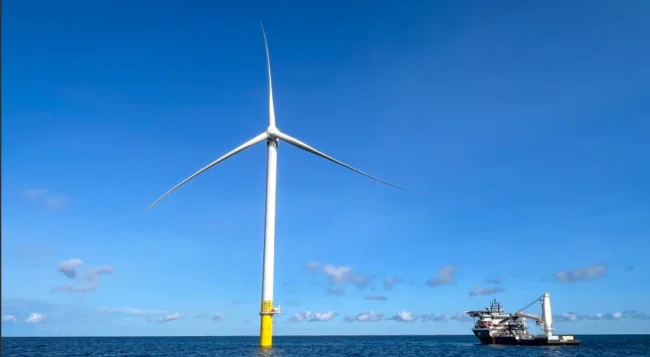
The Revolution Wind project is in its final construction phase, with nearly all key offshore infrastructure in place. According to the company, all offshore foundations have been installed along with 58 of the 65 planned wind turbines. Export cable installation is also complete, and both offshore substations have been deployed. Had the BOEM suspension not occurred, Revolution Wind was expected to begin power generation in January 2026.
The project has already delivered more than 2 million hours of union labor and supports over 1,000 union jobs across shipbuilding, installation, and manufacturing. In total, Revolution Wind is contracted to deliver power to more than 350,000 homes under long-term power purchase agreements with Connecticut and Rhode Island utilities.
From a grid infrastructure standpoint, the project is considered a cornerstone in the New England energy supply plan, with the independent system operator ISO-New England warning that delays could raise electricity prices and reduce grid reliability. The urgency of maintaining construction progress reflects not only decarbonization goals but also the immediate capacity needs driven by accelerating AI data center demand, winter reliability stress, and retirements of fossil-based generation.
What are the legal and regulatory implications for Ørsted, Skyborn, and the broader offshore wind sector?
The court’s decision does not eliminate legal uncertainty for Revolution Wind or the broader offshore wind industry. The underlying lawsuit challenging the BOEM’s authority to issue the lease suspension is still ongoing, and a final ruling could take months or longer. However, the preliminary injunction sets a strong procedural precedent. It signals that courts are willing to scrutinize the basis for administrative suspensions even in highly regulated sectors like offshore energy.
This case also carries significant implications for Sunrise Wind LLC, another Ørsted-backed offshore wind project that was hit with the same December 22 lease suspension order. Sunrise Wind, which is solely owned by Ørsted, has not yet announced a legal challenge of its own, but may now be emboldened by the outcome in the Revolution Wind case. Legal observers suggest the court’s ruling may narrow the future discretion of the BOEM, particularly in suspending active leaseholders who have met mitigation and permitting obligations.
For Ørsted and Skyborn Renewables, the ruling reduces immediate project risk and protects billions of dollars in committed capital. Ørsted has positioned Revolution Wind as a linchpin of its U.S. offshore wind portfolio, which also includes investments in port infrastructure, U.S. shipbuilding, and a domestic supply chain extending across more than 40 states. Global Infrastructure Partners’ Skyborn Renewables, for its part, has used the project as a platform for expansion into U.S. regulated energy development following GIP’s broader decarbonization strategy.
Could Revolution Wind still face execution risk even with legal clarity?
While the court’s decision offers operational breathing room, the resumption of construction at Revolution Wind is not without execution challenges. Weather constraints, subcontractor scheduling, and supply chain disruptions remain risks during the final installation window. Moreover, the delay has compressed the project’s commissioning timeline at a time when many grid interconnection processes are already facing bottlenecks.
There is also the question of federal–state coordination. The Biden administration has been caught in a cross-current of supporting offshore wind targets while enforcing regulatory and environmental oversight that some developers argue has become contradictory. How Ørsted and Skyborn Renewables navigate this ambiguity—particularly with regard to stakeholder engagement and Defense Department consultations—will shape the risk profile for other projects in the pipeline.
Investor sentiment toward offshore wind has already taken a hit in recent quarters, as delays, cost inflation, and cancellation of power purchase agreements have rattled market confidence. Ørsted’s own financials have come under pressure in part due to U.S. project write-downs. While the Revolution Wind injunction is a win, analysts will be watching closely for signs of smooth ramp-up and actual energy production to determine whether the company can meet its recovery narrative in the U.S. market.
What does this ruling mean for grid reliability and energy market planning in the Northeast?
For grid planners and utilities, the court ruling reduces near-term uncertainty around capacity planning and renewable integration in New England. Revolution Wind’s 704 megawatts represent a material contribution to ISO-New England’s capacity targets, especially as electrification efforts accelerate in the heating and transportation sectors. The potential deferral or replacement of this capacity could have forced a more expensive procurement of fossil-based backup or emergency imports during peak demand periods.
Connecticut and Rhode Island ratepayers also have a direct stake in the outcome. Under the 20-year power purchase agreements signed in earlier years, consumers are expected to benefit from stable pricing, emissions reduction, and supply diversity. Prolonged suspension or cancellation could have triggered financial penalties, contract restructuring, or greater reliance on volatile spot market purchases.
Strategically, the ruling may also restore some momentum to U.S. offshore wind developers and suppliers who have grown wary of the unpredictable regulatory climate. A favorable court decision does not erase all risk, but it helps reinforce the credibility of federal permitting processes that many players had started to question after the December suspension wave.
What happens next for Revolution Wind, Ørsted, and offshore wind litigation risk?
The path forward now hinges on two parallel tracks. First, Revolution Wind must complete remaining construction activities and successfully begin commissioning as soon as conditions permit. Any significant further delays could reopen commercial or political vulnerability. Second, the legal case continues in federal court, where the BOEM may defend its authority to impose future lease suspensions under evolving statutory interpretations or emergent national security concerns.
For Ørsted and Skyborn Renewables, the immediate goal is operational execution. But the longer-term strategy will depend on their ability to work constructively with federal agencies and political stakeholders to ensure that the offshore wind pipeline is not repeatedly disrupted by conflicting enforcement dynamics.
The broader lesson from the Revolution Wind injunction may be that while offshore wind remains politically favored and technically feasible, it is not immune to process risk. For institutional investors and industry executives, this episode is a sharp reminder that project finance, regulatory litigation, and grid planning are now tightly interlinked in the offshore energy economy.
Key takeaways on what this development means for the company, its competitors, and the industry
- Revolution Wind secured a federal court injunction allowing immediate resumption of construction, reversing the December 2025 BOEM lease suspension.
- The 704 MW project is 87 percent complete and had been expected to deliver power to 350,000 homes in early 2026 before the suspension halted final works.
- Ørsted and Skyborn Renewables emphasized that the project underwent nine years of federal reviews and mitigation consultations with the U.S. Department of Defense.
- The decision sets a procedural precedent that may limit future BOEM discretion in suspending active offshore wind leaseholders under contested legal grounds.
- Sunrise Wind, another Ørsted project impacted by the same suspension, may now follow a similar legal strategy to protect its timeline.
- Grid reliability risks in the Northeast would have escalated if Revolution Wind had remained offline, especially with growing AI-related electricity demand.
- The ruling boosts confidence in U.S. offshore wind regulatory processes but does not eliminate execution risks related to weather, supply chain, or legal escalation.
- Offshore wind investor sentiment may stabilize if Revolution Wind delivers power on schedule and Ørsted avoids additional legal or financial setbacks.
Discover more from Business-News-Today.com
Subscribe to get the latest posts sent to your email.

