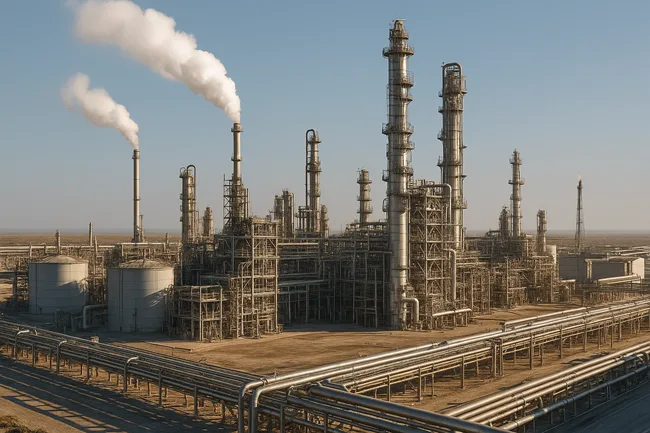
Eni S.p.A. has announced a major gas and condensate discovery at the Murene South-1X exploration well in Block CI-501 offshore Côte d’Ivoire, confirming a new accumulation named Calao South within the broader Calao channel complex. With estimated volumes of up to 5.0 trillion cubic feet of gas and around 450 million barrels of condensate, the find ranks as the country’s second-largest discovery after Baleine and materially reinforces Eni S.p.A.’s upstream growth trajectory in West Africa. Strategically, the discovery strengthens Côte d’Ivoire’s emerging role as a regional energy hub while extending Eni S.p.A.’s portfolio of capital-efficient, fast-cycle offshore developments.
What does the Murene South-1X discovery reveal about the scale and quality of the Calao channel complex offshore Côte d’Ivoire?
The Murene South-1X well provides technical validation that the Calao channel complex is not a one-off discovery but a repeatable, high-quality hydrocarbon system. The confirmation of gas and condensate in Cenomanian sands, with a reported gross hydrocarbon-bearing interval of roughly 50 meters and strong petrophysical properties, points to reservoir characteristics that can support commercial development rather than marginal production. For offshore explorers, reservoir continuity and quality matter as much as volumetric size, and Murene South-1X materially de-risks both.
At an estimated 1.4 billion barrels of oil equivalent, Calao South significantly expands the resource base adjacent to existing discoveries. Its proximity to the earlier Murene-1X well in the CI-205 block suggests a broader connected play fairway rather than isolated traps. This improves development economics by opening the door to shared infrastructure, hub-style development planning, and phased investment rather than a single high-risk capital outlay.
For Côte d’Ivoire, the scale of the discovery reinforces the country’s shift from frontier exploration territory to a proven offshore gas and condensate province. The Calao channel complex now joins Baleine as a cornerstone of that narrative, strengthening national energy security ambitions and export potential over the medium term.
Why does this discovery matter now for Eni S.p.A.’s upstream strategy and capital allocation discipline?
The timing of the Calao South discovery aligns closely with Eni S.p.A.’s stated upstream strategy of focusing on high-return, low-emissions intensity projects with fast monetisation pathways. Offshore Côte d’Ivoire fits that profile. Water depths of around 2,200 meters and a total drilled depth of approximately 5,000 meters place the project firmly within modern deepwater capabilities, but the presence of nearby producing infrastructure materially lowers development risk.
Eni S.p.A. has increasingly prioritised gas-weighted discoveries that can serve both domestic markets and export channels. Calao South’s gas-rich nature complements this approach, especially as European gas security remains a long-term strategic concern even after recent market stabilisation. While Côte d’Ivoire production will not directly supply Europe, it strengthens Eni S.p.A.’s broader gas portfolio and optionality across regions.
From a capital discipline perspective, the discovery allows Eni S.p.A. to sequence investments. The planned drill stem test will clarify production capacity and flow characteristics, enabling a calibrated decision on development scale and timing. This measured approach aligns with Eni S.p.A.’s broader capital allocation framework, which has increasingly favoured phased developments, early cash flow generation, and disciplined reinvestment rather than mega-project risk concentration.
How does Calao South compare strategically with the Baleine field and Eni S.p.A.’s existing Côte d’Ivoire footprint?
Baleine remains the anchor asset in Eni S.p.A.’s Côte d’Ivoire portfolio, already producing more than 62,000 barrels of oil per day and over 75 million cubic feet of gas per day from its first two phases. The upcoming Phase 3 expansion, expected to lift output to around 150,000 barrels of oil per day and 200 million cubic feet of gas per day, underlines Baleine’s role as a cash-generating cornerstone.
Calao South complements Baleine rather than competing with it for capital or operational focus. Whereas Baleine is already in production and scaling rapidly, Calao South represents the next wave of organic growth, extending the production plateau beyond the current decade. The two assets together support a portfolio effect, balancing near-term cash flow with medium-term growth.
Operationally, Eni S.p.A.’s long-standing presence in Côte d’Ivoire since 2015 provides institutional familiarity with regulators, partners, and local supply chains. This reduces execution friction and shortens timelines from appraisal to development, a factor that investors increasingly value in a world of rising project costs and regulatory complexity.
What are the implications for Petroci Holding and Côte d’Ivoire’s national energy strategy?
Petroci Holding’s 10 percent stake in Block CI-501 ensures that the Calao South discovery has direct national participation and alignment with Côte d’Ivoire’s energy objectives. For the state partner, the discovery strengthens future revenue prospects, domestic gas availability, and the potential for downstream industrial development.
Côte d’Ivoire has positioned domestic gas production as a cornerstone of its power generation strategy, reducing reliance on imports and supporting economic growth. Calao South adds depth to this strategy by providing additional volumes that can be phased into domestic supply or potentially exported as infrastructure expands.
At a policy level, the discovery reinforces Côte d’Ivoire’s attractiveness to international explorers and operators. Consistent discoveries, a functioning regulatory framework, and successful partnerships signal a stable investment environment at a time when many African jurisdictions face capital flight or regulatory uncertainty.
How could Calao South reshape competitive dynamics among offshore explorers in West Africa?
The success of Calao South underscores the renewed relevance of West Africa’s deepwater basins, particularly at a time when some international oil companies are reassessing frontier exploration budgets. For peers operating in neighbouring basins, the discovery highlights the value of disciplined geological targeting over acreage accumulation.
Eni S.p.A.’s ability to convert exploration success into production, as demonstrated at Baleine, sets a competitive benchmark. Other operators may face increased pressure from investors to demonstrate similar execution capability rather than relying on discovery announcements alone.
For national oil companies and smaller independents, Calao South raises the bar on technical capability and capital access required to compete effectively in deepwater West Africa. It also reinforces the strategic importance of partnerships that combine local alignment with international technical expertise.
What execution risks still need to be addressed before Calao South can move toward development?
Despite its scale, Calao South remains at the appraisal stage, and several execution risks must be navigated. The upcoming drill stem test will be critical in confirming flow rates, pressure regimes, and commercial viability. Subsurface complexity, particularly in channelised reservoirs, can still introduce uncertainty around connectivity and recovery factors.
Development timing will also depend on broader portfolio prioritisation within Eni S.p.A. While Côte d’Ivoire is strategically important, the company must balance capital allocation across multiple geographies, including other African assets and global gas projects.
External risks include regulatory approvals, fiscal stability, and potential cost inflation in offshore services. Although Eni S.p.A. benefits from operational continuity in Côte d’Ivoire, global offshore cost pressures could still affect project economics if development moves forward aggressively.
How are investors likely to interpret this discovery in terms of valuation and sentiment?
For investors, Calao South reinforces the credibility of Eni S.p.A.’s exploration-led growth narrative rather than representing an immediate valuation inflection point. The market typically discounts early-stage discoveries until appraisal and development clarity emerge, and this is likely to be the case here as well.
However, the scale of the discovery and its proximity to existing infrastructure reduce the risk discount that might otherwise apply. Institutional investors focused on cash flow resilience and reserve replacement are likely to view Calao South positively as part of a broader portfolio effect rather than as a standalone catalyst.
Recent investor sentiment toward Eni S.p.A. has been shaped by disciplined capital returns, balance sheet resilience, and selective growth. Calao South fits within that framework, supporting medium-term reserve visibility without undermining capital discipline.
What does Calao South signal about the future direction of offshore gas development in Africa?
Calao South illustrates that offshore gas discoveries can still play a central role in Africa’s energy transition narrative. Gas offers a bridge between domestic energy needs and export opportunities, particularly for countries seeking to industrialise while managing emissions intensity.
For international operators, the discovery highlights the continued relevance of technically mature basins where geological understanding, infrastructure proximity, and regulatory stability converge. This may redirect exploration capital toward fewer but higher-quality opportunities rather than broad frontier expansion.
In a broader industry context, Calao South reinforces the idea that disciplined exploration, aligned with development capability and local partnership, remains a viable strategy even as energy transition pressures reshape investment priorities.
Key takeaways: What the Calao South discovery means for Eni S.p.A., Côte d’Ivoire, and offshore energy markets
- Calao South ranks as Côte d’Ivoire’s second-largest discovery, materially expanding the country’s offshore gas and condensate resource base.
- The Murene South-1X well validates the Calao channel complex as a repeatable, high-quality hydrocarbon system rather than a single discovery.
- For Eni S.p.A., the find strengthens a gas-weighted, capital-disciplined upstream strategy focused on fast-cycle offshore projects.
- Proximity to existing discoveries and infrastructure improves development economics and reduces execution risk relative to frontier plays.
- Petroci Holding’s participation ensures alignment with national energy security and domestic gas supply objectives.
- The discovery enhances Côte d’Ivoire’s positioning as an emerging West African offshore energy hub.
- Competitive pressure may increase on peers to demonstrate not just exploration success but delivery capability.
- Appraisal results, particularly the drill stem test, will be critical in determining development timing and scale.
- Investors are likely to view Calao South as a medium-term portfolio positive rather than an immediate valuation driver.
Discover more from Business-News-Today.com
Subscribe to get the latest posts sent to your email.