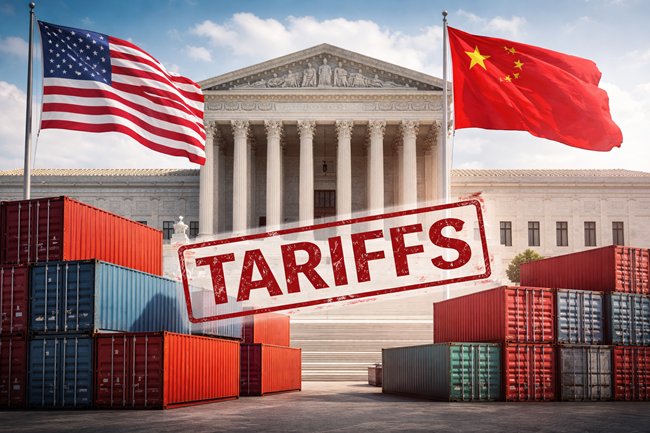
The Supreme Court of the United States has delivered a landmark ruling that fundamentally reshapes the boundaries of presidential authority over trade policy, holding that the International Emergency Economic Powers Act does not permit a president to impose tariffs. In Learning Resources, Inc. v. Trump, decided on February 20, 2026, the Court concluded that tariffs are a form of taxation reserved to Congress and cannot be justified through emergency powers, even when a national emergency has been formally declared.
The decision arrives at a moment of heightened global trade tension and carries sweeping implications for executive power, congressional authority, and the stability of cross border commerce. By rejecting the use of emergency statutes as a backdoor for tariff policy, the Court has curtailed a strategy that would have allowed the executive branch to reshape global trade flows with minimal legislative oversight.
What triggered the Supreme Court challenge to emergency tariffs under the International Emergency Economic Powers Act?
The case arose after President Donald Trump, shortly after returning to office, declared two separate national emergencies. One was tied to the influx of illegal drugs entering the United States from Canada, Mexico, and China, which the administration described as an extraordinary threat to public health. The second focused on persistent and large trade deficits that the administration argued were hollowing out domestic manufacturing and undermining critical supply chains.
Invoking the International Emergency Economic Powers Act, the administration imposed a sweeping set of tariffs. These included a 25 percent duty on most imports from Canada and Mexico, a 10 percent duty on most Chinese imports linked to drug trafficking concerns, and a baseline tariff of at least 10 percent on imports from virtually all trading partners to address trade imbalances. Dozens of countries faced higher rates, and the tariff regime was repeatedly modified through executive actions.
Small businesses and state governments quickly challenged the legality of these measures. Learning Resources Inc and another small business sued in the United States District Court for the District of Columbia, while V.O.S. Selections and a coalition of states brought a parallel challenge in the United States Court of International Trade. Both courts ruled against the government, setting the stage for Supreme Court review.
Why did the Supreme Court rule that IEEPA does not authorize tariffs?
At the heart of the ruling is a sharp distinction between regulating trade and taxing it. Chief Justice John Roberts, writing for the Court, emphasized that tariffs are not simply regulatory tools but a core component of the taxing power. The Constitution assigns the authority to impose taxes, duties, and imposts exclusively to Congress, and the Framers deliberately denied that power to the executive branch in peacetime.
The International Emergency Economic Powers Act allows the president to regulate, block, prohibit, or otherwise control importation and exportation during a national emergency. However, the statute does not mention tariffs or duties. The Court found this omission decisive, particularly given Congress’s long standing practice of explicitly authorizing tariffs when it intends to do so.
According to the majority, reading the word regulate to include taxation would amount to a transformative expansion of presidential authority. It would allow a president to impose tariffs of unlimited scope, size, and duration based on ambiguous statutory language. The Court rejected that interpretation, concluding that if Congress had intended to delegate such a consequential power, it would have done so clearly and with carefully defined limits.
How the major questions doctrine shaped the Supreme Court’s reasoning
A central pillar of the decision was the major questions doctrine, which holds that courts should not presume Congress has delegated powers of vast economic and political significance through vague or ancillary statutory language. The Court reasoned that tariff policy sits at the core of national economic governance and has immediate and far reaching consequences for consumers, businesses, and international relations.
Allowing a president to unilaterally impose global tariffs under an emergency statute would, in the Court’s view, eclipse even prior cases involving environmental regulation, workplace safety, or public health mandates. The majority noted that in nearly fifty years since the International Emergency Economic Powers Act was enacted, no president had ever used it to impose tariffs, let alone tariffs of this magnitude and breadth. That historical silence, combined with the scale of the asserted authority, reinforced the conclusion that Congress never intended such a delegation.
The Court also rejected arguments that emergencies or foreign affairs considerations weaken the doctrine’s application. Tariffs, the Court stressed, remain a legislative function regardless of context. The foreign policy implications of trade measures do not justify bypassing constitutional structure or established limits on executive power.
Why the Court rejected historical and statutory arguments supporting emergency tariffs
The administration argued that tariffs have historically been discussed as tools of commerce regulation and pointed to wartime precedents and earlier statutes such as the Trading with the Enemy Act. The Court found these arguments unpersuasive. Wartime cases were deemed inapplicable because all parties agreed the president lacks inherent authority to impose tariffs during peacetime. The Court also dismissed reliance on isolated lower court decisions interpreting earlier statutes, concluding that such precedents did not establish a settled meaning incorporated into the International Emergency Economic Powers Act.
The Court further observed that when Congress addresses regulation and taxation together, it does so explicitly and separately. The absence of any reference to duties or tariffs in the International Emergency Economic Powers Act underscored that regulate was never meant to smuggle in the power to tax. Accepting the government’s reading, the Court warned, would raise serious constitutional concerns, including the possibility of taxing exports, which the Constitution expressly forbids.
What happens procedurally after the Supreme Court decision?
In practical terms, the Supreme Court affirmed the judgment of the United States Court of Appeals for the Federal Circuit in the V.O.S. Selections case, which had already struck down the tariffs. In the Learning Resources case, the Court vacated the district court’s judgment and remanded with instructions to dismiss for lack of jurisdiction, clarifying that challenges to tariffs belong in the specialized trade courts.
While the procedural outcomes differed, the substantive holding was clear and unified. The International Emergency Economic Powers Act does not grant tariff authority, and the challenged duties could not stand.
How does the ruling affect United States trade policy going forward?
The immediate effect of the decision is to sharply limit the executive branch’s ability to deploy tariffs as a rapid response tool during emergencies. Future administrations seeking to impose broad tariffs will need to rely on statutes that explicitly authorize such measures, such as provisions of the Trade Expansion Act, or return to Congress for new legislative authority.
For businesses, particularly importers and manufacturers, the ruling offers greater predictability. One of the most disruptive features of the challenged tariff regime was its fluidity, with rates changing frequently through executive action. By reaffirming that tariff policy must rest on clear statutory foundations, the Court has reduced the risk of sudden and unilateral trade shocks.
How are markets and investors likely to interpret the Supreme Court’s ruling?
Investor sentiment around the decision has been cautiously constructive. While tariffs can protect certain domestic industries, they also raise costs, disrupt supply chains, and inject uncertainty into earnings forecasts. The Court’s ruling limits the scope for abrupt policy shifts driven by emergency declarations, a development generally welcomed by markets that prize stability and rule based governance.
At the same time, the decision places renewed pressure on Congress to own trade policy outcomes. Legislative gridlock could make comprehensive tariff reform more difficult, potentially constraining the United States’ ability to respond quickly to global trade disputes. From an investor perspective, this trade off favors predictability over speed.
What does the decision signal about the Supreme Court’s broader approach to executive power?
Beyond trade, Learning Resources, Inc. v. Trump reinforces a broader judicial pattern of scrutinizing expansive claims of executive authority. Notably, even the justices who declined to rely explicitly on the major questions doctrine agreed that traditional statutory interpretation was sufficient to resolve the case. That consensus underscores a shared view that courts should not infer sweeping delegations of power from silence or ambiguity.
The ruling also sends a clear institutional message. Emergency statutes are not blank checks, and constitutional structure does not bend simply because a policy goal is urgent or politically salient. For the executive branch, the decision narrows the menu of unilateral options. For Congress, it restores responsibility and accountability over one of the most powerful levers of economic policy.
Why the Learning Resources ruling redraws constitutional limits on emergency economic power beyond trade policy
This decision is ultimately about more than import duties. It is about preserving the balance of power between branches of government in an era where emergencies are increasingly invoked to justify extraordinary action. By drawing a firm line around the taxing power, the Supreme Court has reaffirmed that even in moments of crisis, fundamental constitutional allocations remain intact.
For policymakers, the message is clear. If tariffs are to be used as tools of national strategy, they must be debated, authorized, and constrained by Congress. For markets and global trading partners, the ruling offers reassurance that United States trade policy will remain anchored in law rather than executive improvisation.
Key takeaways from the Supreme Court’s Learning Resources ruling on emergency tariffs
- The Supreme Court of the United States ruled in Learning Resources, Inc. v. Trump that the International Emergency Economic Powers Act does not authorize a president to impose tariffs, even when a national emergency has been formally declared, reaffirming that tariff powers rest exclusively with Congress.
- The Court drew a clear constitutional distinction between regulating imports and taxing them, concluding that tariffs are a form of taxation and therefore fall under Congress’s Article I authority rather than the executive branch.
- The majority applied the major questions doctrine to reject the administration’s interpretation, holding that Congress cannot be presumed to have delegated such economically and politically significant power through vague statutory language.
- Historical practice weighed heavily against the government’s position, with the Court noting that no president in nearly five decades had used the International Emergency Economic Powers Act to impose tariffs of any kind.
- Arguments based on wartime precedents, foreign affairs authority, and earlier trade statutes were rejected as inapplicable to peacetime tariff policy under the International Emergency Economic Powers Act.
- Procedurally, the Court affirmed the United States Court of Appeals for the Federal Circuit’s decision striking down the tariffs in the V.O.S. Selections case and ordered the Learning Resources case dismissed for lack of jurisdiction, clarifying the proper judicial forum for tariff disputes.
- The ruling significantly limits the executive branch’s ability to deploy tariffs rapidly during crises, forcing future administrations to rely on statutes with explicit tariff authorization or to seek new legislation from Congress.
- For businesses and investors, the decision reduces policy volatility by curbing the risk of sudden, unilateral tariff changes driven by emergency declarations.
- More broadly, the case signals a continued tightening by the Supreme Court around expansive claims of executive power, reinforcing that emergency statutes are not blank checks for major economic policymaking.
Discover more from Business-News-Today.com
Subscribe to get the latest posts sent to your email.