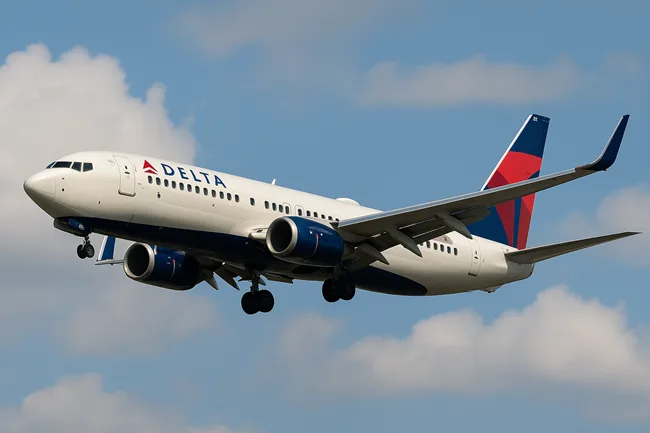
Why did Delta Air Lines stock jump over 11% after Q2 2025 results, and what’s driving investor optimism?
Delta Air Lines, Inc. (NYSE: DAL) saw its stock price surge 11.44% to $56.50 by midday on July 10, 2025, following the release of its second-quarter earnings report earlier in the day. The sharp rise added over $3.5 billion to the airline’s market capitalization, pushing it to $36.9 billion. Trading volume spiked to over 31 million shares within the first four hours of market activity—more than three times the average daily volume of 10.2 million.
The bullish price action came as the American airline operator reported GAAP earnings per share of $3.27 and non-GAAP EPS of $2.10 for the June quarter, outperforming many institutional forecasts. Delta Air Lines also reinstated full-year guidance, targeting $5.25–$6.25 in earnings per share and $3–$4 billion in free cash flow, which reassured investors after a cautious start to the year. The board additionally announced a 25% increase in the quarterly dividend beginning in Q3, strengthening the appeal of Delta’s stock to income-focused shareholders.
How did Delta Air Lines perform financially in Q2 2025, and what were the key revenue drivers?
For the three months ended June 30, 2025, Delta Air Lines posted adjusted operating revenue of $15.5 billion, up 1% year-over-year. This modest growth was supported by a 4% rise in capacity but offset by a 3% decline in total revenue per available seat mile (TRASM). However, the composition of revenue showed a strategic shift towards more profitable segments.
Approximately 59% of adjusted operating revenue was derived from premium and diversified streams, including Delta One and American Express partnerships. Premium product revenue rose 5% year-over-year to $5.9 billion, while loyalty-related income grew 8%, reaching $2 billion from co-branded card activity and travel awards. Maintenance, repair, and overhaul (MRO) services posted a standout 29% increase in revenue, and cargo income rose 7%.
While main cabin ticket sales declined by 5% to $6.3 billion, the premium cabin’s growth reinforced Delta Air Lines’ strategy of maximizing yield rather than volume alone. Revenue from international operations, particularly Transpacific routes, showed robust momentum. Pacific revenues jumped 11% with expanded service to Asia, and Transatlantic travel remained strong with record summer demand driving 2% year-over-year revenue growth.
What cost trends and margin dynamics shaped Delta’s Q2 performance and 2025 guidance?
Delta Air Lines maintained strong profitability despite slightly elevated cost pressures. Adjusted operating income for the quarter stood at $2.0 billion, reflecting a 13.2% operating margin. GAAP pre-tax profit reached $2.6 billion, aided in part by mark-to-market investment gains, while non-GAAP pre-tax income totaled $1.8 billion.
On the cost side, total operating expense rose to $14.5 billion (GAAP), with non-fuel costs reaching $10.5 billion. Non-fuel unit cost (CASM-Ex) rose 2.7% year-over-year to 13.49¢, in line with management expectations. Fuel expense declined 11% to $2.5 billion as the average fuel price fell to $2.26 per gallon—down from $2.64 in Q2 2024.
Executives indicated that cost discipline would remain a focus going forward. For the September quarter, Delta expects flat to declining non-fuel unit costs compared to the prior year, and reiterated its goal of low single-digit cost growth for FY25.
What are analysts saying about Delta’s full-year guidance reinstatement and Q3 forecast?
Institutional investors appeared encouraged by Delta’s reinstated full-year guidance, which calls for 9–11% operating margin in Q3 and EPS of $1.25 to $1.75. Analysts broadly viewed the guidance as achievable, citing strong credit card income, premium travel demand, and disciplined cost execution as key enablers.
The announcement of a 25% dividend hike was interpreted as a confidence signal from Delta’s board regarding forward cash flow generation. The airline aims to generate $3–$4 billion in free cash flow in FY25, in line with its long-term target. In the first half alone, Delta reported $2 billion in free cash flow after capital expenditures of $2.3 billion.
Despite a 24% decline in year-over-year operating cash flow to $1.9 billion in Q2, the airline still paid down $2.9 billion in debt and ended the quarter with $16.3 billion in adjusted net debt—down $1.7 billion from the end of 2024.
How is Delta Air Lines advancing in international partnerships, fleet expansion, and customer loyalty?
Delta Air Lines’ operational and strategic initiatives in Q2 extended well beyond earnings. The airline launched new nonstop service from Salt Lake City to Seoul-Incheon, expanded its joint venture with LATAM to include Argentina, and announced new routes from Seattle to Barcelona and Rome for 2026.
On the partnership front, Delta entered a minority equity agreement with WestJet and unveiled plans to deepen alliances with IndiGo, Air France-KLM, and Virgin Atlantic. These moves signal a broader effort to position Delta as the preferred transcontinental and transatlantic carrier for both leisure and corporate travelers.
In terms of fleet strategy, Delta took delivery of 10 aircraft in the quarter, including A350-900s and A321neos, while retiring 10 older aircraft. The airline expects 95% of its mainline fleet to be equipped with high-speed Wi-Fi by the end of 2025.
Delta’s loyalty program also made gains, driven by elevated American Express remuneration, which reached $2 billion in the quarter. The launch of Uber integration and the expansion of Delta One Lounge offerings further enhanced the brand’s premium positioning. Delta was once again ranked No. 1 in J.D. Power’s Premium Economy Satisfaction survey and received top honors from Skytrax and APEX.
What does the broader travel and airline market outlook suggest for Delta’s trajectory?
The June quarter earnings reaffirmed that Delta Air Lines remains one of the best-positioned U.S. airline operators to weather volatility in travel demand. Even as unit revenue remains under pressure industry-wide, Delta’s premium-heavy model and diversification into loyalty and services continue to insulate margins.
Fuel price volatility, capacity normalization, and competitive dynamics in domestic routes remain key risks. However, Delta’s continued focus on cash flow, debt reduction, and product innovation has resonated positively with investors. The stock’s 11% gain on earnings day reflects renewed confidence in the airline’s forward execution.
With adjusted EPS of $2.10 for Q2, Delta Air Lines is now on track to potentially match or exceed the top end of its FY25 guidance. The 52-week price range spans from $34.74 to $69.98, with current intraday pricing placing the stock closer to its one-year high. The PE ratio stands at 10.01, and the forward dividend yield is now 1.53% post-hike.
Analysts expect the airline’s capital discipline and premium push to sustain earnings quality even if broader macroeconomic headwinds impact demand in H2 2025.
Discover more from Business-News-Today.com
Subscribe to get the latest posts sent to your email.