




Why Deloitte’s S2S Platform Is Built on Dell and NVIDIA—And Not HPE, AMD, or Intel
Deloitte’s Silicon to Service (S2S) platform is not simply a new AI framework for regulated clients—it is a calculated declaration of infrastructure allegiance. By choosing Dell Technologies and NVIDIA as the technological backbone, Deloitte is committing to a highly integrated, performance-focused architecture that aims to deliver scalable, secure artificial intelligence to federal agencies. The decision to rely on Dell and NVIDIA—over alternatives like Hewlett Packard Enterprise, AMD, or Intel—is not arbitrary. It reflects a strategic alignment with reliability, compliance readiness, and AI performance leadership. As Deloitte positions S2S at the heart of government modernization, its underlying hardware-software stack deserves close analysis.
What Infrastructure Powers Deloitte’s AI Factory?
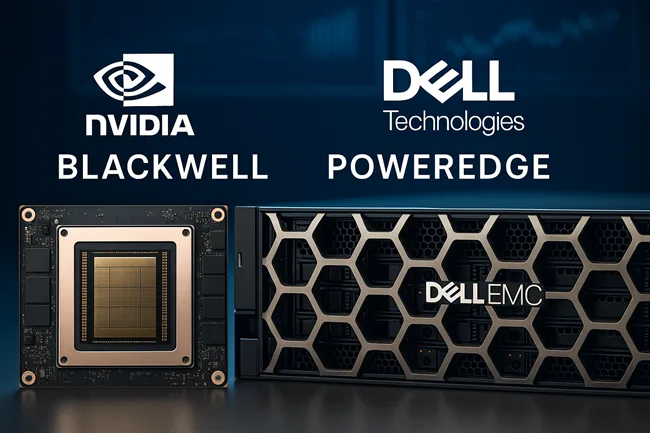
Deloitte’s AI Factory relies on Dell’s PowerEdge XE9680 servers in combination with NVIDIA’s Blackwell architecture to deliver the compute-intensive capabilities needed for mission-critical AI applications. These servers are equipped to host up to eight NVIDIA B100 GPUs, operating in tandem through NVLink and NVSwitch interconnects. This configuration minimizes latency and enables efficient parallel processing, crucial for use cases such as generative AI, real-time threat analysis, and predictive mission planning. PowerScale storage arrays supplement compute performance by offering high-throughput access to unstructured datasets, further optimizing data-intensive tasks.
The introduction of NVIDIA’s Blackwell GPUs brings significant advancements over previous generations, including enhanced transformer optimization, FP8 precision formats for improved training efficiency, and expanded memory bandwidth. Combined with Dell’s orchestration layer, Deloitte is able to deliver enterprise-grade AI with deployment flexibility across Equinix’s FedRAMP-compliant hosting environments. This architecture positions S2S not only as a deployment platform but as an infrastructure template for public sector transformation.
How Does This Compare to HPE’s AI Offering?
Hewlett Packard Enterprise, while respected for its legacy in high-performance computing, approaches the AI infrastructure market from a different angle. Through its Cray line and HPE GreenLake services, the company emphasizes HPC and hybrid supercomputing workloads that are particularly suited for scientific computing or research institutions. Although HPE integrates with NVIDIA GPUs, its systems have been more closely aligned with specialized environments than with turnkey government-focused AI platforms.
In contrast, Dell’s approach—embodied in the XE9680 and PowerScale stack—is optimized for scalable commercial AI deployments. Its integration simplicity, operational modularity, and widespread adoption in federal data centers give it a practical edge. Deloitte’s decision likely stems from Dell’s proven ability to deliver government-certified systems that can support AI, analytics, and traditional workloads within a single, streamlined footprint.
Why Did Deloitte Choose NVIDIA Over AMD or Intel?
NVIDIA remains the industry leader in AI acceleration, with a dominant market share and unmatched software ecosystem. Deloitte’s decision to standardize on Blackwell GPUs reflects the value placed on both performance and operational maturity. NVIDIA’s CUDA toolkit, developer resources, and full-stack software suite have become essential infrastructure for training and deploying large language models, computer vision systems, and other advanced AI workloads.
While AMD has introduced the MI300X accelerators with notable memory and throughput enhancements, it has yet to achieve comparable traction in the public sector. Its CDNA 3 architecture, although powerful, lacks the same level of software integration and institutional trust. Intel, meanwhile, has entered the AI accelerator race with the Gaudi 3 chip developed through Habana Labs. Gaudi offers competitive inference performance, but its software ecosystem remains underdeveloped, and it has seen limited real-world validation.
The combination of NVIDIA’s deep AI experience and Dell’s integration flexibility makes for a compelling infrastructure solution that is both performance-optimized and deployment-ready—an essential requirement for government agencies that demand consistency and transparency in technology implementation.
How Do Dell and NVIDIA Collaborate Differently Than Their Rivals?
The Dell-NVIDIA alliance goes beyond a typical vendor relationship. It represents a strategic co-engineering collaboration that spans hardware, software, and operational design. Their joint AI Factory initiative offers pre-tested, pre-validated modules for enterprise AI deployment. These modules can be rapidly deployed using Dell’s orchestration tools and NVIDIA’s containerized inference microservices, which streamline the productionization of AI models.
Unlike more fragmented offerings from vendors like HPE or Lenovo, the Dell-NVIDIA integration is built around a seamless DevOps toolchain, including Kubernetes-based orchestration, MLOps workflows, and containerized model management. This level of cohesion enables Deloitte to provide clients with repeatable, scalable AI deployments that reduce integration risk and shorten time-to-impact. For regulated industries, where delays and inefficiencies can derail critical projects, such vertical alignment can be a decisive advantage.
Why Does This Infrastructure Choice Matter for Federal AI Deployment?
Infrastructure matters enormously in public sector AI, where compliance, control, and long-term reliability outweigh cost alone. Agencies need platforms that can operate under strict FedRAMP High controls, support data localization mandates, and function across hybrid environments. They must also assure continuity of operations during cybersecurity events, mandate audits, or government transitions.
Dell’s secure manufacturing process and NVIDIA’s established presence in national AI infrastructure projects give Deloitte a uniquely compliant and resilient AI foundation. These technologies are already in use across mission-critical domains and have passed multiple layers of scrutiny. Deloitte’s clients—ranging from defense departments to civilian agencies—require that level of assurance before deploying AI in operational contexts. S2S delivers this through its carefully vetted infrastructure stack.
What Are Analysts Saying About the Competitive Landscape?
Recent analyses from IDC and Gartner place Dell and NVIDIA at the top of the AI infrastructure leaderboard. Dell leads in AI-optimized server shipments, particularly to enterprise and public sector buyers, while NVIDIA continues to command over 85 percent of the data center GPU market. Analysts cite co-engineered platforms as key drivers of enterprise AI success, especially in complex regulated environments.
HPE and AMD, while still competitive, are positioned more for niche or cost-sensitive deployments rather than broad-based public sector AI frameworks. Intel’s re-entry with Gaudi has drawn attention, but market analysts remain cautious about its ability to challenge NVIDIA’s dominance in the near term. For Deloitte, the stability, performance, and ecosystem alignment of the Dell-NVIDIA partnership allow it to focus on mission outcomes rather than backend integration hurdles.
What Is the Strategic Outlook for Deloitte’s AI Infrastructure?
Deloitte’s platform-centric approach reflects a broader shift toward AI as infrastructure—where success is determined not by isolated tools, but by how well they are integrated, secured, and scaled across mission landscapes. As Deloitte expands S2S across sectors like health administration, defense logistics, and environmental monitoring, its reliance on Dell and NVIDIA gives it both technical leverage and market credibility.
This combination supports Deloitte’s positioning as a systems integrator that delivers full-stack transformation—not just AI pilots or proofs of concept. In a time when CIOs are being tasked with deploying secure, trustworthy AI under tighter timelines and increasing scrutiny, infrastructure consistency matters more than ever.
By choosing Blackwell and PowerEdge as the foundation for S2S, Deloitte is not only endorsing best-in-class performance—it is embedding resilience, compliance, and readiness into the heart of its public sector AI strategy.
Discover more from Business-News-Today.com
Subscribe to get the latest posts sent to your email.


