



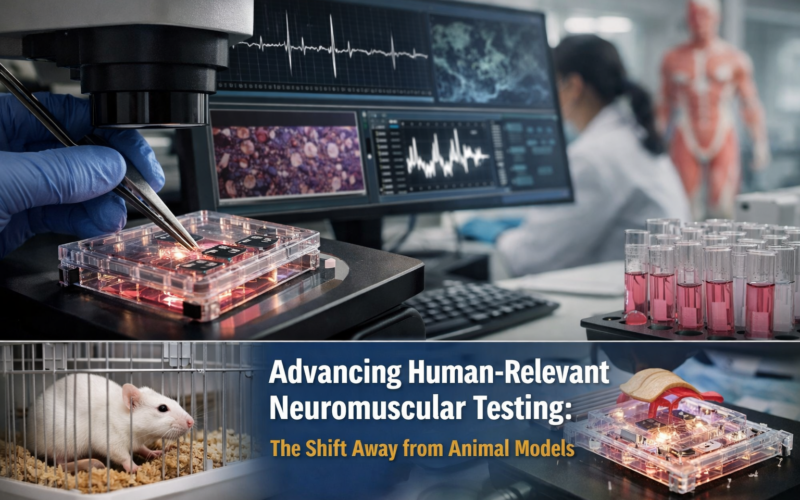
Curi Bio, a Seattle-based leader in human-relevant 3D tissue technology, and Battelle, the world’s largest independent nonprofit research organization, have announced a strategic partnership to commercialize next-generation Neuromuscular Junction (NMJ) assay technology. The collaboration combines Curi Bio’s innovative microphysiological systems with Battelle’s extensive GLP-ready infrastructure to offer what the companies describe as a transformative, human-relevant alternative to traditional animal-based pharmacology methodologies. The partnership emerges as the regulatory landscape shifts dramatically toward human-centric drug testing, with the FDA releasing new Non-Animal Model guidance just this week and the NIH committing $150 million to human-relevant alternatives.
How does the Curi Bio and Battelle partnership position neuromuscular drug testing for the post-animal regulatory era
The partnership leverages Curi Bio’s proven Mantarray ecosystem, which provides real-time functional readouts of human heart, muscle, and neuromuscular junction contractility, offering a ready-to-use commercial solution for botulinum neurotoxin potency testing. The collaboration enables customers to generate data with their specific drug products, accelerating the adoption of human-relevant, cell-based NMJ assays that promise to deliver more predictive results than legacy animal models.
Battelle serves as the scale and integration partner, bringing regulatory expertise and specialized laboratory facilities necessary to implement these technologies across global drug substance and medical countermeasure development pipelines. The timing appears strategically aligned with the FDA’s March 18, 2026 draft guidance on New Approach Methodologies, which explicitly encourages drug developers to incorporate non-animal testing methods into regulatory submissions without requiring full validation.
What regulatory and funding developments are driving the accelerated adoption of human-relevant testing platforms
The FDA’s new NAMs guidance represents a significant departure from traditional animal-first drug development paradigms.
The framework emphasizes four core validation principles: context of use, human biological relevance, technical characterization, and fit-for-purpose assessment. Critically, the guidance clarifies that full validation is not always a prerequisite for NAMs to be considered in drug development submissions, with FDA Acting CDER Director Tracy Beth Hoeg stating that the agency is ready to shift from animal-centric to human-centric predictive models.
Parallel to the FDA’s regulatory modernization, the NIH has launched a $150 million Complement Animal Research in Experimentation program specifically designed to develop, implement, and standardize lab-based and computer-based methods that better simulate human biology. The five-year funding commitment targets technology development centers, NAMs data hubs, and coordinating centers, signaling federal coordination around animal alternatives that extends beyond individual agency initiatives.
Why are neuromuscular junction assays particularly critical for pharmaceutical development and medical countermeasure programs
Neuromuscular junction testing has historically relied on animal bioassays for botulinum neurotoxin potency determination, creating both ethical concerns and predictive limitations when translating results to human physiology. Curi Bio’s human-relevant NMJ assays address this gap by using 3D human tissue models that replicate complex neuromuscular physiology, offering functional readouts that could prove more predictive of human responses than traditional animal models.
The commercial significance extends beyond ethical considerations to operational efficiency and regulatory confidence. Traditional animal bioassays for botulinum toxin testing can take weeks to complete and show significant variability, while human-relevant platforms promise faster turnaround times with potentially greater reproducibility. For pharmaceutical companies developing neuromuscular therapeutics or government agencies maintaining medical countermeasure stockpiles, this technological shift could materially impact both development timelines and regulatory approval pathways.
How does Battelle’s infrastructure and regulatory expertise complement Curi Bio’s technology platform
Battelle brings substantial operational scale and regulatory depth to the partnership, with $6.5 billion in annual global research and development operations spanning 22,000 employees across more than 130 locations worldwide. The organization manages seven national laboratories for the U.S. Department of Energy and Department of Homeland Security, providing established pathways for government adoption of new technologies through existing contractual relationships and security clearances.
The collaboration addresses a common scaling challenge for biotechnology companies developing innovative platforms but lacking the regulatory infrastructure and manufacturing capacity needed for widespread commercial adoption. Battelle’s GLP-ready facilities and established quality systems could accelerate the path from proof-of-concept to routine commercial testing, particularly for applications requiring government qualification or international regulatory acceptance.
What competitive dynamics and execution risks could influence the commercial success of this partnership
The partnership enters a competitive landscape where multiple technology providers are developing human-relevant alternatives to animal testing, including organ-on-chip platforms, organoid technologies, and computational modeling approaches. Success will depend on demonstrating superior predictive accuracy compared to both traditional animal models and competing NAM technologies, while maintaining cost-effectiveness at commercial scale.
Execution risks include the complexity of harmonizing Curi Bio’s research-focused technology with Battelle’s industrial-scale operations, potential regulatory delays in NAM acceptance despite favorable guidance trends, and the challenge of displacing established testing protocols that pharmaceutical and government customers have used for decades. The partnership’s ability to generate compelling comparative data demonstrating improved human predictivity will likely determine market penetration rates.
What does this partnership signal about the broader transformation of preclinical drug development methodologies
The Curi Bio-Battelle collaboration reflects a fundamental shift in preclinical drug development infrastructure, moving from animal-centric to human-relevant testing paradigms. This transformation is being driven by converging factors including regulatory modernization, federal funding commitments, technological maturation, and growing recognition that animal models often fail to predict human responses effectively.
For pharmaceutical companies, the partnership represents both an opportunity to access more predictive testing methods and a potential competitive necessity as regulators increasingly favor human-relevant data. The collaboration’s focus on establishing commercial-ready, scalable platforms suggests that NAM adoption is moving beyond research applications toward routine drug development workflows, with implications for how companies structure their preclinical operations and regulatory strategies.
The partnership also demonstrates how technology companies and established research organizations are reconfiguring relationships to capitalize on regulatory shifts. Rather than competing for market share in traditional animal testing, organizations are collaborating to create entirely new testing paradigms that promise improved predictivity and reduced ethical concerns.
Key takeaways on what this development means for the company, its competitors, and the industry
- Curi Bio gains access to Battelle’s extensive GLP infrastructure and government relationships, potentially accelerating commercial adoption of its human-relevant NMJ assay technology beyond research applications into routine drug development workflows
- The partnership positions both companies to capitalize on regulatory momentum toward animal alternatives, with FDA’s new NAMs guidance and NIH’s $150 million funding commitment creating favorable market conditions for human-relevant testing platforms
- Neuromuscular junction testing represents a high-value application for NAM technologies, addressing both ethical concerns around animal testing and predictive limitations in current botulinum toxin potency assays used by pharmaceutical and government customers
- Battelle’s operational scale and regulatory expertise could help establish industry standards for human-relevant neuromuscular testing, creating competitive advantages for the partnership while raising barriers for alternative technology providers
- The collaboration reflects broader industry transformation toward human-centric drug development, driven by converging regulatory, technological, and funding developments that are reshaping preclinical testing paradigms
- Success depends on demonstrating superior predictive accuracy compared to traditional animal models and competing NAM technologies while maintaining cost-effectiveness and regulatory acceptance at commercial scale
- Execution risks include technology integration complexity, potential regulatory delays despite favorable guidance trends, and challenges displacing established testing protocols that customers have used for decades
- The partnership demonstrates how technology companies and research organizations are collaborating rather than competing to create new testing paradigms that promise improved human predictivity and reduced ethical concerns
- Market penetration will likely depend on generating compelling comparative data showing improved human relevance, regulatory acceptance rates, and operational efficiency versus existing animal-based testing protocols
- The timing aligns strategically with federal initiatives to reduce animal testing, creating potential opportunities for government adoption through Battelle’s existing national laboratory management contracts and security relationships
Discover more from Business-News-Today.com
Subscribe to get the latest posts sent to your email.