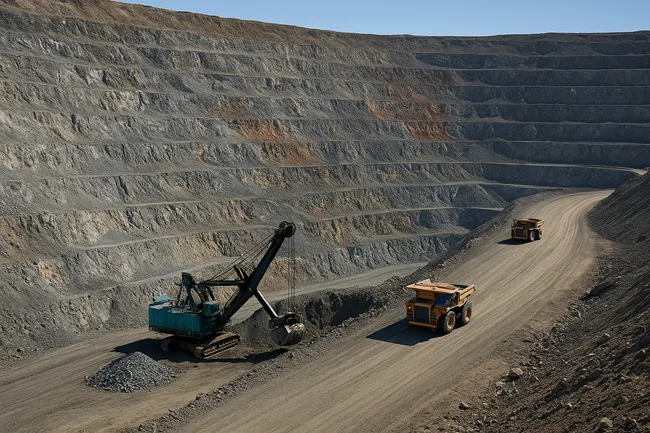
Cokal Limited (ASX: CKA), the Australian-listed metallurgical coal developer, has moved to formalize its strategic infrastructure partnership in Indonesia by executing a binding term sheet with PT Petrindo Jaya Kreasi Tbk. This agreement covers shared facilities and development of the Bumi Barito Mineral (BBM) haul road, a critical transport corridor for metallurgical coal in Central Kalimantan. The deal is an extension of a memorandum of understanding first announced in March 2024, which outlined cooperation on multiple infrastructure assets including roads, ports, and barging facilities.
The BBM mine, in which Cokal holds a 60 percent stake, lies at the center of this arrangement. By deepening its partnership with PT Petrindo, which owns the neighboring Daya Bumindo Karunia (DBK) coal mine, Cokal is positioning itself to accelerate the ramp-up of coal production at BBM and unlock synergies with its other prospective assets in the region such as the TBAR mine. Infrastructure is often the deciding factor in the economic viability of coal projects in Kalimantan, where challenging weather and limited public road access make dedicated haulage routes essential.
How will PT Petrindo’s funding reshape the BBM haul road capacity and structure?
A key feature of the binding term sheet is that PT Petrindo will finance upgrades to the BBM haul road. While the asset will remain solely owned and licensed by PT BBM, the funding will come through a structured prepayment of future toll fees. This means Cokal receives upfront investment support without diluting shareholder equity or ceding control of the road.
The haul road will be upgraded to an all-weather standard, ensuring year-round coal transport despite Kalimantan’s heavy rainfall cycles. Toll fees payable by PT Petrindo will be linked to the Platts SS Coal Free on Board Australia benchmark index, with rates ranging from Rp300 per metric ton per kilometer at coal prices below USD 140 per tonne to Rp900 per metric ton per kilometer at prices above USD 175 per tonne. Importantly, toll revenue will commence once combined coal transport volumes from DBK and BBM reach two million tonnes, or by July 2026, whichever comes first.
This arrangement offers Cokal a predictable revenue stream from infrastructure even before the mines achieve full production. For PT Petrindo, it guarantees reliable access to haulage capacity for DBK mine output at the same toll fee structure, while aligning incentives for both parties to maximize throughput.
What role will PT Petrosea play in the construction and delivery of the haul road upgrades?
To execute the road development works, Cokal and PT Petrindo have jointly appointed PT Petrosea Tbk as the lead contractor. PT Petrosea, listed on the Indonesian Stock Exchange, has a long track record of delivering large-scale mining infrastructure projects. Its involvement provides an additional layer of execution confidence to investors, as the contractor is well-versed in managing complex coal transport and logistics projects in Indonesia.
Construction activities are expected to commence in October 2025. The contract will operate on a cost-plus pricing basis, ensuring transparency in expenditure while maintaining flexibility in project delivery. The collaboration between Cokal, Petrindo, and Petrosea highlights the multi-stakeholder model now driving much of Indonesia’s coal infrastructure development, where ownership, funding, and execution are divided among specialized players.
How does this deal strengthen Cokal’s financial outlook and recurring revenue model?
For Cokal, the agreement is structured in a way that enhances financial sustainability. Instead of raising fresh equity or increasing leverage, the haul road upgrades are funded by future toll fees. This structure allows Cokal to preserve cash while unlocking capital to accelerate mining and infrastructure development.
A 12 percent annual interest fee applies to Petrindo’s investment, but this only comes into effect once the road reaches an actual combined transport capacity of 2.5 million tonnes per annum. Until that milestone, no interest payments are due. This tiered mechanism reduces near-term cash flow strain and allows Cokal to focus on production scale-up.
Crucially, once both parties’ investments have been fully repaid, Cokal will continue to earn toll revenue indefinitely. This creates a long-term infrastructure income stream that runs parallel to mining operations, diversifying cash flow and offering potential resilience in volatile commodity markets. Management has highlighted that this model strengthens the balance sheet while preserving ownership of critical assets, a strategy increasingly favored by resource companies seeking to hedge operational risk.
How is Cokal Limited’s share price reflecting these strategic moves in 2025?
Cokal’s operational progress has not yet translated into stock market momentum. The company’s shares are currently trading at AUD 0.03, near the lower end of their 52-week range between AUD 0.021 and AUD 0.087. The market capitalization sits at AUD 32.37 million, with 1.08 billion shares outstanding. Over the past twelve months, Cokal has lost around 60 percent of its market value, reflecting investor caution toward small-cap resource stocks amid broader market volatility and uncertain coal price trajectories.
Trading volumes remain relatively modest, with recent turnover of just over 562,000 shares. Sentiment is dominated by retail investors, with limited evidence of significant institutional or foreign flows. Analysts point out that while the structural improvements in infrastructure funding are positive, the market is still waiting for proof of execution at the project level before re-rating the stock.
Cokal’s sector ranking is 484 out of 1,069 in basic materials, and its overall Australian Securities Exchange rank is 1,435 out of 2,302, placing it in the lower half of ASX-listed companies by market performance. This underlines the challenges the company faces in building market confidence despite progress on the ground.
Why does coal transport infrastructure remain critical for Indonesia’s export competitiveness?
Coal haul roads in Central Kalimantan are far more than logistical add-ons—they are strategic enablers of production. Without reliable transport infrastructure, even high-quality metallurgical coal reserves remain stranded assets. Indonesia has faced persistent bottlenecks in scaling metallurgical coal exports due to infrastructure limitations, a contrast to thermal coal where established port and transport routes support larger volumes.
By partnering with Petrindo and securing Petrosea as contractor, Cokal is addressing one of the region’s most pressing operational risks: the ability to move coal consistently to jetties and ports for export. With steel demand in Asia remaining robust, particularly from China, India, and Southeast Asia, securing logistics capacity is central to capturing market share. Investors often view such infrastructure agreements as a sign of project seriousness and as a hedge against execution delays that have historically plagued coal juniors in the region.
What indicators will analysts and investors monitor to gauge success in the next phase?
Several factors will determine whether this partnership delivers tangible shareholder value. The commencement of haul road construction in October 2025 will be the first milestone, followed by updates on progress and capacity expansion. Analysts will also watch for clarity on the cost recovery timeline, since toll revenues are linked to throughput and indexed coal prices.
Coal price volatility remains an external factor. Since toll fees are indexed to the Platts SS Coal benchmark, stronger prices could accelerate payback and boost toll income, while weaker pricing could delay revenue collection. Institutional investors are also likely to focus on Cokal’s ability to bring the TBAR mine into development, which would create further economies of scale in infrastructure usage.
Longer term, if Cokal successfully demonstrates reliable production and transport capability, it could attract greater institutional coverage, improve liquidity, and potentially re-rate the stock away from speculative status. Execution will therefore be the critical differentiator between sentiment remaining flat and the stock regaining investor confidence.
What is the forward-looking outlook for Cokal and its Indonesian coal portfolio?
The strategic partnership with PT Petrindo represents more than just a funding solution—it provides a framework for long-term collaboration in infrastructure development. By retaining ownership of the BBM haul road, securing non-dilutive capital support, and establishing a recurring toll-based revenue stream, Cokal has created a foundation for sustainable growth.
Yet, the company faces ongoing challenges. Its share price performance remains weak, institutional flows are limited, and the coal industry itself continues to face scrutiny amid global decarbonization efforts. Even so, metallurgical coal remains a critical raw material for steelmaking, and Indonesia’s deposits are well-positioned to supply Asia’s industrial growth.
If execution timelines are met, particularly the October 2025 start for Petrosea and the July 2026 commencement of toll revenue, Cokal could transform from a speculative junior into a more stable mid-tier producer with infrastructure-backed earnings. For investors, the coming 12 to 24 months will be decisive in determining whether this strategy delivers a turnaround in both operations and market sentiment.
Discover more from Business-News-Today.com
Subscribe to get the latest posts sent to your email.