


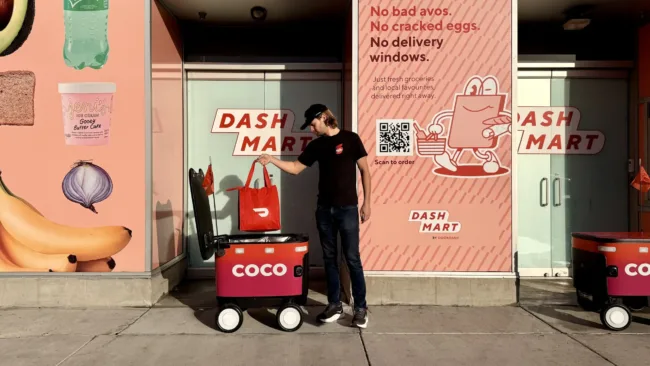
DoorDash, Inc. (NASDAQ: DASH) has expanded its collaboration with Coco Robotics, bringing autonomous delivery to Miami and further scaling its DashMart-focused logistics model across key U.S. urban markets. This expansion builds on a successful rollout in Los Angeles and Chicago, where Coco’s sidewalk delivery robots have already completed over 14,000 grocery and retail deliveries. The Miami deployment marks a new chapter in DoorDash’s multi-modal delivery strategy, which now integrates gig workers, drones, and autonomous robots to meet surging consumer demand for rapid fulfillment and convenience.
The partnership centers around DashMart, DoorDash’s network of delivery-only convenience hubs that stock fresh groceries, local retail items, and essential goods. With the inclusion of Coco’s zero-emission delivery robots, DoorDash is not only expanding its operational footprint but also reaffirming its vision of a technology-enabled logistics infrastructure that can scale cost-efficiently while reducing environmental impact. Coco Robotics, founded in 2020, has rapidly become one of the leading players in urban autonomous delivery. The company has already completed more than 500,000 zero-emission deliveries in the United States and Europe and plans to deploy over 10,000 robots in 2026.
How does this expansion strengthen DoorDash’s DashMart Fulfillment Services for national retailers?
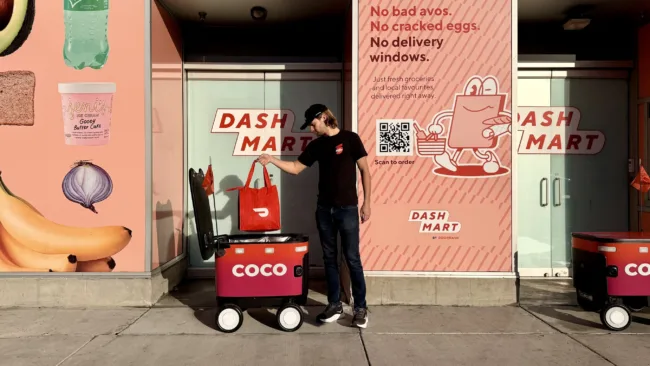
Through the Miami expansion, Coco will support deliveries not just for DashMart-owned inventory, but also for national retailers and grocers utilizing DoorDash’s DashMart Fulfillment Services platform. This white-label model allows third-party brands to use DoorDash’s logistics infrastructure to reach new customers, with Coco’s robots serving as an efficient and sustainable last-mile option in high-density urban zones.
This marks a shift in the model from small-scale pilots to operational integration. Coco’s autonomous robots are being used not only to complete DashMart deliveries but also to power DoorDash’s broader fulfillment-as-a-service strategy. This gives retailers and grocers an off-the-shelf logistics solution to scale delivery without investing in their own infrastructure.
What operational advantages does autonomous delivery offer DoorDash in dense urban markets like Miami?
The move comes as DoorDash continues to diversify its fulfillment architecture. Over the past year, the company has made major strides in integrating autonomous systems across its delivery operations. DoorDash Labs, the innovation arm of DoorDash, has been leading efforts to prototype and deploy autonomous solutions that lower delivery costs, reduce traffic congestion, and shorten fulfillment windows. The rollout of Coco robots in Miami is a direct result of those R&D efforts, according to Harrison Shih, Head of Product at DoorDash Labs, who noted that the company’s goal is to expand access to fast, low-friction delivery options for both consumers and merchants.
In a statement, Coco Robotics co-founder and Chief Executive Officer Zach Rash described the Miami expansion as a response to growing urban demand for automation. He added that autonomous delivery is becoming essential for managing rising order volumes across diverse product categories, including groceries, restaurant meals, and household items. Coco’s robots are designed for low-speed, sidewalk-based delivery, which allows them to operate legally and safely within most municipal frameworks. The platform leverages proprietary hardware and artificial intelligence to navigate urban environments and complete deliveries without human intervention.
How does the DoorDash–Coco model support cost control and environmental goals at scale?
DoorDash is leveraging this partnership not only to improve delivery speed, but also to optimize its unit economics. In dense metro areas like Miami, where driver costs and traffic congestion remain persistent challenges, autonomous robots offer a viable alternative for short-distance deliveries. DoorDash executives see this as an important step in future-proofing their logistics network, particularly as consumers expect faster, lower-cost options for same-day or even same-hour delivery.
The broader industry has taken note of this shift. DoorDash’s competitors, including Uber Technologies, Inc., Amazon.com, Inc., and Instacart, have all announced pilots or investments in autonomous delivery systems. However, most of these efforts remain in early stages, with limited real-world deployment. Coco’s ability to scale robot operations in live environments, coupled with DoorDash’s expansive platform, gives this partnership a first-mover advantage in the urban autonomy space.
This expansion also positions DoorDash to further reduce its carbon footprint. Coco Robotics’ entire delivery model is based on zero-emission electric vehicles, aligning with broader sustainability goals that are becoming increasingly relevant for both investors and regulators. The capital-efficient nature of Coco’s approach means that each deployment adds incremental value without requiring significant infrastructure overhaul. That scalability is essential as DoorDash looks to strengthen its margins amid competitive pricing pressure in the on-demand delivery sector.
What performance milestones and pilot data convinced DoorDash to scale Coco’s robot fleet?
The partnership’s success hinges on maintaining performance and reliability at scale. In earlier pilot deployments across Los Angeles and Chicago, Coco’s robots reportedly completed thousands of deliveries with minimal incident. DoorDash now appears confident that those results can be replicated in Miami’s urban grid. The inclusion of high-volume DashMart Fulfillment Services clients is a signal that the companies are preparing for a broader commercial rollout.
DoorDash’s stock has shown resilience in recent months, buoyed by improved margins, growth in its international operations, and investor confidence in its platform strategy. Analysts covering DoorDash believe that autonomous delivery could enhance long-term profitability, particularly if operating costs can be lowered by replacing or supplementing human labor in dense markets. While widespread robot deployment remains constrained by regulation in some cities, investor sentiment is generally positive around DoorDash’s disciplined, data-driven approach to automation.
How is Coco Robotics positioning itself as a category leader in urban delivery automation?
From a technology perspective, Coco’s sidewalk delivery robots represent a different paradigm than drone-based systems or vehicle-based autonomous vans. Their low speed and small footprint reduce the regulatory hurdles typically associated with driverless transport. That makes them more compatible with current city infrastructure and local rules, allowing for faster deployment and fewer compliance challenges.
The integration of Coco’s robots into DashMart’s retail and grocery fulfillment ecosystem is also expected to benefit small and mid-sized merchants. By outsourcing delivery to a platform that includes automated options, retailers can reach new customers without investing in logistics capabilities of their own. This is particularly relevant in the grocery sector, where delivery costs can erode margins. DashMart Fulfillment Services, powered in part by Coco, provides a turnkey alternative.
What is the long-term outlook for DoorDash’s multi-modal logistics infrastructure strategy?
Looking ahead, DoorDash is likely to expand this model to additional cities, particularly those with dense urban cores and favorable regulatory environments. Miami serves as a proving ground not just for Coco’s hardware, but for DoorDash’s ability to orchestrate a seamless, multi-modal delivery operation. If successful, this deployment could pave the way for broader automation across the entire DashMart and DoorDash platform.
DoorDash’s roadmap increasingly reflects an infrastructure play rather than a pure marketplace model. The integration of AI, robotics, and fulfillment hubs suggests a pivot toward becoming a vertically integrated logistics provider. Coco Robotics, for its part, is rapidly emerging as a foundational partner in that vision, offering scalable autonomy that complements DoorDash’s human and drone delivery layers.
The success of the Miami rollout will be closely watched by industry analysts, regulators, and investors alike. With over 10,000 robot units projected for deployment in 2026, Coco Robotics is positioning itself as a central player in the future of last-mile logistics. For DoorDash, the move underscores a continued commitment to innovation, efficiency, and differentiated customer experience in an increasingly competitive delivery market.
What are the key takeaways from DoorDash’s expanded partnership with Coco Robotics in Miami?
- DoorDash, Inc. has expanded its autonomous delivery partnership with Coco Robotics to include the Miami market, following earlier pilots in Los Angeles and Chicago.
- Coco’s sidewalk delivery robots will now handle select deliveries from DashMart, DoorDash’s delivery-only convenience hub that stocks groceries, retail products, and household essentials.
- The rollout includes DashMart Fulfillment Services, allowing national grocers and retail brands to access autonomous last-mile delivery via DoorDash’s infrastructure.
- Over 14,000 deliveries were completed during the initial pilot phases, demonstrating strong performance and consumer satisfaction in high-density urban areas.
- DoorDash aims to use autonomous systems alongside human Dashers and drones as part of a larger multi-modal logistics strategy to improve delivery speed, cut emissions, and lower operational costs.
- Coco Robotics, which has completed over 500,000 zero-emission deliveries globally, plans to deploy more than 10,000 delivery robots in 2026.
- The expansion supports DoorDash’s efforts to build a vertically integrated, scalable logistics infrastructure focused on sustainability and cost-efficiency.
- Analysts view the partnership as a forward-looking move that may improve margins and reinforce DoorDash’s competitive edge in the last-mile delivery sector.
- Regulatory-friendly sidewalk delivery robots provide Coco with a speed-to-scale advantage over drone and vehicle-based systems in complex urban environments.
- Institutional sentiment around DoorDash remains cautiously positive as it continues to invest in automation and diversify its delivery capabilities.
Discover more from Business-News-Today.com
Subscribe to get the latest posts sent to your email.