Why the Centre moved against Sonam Wangchuk’s SECMOL amid charges of financial irregularities and violent unrest
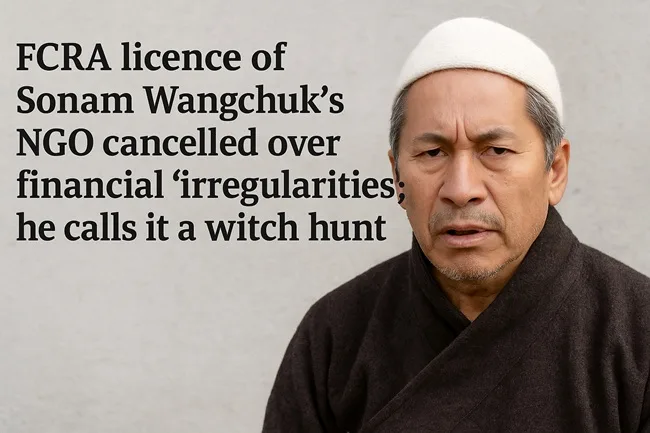
The Ministry of Home Affairs has cancelled the Foreign Contribution Regulation Act (FCRA) licence of the Students’ Educational and Cultural Movement of Ladakh (SECMOL), the well-known organisation founded by educator and climate activist Sonam Wangchuk. The decision, announced this week, cites repeated violations of the FCRA, including alleged financial irregularities, improper deposits into the designated foreign funding account and the use of funds in ways the government claims contravened national interest.
The timing of the move has intensified political debate, coming just after violent clashes in Leh left four people dead and dozens injured. Wangchuk, who has emerged as the most prominent voice calling for Ladakh’s inclusion under the Sixth Schedule and greater statehood protections, responded defiantly, describing the cancellation as a witch hunt aimed at silencing him.
What reasons did the government give for cancelling the FCRA licence?
In its order, the Home Ministry laid out several alleged irregularities in SECMOL’s financial operations. A central point was the deposit of around ₹3.5 lakh in the organisation’s FCRA account during the 2021–22 financial year. SECMOL explained that the sum represented the sale proceeds of an old bus originally bought using FCRA funds. However, officials argued that depositing this money in cash was a breach of section 17 of the FCRA, which requires strict reporting and channelled transactions.
Authorities also flagged a foreign donation of approximately ₹4.93 lakh received from Sweden for youth awareness programmes covering issues such as climate change, migration, sovereignty and organic farming. The ministry determined these activities to be inconsistent with the conditions for permissible use of foreign contributions, ruling them against “national interest.”
In addition, local contributions amounting to nearly ₹54,600 were reportedly deposited into the same FCRA account. Regulators said this mixed accounting practice was a violation of section 17, which explicitly prohibits the mingling of domestic funds with foreign contributions. Furthermore, some transactions were allegedly missing from SECMOL’s FCRA return filings, raising red flags about compliance with sections 18 and 19 of the Act.
How did the compliance process unfold before the cancellation order?
The ministry issued a show-cause notice to SECMOL on August 20 this year, asking the organisation to clarify the discrepancies. When no response was received by the stipulated date, a reminder was sent on September 10. Wangchuk’s organisation eventually submitted its explanation on September 19, defending its accounting practices and maintaining that no misuse of funds had taken place.
Despite this, officials deemed the responses unsatisfactory. The cancellation order cited Section 14 of the FCRA, which empowers the government to revoke licences in cases of persistent or serious contraventions. With the licence now revoked, SECMOL is barred from receiving or utilising any foreign funds, cutting off a significant avenue of support for its activities in Ladakh.
Why does the cancellation matter for Ladakh’s socio-political climate?
The revocation is not happening in isolation. Ladakh has been in ferment, with large-scale demonstrations demanding Sixth Schedule protections and full statehood. The recent violence in Leh, where protesters clashed with police and stormed the local BJP office, underscores the intensity of discontent. In this environment, action against SECMOL carries symbolic weight: it targets the organisation founded by the figurehead of the region’s protest movement.
Critics argue the government’s decision reflects an effort to weaken Wangchuk’s influence just as his campaign is gaining momentum. Supporters of the administration counter that compliance with the FCRA is non-negotiable, and NGOs, no matter how celebrated, must operate within the law.
What has been Sonam Wangchuk’s reaction to the licence cancellation?
Wangchuk has accused the government of targeting him for political reasons, linking the move directly to his activism. In his response, he said that the authorities were engaging in a “witch hunt” and that his NGO had long worked towards self-sufficiency rather than dependency on foreign donations. He emphasised that shutting down SECMOL’s foreign funding channel would not silence him or deter the wider movement in Ladakh.
He also warned the government that arresting or jailing him could backfire by fuelling further unrest. His comments reflect his belief that civil society movements cannot be curtailed through financial restrictions alone. The tone of his reaction suggests that he intends to continue pressing for Ladakh’s rights regardless of institutional pressures.
How does this case connect to wider scrutiny of Wangchuk’s initiatives?
This is not the first time Wangchuk’s ventures have come under the scanner. The Central Bureau of Investigation (CBI) has already launched a probe into alleged FCRA violations at the Himalayan Institute of Alternatives Ladakh (HIAL), another organisation he established to pioneer innovative educational and environmental solutions in the region. Investigators are examining whether the institute’s use of foreign contributions aligns with statutory requirements.
The dual scrutiny of SECMOL and HIAL suggests a broader tightening of regulatory oversight over NGOs associated with Wangchuk. For activists and NGOs across India, it also signals the risks of regulatory clampdowns when their work intersects with sensitive political demands.
Why is the FCRA so central to India’s regulatory landscape?
The Foreign Contribution Regulation Act, first enacted in 1976 and amended in 2010 and 2020, governs how NGOs and other entities in India receive and use foreign donations. The law requires registration, stringent reporting and the maintenance of separate accounts exclusively for foreign contributions. It prohibits using funds for activities deemed detrimental to national interest and bars the commingling of local and foreign funds.
Successive governments have tightened the FCRA, citing the need to prevent money laundering, terror financing and foreign interference in domestic politics. However, activists argue that the law has increasingly been used to stifle dissent and restrict the operational space of NGOs engaged in rights-based advocacy. Well-known organisations such as Greenpeace India, Amnesty International India and Oxfam India have all faced FCRA challenges in the past decade. SECMOL now joins this list of high-profile entities to lose their licences.
How does the cancellation of SECMOL’s FCRA licence reshape the space for civil society and influence institutional sentiment in India?
From the perspective of civil society, the cancellation is a significant setback. NGOs in remote and challenging geographies such as Ladakh often rely on international networks for funding, expertise and project support. Blocking this channel could reduce the scale and effectiveness of initiatives focused on education, climate adaptation and community development.
Institutional sentiment reflects a polarisation. Pro-government voices, including segments of the bureaucracy, stress the importance of rule-based governance and argue that irregularities cannot be overlooked merely because of public stature. On the other hand, opposition parties and activist groups see the cancellation as part of a broader pattern of shrinking democratic space. They point to the timing, immediately after violent protests, as evidence that enforcement has been weaponised to target a political opponent.
For investors and policy analysts, the event highlights the rising unpredictability of India’s regulatory environment for non-profit and developmental organisations. While corporate FDI flows remain robust, restrictions on NGOs may complicate India’s soft power narratives around sustainability and grassroots empowerment.
Could this case affect Ladakh’s movement for constitutional safeguards?
The cancellation is likely to embolden both sides of the Ladakh debate. The government can argue that it is acting decisively to uphold financial integrity and law and order. Wangchuk and his supporters, however, may see this as proof of state repression, strengthening their claim that Ladakhis need stronger constitutional protections.
The next steps could include legal appeals by SECMOL, continued street mobilisation by protesters and heightened national attention on the region’s governance. If the unrest spreads or intensifies, the Centre could face pressure to revisit its approach to both political demands and civil society engagement.
How does the cancellation of SECMOL’s FCRA licence reflect the broader tension between regulation, activism, and dissent in India?
The cancellation of SECMOL’s FCRA licence is both a legal and political moment. On the surface, it reflects alleged financial non-compliance. But in the broader context, it underscores the fraught relationship between the Indian state and activist organisations operating at the intersection of governance, identity and rights.
For Wangchuk, the immediate challenge will be sustaining his movement without the foreign funds his NGO can no longer receive. For the government, the challenge will be convincing citizens that the action was a matter of law, not an attempt to muzzle dissent. For observers, the episode is another reminder of how financial regulation has become one of the most effective levers in managing India’s contentious civil society space.
Discover more from Business-News-Today.com
Subscribe to get the latest posts sent to your email.