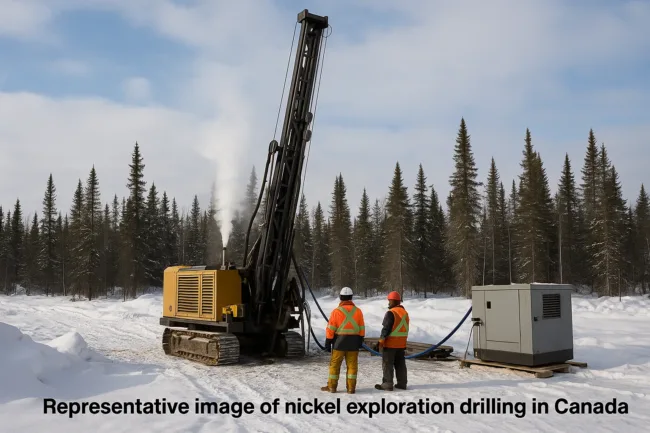
Canada Nickel Company Inc. (TSXV: CNC) (OTCQX: CNIKF), a developer focused on next-generation nickel-sulphide projects for electric vehicles and stainless steel markets, reported significant new drill results from its 2025 campaign at the MacDiarmid property, part of its Timmins Nickel District portfolio in Ontario. The latest assays from the central portion of the MacDiarmid ultramafic body confirm consistent mineralization, including intercepts such as 0.25% nickel over 363 metres in hole MAC25-09. These results support the firm’s strategy to establish multiple high-grade resources in proximity to its flagship Crawford project.
The new results build on prior work from 2021 and 2022 and precede the upcoming July 14 kickoff of a new exploration phase at the Midlothian property. In addition, Canada Nickel expects to publish resource estimates for its Mann Central and Texmont properties in the same week—bringing its total district-wide resource count to five. With three more resource estimates anticipated by year-end, the Canadian exploration firm aims to further solidify its claim to scale across the prolific Timmins district.
What are the most significant assay results from the 2025 drilling campaign at Canada Nickel’s MacDiarmid site?
The winter 2025 drilling campaign at the MacDiarmid property yielded multiple high-grade intercepts of nickel sulphide mineralization across five drillholes. Canada Nickel focused this program on the central portion of the arcuate-shaped ultramafic body, targeting strike and width extensions beyond its earlier delineated zones.

Hole MAC25-09 recorded a standout intercept of 0.25% nickel over 363 metres, while hole MAC25-11 revealed 254 metres at 0.27% nickel. Similarly, MAC25-08 intersected 232 metres at 0.26% nickel, highlighting mineral continuity along a 2,200-metre strike and a 400-metre width. Disseminated pentlandite and heazlewoodite were the dominant nickel-bearing minerals found within serpentinized dunite and minor peridotite sections.
Other mineralization of note included platinum and palladium values between 0.003 and 0.015 g/t, alongside cobalt averaging 0.01%. The exploration team also noted sulphur concentrations as high as 3.6% in MAC25-10, suggesting sulphide-enriched zones near structural faults. The presence of layered metasedimentary rocks and felsic volcanics in some holes, such as MAC25-06 and MAC25-10, opens new exploration vectors that will be revisited in fall 2025.
How does the MacDiarmid property fit within Canada Nickel’s broader Timmins Nickel District strategy?
Located 23 kilometres southwest of the Crawford project and 27 kilometres northwest of Timmins, the MacDiarmid property is a key satellite deposit within Canada Nickel’s integrated strategy to control multiple nickel-cobalt sulphide resources in the district. Measuring approximately three kilometres in strike length and up to 600 metres in width, the MacDiarmid target is comparable in scale to Crawford’s Main Zone.
According to Canada Nickel’s chief executive Mark Selby, the consistent drilling success at MacDiarmid strengthens the company’s regional thesis. With exploration efforts now supported by recently completed financing, the firm is moving ahead to activate further resource delineation at Midlothian and other prospective sites across the district.
Analysts monitoring nickel exploration trends in Canada interpret the MacDiarmid campaign as part of a broader race to establish Tier-1 nickel assets that can support the electric vehicle supply chain. MacDiarmid’s grade and scale, when combined with Crawford’s established potential, suggest Canada Nickel is well-positioned to benefit from institutional demand for low-political-risk nickel assets.
What new exploration programs and resource updates has Canada Nickel announced beyond MacDiarmid?
Canada Nickel’s next drilling initiative will commence on July 14 at its Midlothian property. This will coincide with the publication of maiden mineral resource estimates for two additional projects—Mann Central and Texmont—bringing its total number of defined resources in the Timmins Nickel District to five. By the end of 2025, the exploration company aims to publish resource updates for three more assets, culminating in nine total district resources including the flagship Crawford project.
This accelerated schedule underscores the firm’s commitment to showcasing the full scope of its nickel sulphide portfolio. Institutional sentiment around these moves has been constructive, particularly among investors seeking exposure to low-emissions battery metals. Canada Nickel has trademarked the terms NetZero Nickel™, NetZero Cobalt™, and NetZero Iron™, signalling a long-term strategy to deliver carbon-neutral critical minerals.
Future exploration will also target fault and EM (electromagnetic) anomalies identified during the 2025 MacDiarmid campaign. In particular, MAC25-10’s intersection of sulphide-rich felsic volcanics near a fault zone presents an attractive target for follow-up work later this year.
What are the metallurgical and geochemical highlights of the MacDiarmid drill program?
Geochemical assays from the 2025 campaign confirm a consistent nickel grade around 0.25% across substantial intervals, with localized enrichments above 0.30%. Cobalt levels remained stable at 0.01%, while palladium and platinum levels were detectable in most holes. Chromium and iron content varied between 0.3–0.5% and 5–8%, respectively, depending on lithology. Sulphur levels ranged widely, with values peaking at 3.6% in deeper sections of MAC25-10, correlating with increased sulphide mineralization.
Quality assurance was conducted under the supervision of Edwin Escarraga, P.Geo., with samples analyzed at accredited labs Actlabs Timmins and SGS Burnaby. Fire Assay was employed for precious metals, while nickel, cobalt, sulphur, and base metals were analyzed using peroxide fusion and ICP-OES. Canada Nickel employed rigorous QA/QC protocols with standards and blanks inserted at a rate of 3 per 20 core samples.
These data-rich results reinforce confidence in MacDiarmid’s bulk-tonnage potential and its alignment with Canada Nickel’s ambitions to deliver large-scale nickel supply to global markets.
How does institutional sentiment reflect the evolving value proposition of Canada Nickel’s Timmins portfolio?
Institutional sentiment toward Canada Nickel Company remains largely positive, driven by the consistency of its exploration results, the scale of its land package, and the strategic importance of its nickel sulphide resources. Investors are encouraged by the company’s ability to convert exploration momentum into tangible resource delineation, as seen with Crawford and now MacDiarmid.
Canada Nickel’s proximity to established mining infrastructure in Timmins and its carbon-neutral ambitions resonate with ESG-oriented funds and long-term metals investors. The company’s strategic pacing—publishing up to four new resource estimates in 2025 alone—has increased visibility within the critical minerals investment landscape.
Furthermore, the firm’s multipronged resource development, spanning MacDiarmid, Midlothian, Mann Central, and Texmont, presents a district-scale vision that aligns with market demands for low-carbon, geopolitically stable nickel production.
What is the forward-looking development outlook for Canada Nickel and the Timmins Nickel District?
Looking ahead, analysts expect Canada Nickel to deepen its project pipeline through additional resource updates and ongoing drill campaigns. The upcoming Midlothian program is anticipated to reveal further ultramafic mineralization, while fall follow-ups at MacDiarmid may confirm fault-hosted sulphide systems that could open higher-grade zones.
By year-end 2025, Canada Nickel aims to release three more resource estimates, pushing its total to nine and solidifying its footprint as one of the most resource-rich nickel players in the region. This strategy is complemented by its ambition to become a zero-carbon metals producer, further distinguishing its assets in the global marketplace.
Institutional investors are likely to monitor Canada Nickel’s ability to transition from exploration to development, particularly in light of the surging demand for battery-grade nickel and the tightening global supply of class-1 nickel.
Discover more from Business-News-Today.com
Subscribe to get the latest posts sent to your email.