

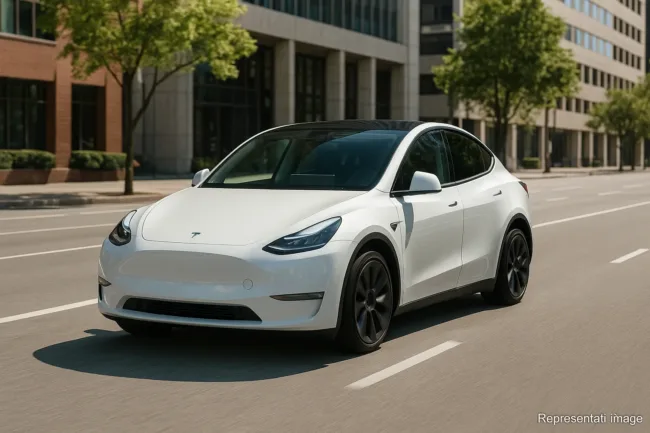
Tesla, Inc. (NASDAQ: TSLA) has postponed the rollout of its highly anticipated Full Self-Driving version 14, or FSD v14, to Monday, October 6, 2025, after a last-minute software bug was discovered just before deployment. Chief Executive Officer Elon Musk confirmed the short delay on X, explaining that the brief pause gives the company’s Autopilot and AI teams extra time to make final adjustments and add new features.
The announcement, though brief, has stirred fresh discussion among investors, engineers, and regulators about Tesla’s readiness to deploy major autonomy upgrades at scale. While the delay is measured in days rather than months, the fact that a final-stage bug could halt rollout highlights the complexity of Tesla’s software-defined vehicle strategy and the razor-thin margin for error that surrounds autonomous systems.
Why did Tesla delay FSD v14, and what does this reveal about its engineering process?
Tesla’s reason for the postponement was straightforward: a “last-minute bug” appeared in the final testing phase, forcing engineers to revise the build and re-validate safety metrics before pushing it to the public. Such bugs, though not uncommon, can have disproportionate implications in systems that depend on artificial intelligence and real-time perception.

Each new FSD iteration increases in size and sophistication. Musk has previously said that version 14’s neural network would contain roughly ten times the number of parameters compared with its predecessor. That expansion raises both expectations and risk. Adding to the complexity is Tesla’s commitment to end-to-end neural architecture—meaning even small code issues can ripple across perception, planning, and control subsystems.
The company’s decision to delay instead of patch later suggests a maturing engineering culture that now values stability as much as speed. While Tesla has long prided itself on rapid over-the-air updates, the FSD 14 postponement signals a slightly more cautious approach, likely shaped by years of regulatory scrutiny and the need to demonstrate consistent safety performance across millions of miles of autonomous driving data.
What will FSD v14 bring, and who will get it first?
Although Tesla has not published official release notes, earlier internal references and Musk’s comments indicate that FSD v14 is one of the most substantial leaps in Tesla’s autonomy roadmap. The update is expected to improve navigation in dense urban environments, reduce the frequency of steering prompts, and enable smoother cornering behavior in complex intersections.
The release will initially be available only to vehicles equipped with Hardware 4—the latest version of Tesla’s AI computer and camera suite. Older cars running Hardware 3 will continue on the v12 branch, meaning a significant portion of the fleet will not yet benefit from this update. That selective availability could influence upgrade cycles, with owners of older vehicles weighing the cost of hardware retrofits or new car purchases.
Tesla is also expected to follow up quickly with sub-versions 14.1 and 14.2, which Musk hinted will enhance what he described as “almost sentient” driving behavior. Whether this is marketing language or a reflection of true qualitative improvement remains to be seen, but the framing indicates Tesla’s confidence in the scale of the upgrade.
How does this delay affect Tesla’s stock and investor sentiment?
Tesla’s share price has long been tied to its perceived technological edge. Even small changes in FSD timelines tend to move the market. The latest postponement pushed Tesla’s stock down roughly 2.4 percent to around 429.83 USD after recently trading near 470 USD. Investors appear to have priced in high expectations for early-October autonomy progress, and any delay—however brief—triggered short-term corrections.
Institutional analysts view the delay as a near-term sentiment event rather than a structural concern. Fund managers tracking autonomy-driven growth themes remain focused on metrics such as active FSD subscriptions, vehicle hardware penetration, and monthly recurring software revenue. If FSD v14 meets its performance promises, Tesla could offset the delay with stronger medium-term confidence.
Foreign institutional investors and domestic mutual funds have been active in Tesla’s stock through the summer, taking advantage of delivery strength and U.S. tax-credit dynamics. Retail participation, however, remains cautious, with many investors waiting for tangible data on how much safer or smoother FSD v14 really is. The next few weeks will therefore shape whether the delay becomes a forgotten footnote or a minor trust deficit in Tesla’s innovation narrative.
What does this mean for the broader autonomous-driving industry?
Tesla’s postponement reflects challenges shared across the global autonomous-driving ecosystem. Every company developing driver-assist or self-driving capabilities, from Waymo and Cruise in the United States to Baidu Apollo in China, grapples with late-stage technical bugs, data drift, and unpredictable real-world behavior.
For Tesla, the difference lies in visibility. Each setback is magnified by the company’s public-first development model, where millions of customer vehicles effectively act as rolling beta testers. The upside of that approach is accelerated data gathering; the downside is reputational volatility whenever schedules shift.
Competitors will likely use this moment to stress their own focus on safety and predictability. Waymo’s robotaxi services, Cruise’s supervised driving resumption, and Mobileye’s cautious rollout of SuperVision systems all emphasize incremental expansion rather than sweeping public releases. Tesla’s all-in strategy continues to set it apart, but also invites a higher burden of proof.
The delay could also inform regulatory sentiment. Transportation agencies in North America and Europe have already sought more visibility into Tesla’s driver-monitoring protocols and intervention data. A transparent, bug-related delay may bolster Tesla’s case that it prioritizes safety, but regulators will be watching closely when v14 finally deploys at scale.
How does this fit into Tesla’s long-term autonomy and revenue strategy?
Autonomy remains the core of Tesla’s long-term valuation story. The company projects that its FSD software could eventually underpin a robotaxi network generating recurring revenue per mile driven. Achieving that vision requires flawless performance across billions of real-world scenarios—a bar no automaker has yet cleared.
FSD version 14 represents the next major step toward that goal, integrating the company’s latest Dojo-trained neural nets and more granular behavior prediction. It also deepens Tesla’s reliance on AI-specific compute, further tying its hardware roadmap to its software ambitions. The delay may slow momentum slightly, but it also allows the company to ensure that its most sophisticated release yet meets internal reliability thresholds before public exposure.
Financially, even incremental FSD adoption carries weight. At 12,000 USD per license or 99 USD per month for subscriptions, improved reliability could boost Tesla’s software revenue mix. Analysts estimate that each percentage-point increase in global FSD uptake adds several hundred million dollars annually in high-margin income. Investors will thus watch whether v14 converts more users into paying subscribers, offsetting concerns about production cyclicality.
Why short delays like this can actually strengthen long-term credibility
From an engineering perspective, postponements often help a company maintain credibility rather than erode it. Tesla has faced criticism in the past for aggressive software promises, but delaying to resolve a critical issue signals discipline. With regulators increasingly focused on safety validation frameworks, launching an imperfect update would have invited greater scrutiny and potential liability.
The psychological effect on investors is nuanced. While short-term traders may interpret delays as missed milestones, long-term shareholders often see them as maturity signals—evidence that Tesla’s leadership understands the importance of reliability over hype. If the Monday rollout proceeds smoothly, this decision could strengthen trust among both customers and institutions.
What happens next: milestones, monitoring, and regulatory watchpoints
Once the rollout resumes, the key metric will be real-world performance. Tesla will likely deploy the update in batches, starting with internal and early-access testers before wider distribution. Analysts will track driver intervention rates, system disengagements, and customer feedback across diverse environments.
Regulators may also request post-release safety summaries, particularly in the United States, where agencies are studying how human supervision interacts with semi-autonomous systems. The results will determine whether Tesla can sustain its lead against increasingly well-funded rivals.
Meanwhile, Musk’s own communication cadence will play a role in shaping sentiment. Frequent, transparent updates about performance data could reassure investors that the delay was justified. If silence prevails or issues persist, critics will point to over-reliance on marketing momentum rather than engineering stability.
Tesla’s FSD v14 delay shows that perfection, not speed, drives the next phase of autonomy
Tesla’s decision to delay FSD v14 is less about a missed date and more about a maturing approach to risk. In an industry where perception errors can cost lives and headlines, the willingness to pause reflects an evolution in Tesla’s culture—from relentless iteration toward measured refinement.
The next few weeks will test whether that patience pays off. If the rollout delivers demonstrably safer, smoother, and more human-like driving, Tesla could reassert its dominance and validate the patience of long-term investors. But if recurring bugs or regulatory pushback follow, the episode will reinforce how challenging autonomy remains even for the most advanced players.
Either way, this moment underscores one truth: in the race toward full self-driving, speed wins attention, but stability earns trust. And trust is what will ultimately decide which companies define the future of mobility.
Share this:
Discover more from Business-News-Today.com
Subscribe to get the latest posts sent to your email.