





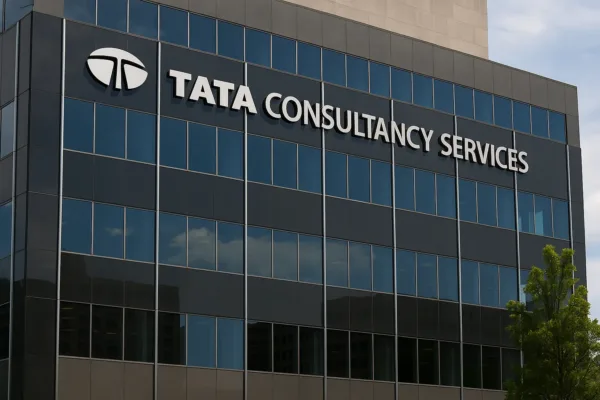
Tata Consultancy Services Limited (BSE: 532540, NSE: TCS) is no longer positioning itself as just another Indian IT services powerhouse. In its Q2 FY26 results, the company signaled something far more ambitious: a measured but unmistakable pivot toward becoming the world’s first AI-native IT consulting giant. While the headline numbers offer comfort to investors, it is the underlying strategic intent—anchored in datacenter expansion, AI talent development, and sovereign cloud partnerships—that hints at a deeper transformation underway.
The Mumbai-headquartered firm has already declared its objective to become the largest AI-led technology services company in the world. And in a quarter marked by consistent operating performance, a $10 billion deal haul, and broad vertical growth, it is increasingly clear that Tata Consultancy Services is shifting from legacy system integrator to full-stack AI enabler across continents.
Why is Tata Consultancy Services leaning so heavily into AI infrastructure, and how is it executing this pivot?
Tata Consultancy Services has put infrastructure at the center of its AI-first evolution. The company announced plans to launch a 1-gigawatt AI datacenter business in India, designed to support future enterprise workloads in generative AI, LLM training, and autonomous platforms. Unlike pilot experiments or client-specific sandboxes, this is a capacity move on hyperscaler terms.
But this infrastructure play is not standalone. The company is integrating its workforce into the AI vision. Over 275,000 employees participated in what Tata Consultancy Services described as the world’s largest internal AI Hackathon, designed to build competencies across prompt engineering, AI Ops, and AI/ML model governance. A new business entity—the AI and Services Transformation unit—has been created to consolidate delivery, consulting, and client co-innovation under a unified AI-native framework.
This approach reflects a strategic shift. Rather than treating AI as an add-on service or cross-sell feature, Tata Consultancy Services is embedding AI as the operating spine of its consulting, platform, and delivery stack.
How did Tata Consultancy Services perform financially in Q2 FY26, and what segments supported growth?
For the quarter ending September 30, 2025, Tata Consultancy Services reported consolidated revenue of ₹65,799 crore, up 3.7 percent sequentially and 0.8 percent in constant currency terms. Net income stood at ₹12,904 crore, an 8.4 percent increase year-on-year, yielding a robust net margin of 19.6 percent. The company’s operating margin rose by 70 basis points sequentially to 25.2 percent, a metric that investors closely watch as a sign of delivery discipline and cost efficiency.
Cash flow from operations was strong at over 110 percent of net income, reinforcing the company’s financial resilience. The board declared a dividend of ₹11 per share, with a record date of October 15, 2025, and payout scheduled for November 4.
From a segmental perspective, the Life Sciences and Healthcare vertical delivered the strongest sequential growth at 3.4 percent in constant currency, followed by Technology and Services at 1.8 percent, BFSI at 1.1 percent, and Manufacturing at 1.6 percent. Regionally, North America contributed 48.8 percent of total revenue, while Continental Europe showed signs of recovery with 1.4 percent sequential growth. India delivered the highest sequential gain at 4 percent but still lagged year-on-year due to earlier project delays and sector-specific headwinds.
What client contracts are driving this transformation, and how is Tata Consultancy Services repositioning itself in key markets?
Tata Consultancy Services reported a total contract value of $10 billion for Q2 FY26, with multiple marquee wins reflecting strong demand for AI-led transformation. The company signed a seven-year, $647 million contract with Tryg, a leading Scandinavian insurer, to replatform operations across Denmark, Sweden, and Norway. The scope includes standardization, modernization, and cloud-native digital core development.
In the healthcare space, Tata Consultancy Services secured a multi-hundred-million-dollar engagement with a global healthcare conglomerate, focused on value-based care, pharmacy services, digital CX, and AI-powered data management. In retail, the firm deepened its relationship with ALDI SOUTH, delivering cloud operations transformation across geographies.
In Asia, Tata Consultancy Services announced a digital sovereignty partnership with NOW Corporation in the Philippines to co-develop national AI infrastructure and citizen-centric public services. In India, the company enabled ICICI Lombard to achieve a fully automated AWS multi-region disaster recovery switchover—placing it among the country’s first insurers with such resilience.
Other strategic client partnerships this quarter included Kesko in Finland, Weatherford International in North America, The Warehouse Group in New Zealand, and a leading Australian bank—all of which prioritized AI, cloud, and data observability as core transformation themes.
What institutional sentiment is emerging around Tata Consultancy Services, and how are investors responding?
Institutional investors and analysts appear largely aligned in their assessment of Tata Consultancy Services’ evolving strategy. While global IT spend moderation and cautious client budgets remain concerns, the company’s ability to expand margins while growing its contract base is being seen as a sign of strong operational execution.
Analysts point to the consistency of foreign institutional investor inflows, supported by the company’s robust dividend policy, clean balance sheet, and high return on invested capital. Domestic institutional investors also remain engaged, with several large mutual funds reportedly maintaining their exposure or marginally increasing it.
Sell-side research notes that Tata Consultancy Services’ steady deal conversion and infrastructure focus position it ahead of the curve relative to mid-tier IT services firms that are more exposed to discretionary budgets. Buy or Hold ratings dominate the institutional landscape, with analysts watching the datacenter buildout and AI services pipeline as key triggers for future valuation re-rating.
How does the acquisition of ListEngage fit into TCS’ broader martech and Salesforce strategy?
Tata Consultancy Services announced the acquisition of U.S.-based ListEngage, a Salesforce Marketing Cloud partner, in a move that adds depth to its enterprise marketing transformation capabilities. While financial terms were not disclosed, the acquisition brings with it significant implementation and personalization expertise for Salesforce’s generative AI-powered stack, including Data Cloud and Einstein GPT.
This deal aligns with the company’s objective to build verticalized transformation offerings that blend CX, martech, and AI orchestration. With Salesforce pushing deeper into generative content and customer experience automation, ListEngage enhances Tata Consultancy Services’ ability to deliver full-stack enterprise campaigns in the U.S. market.
It also reflects a broader strategy to selectively acquire capability-focused boutiques that accelerate delivery in high-demand domains such as insurance, retail, and healthcare.
What does the push toward sovereign AI platforms and datacenters reveal about long-term strategy?
Tata Consultancy Services is not only transforming enterprises—it is also working with governments and national infrastructure bodies to reshape how AI and cloud are deployed. In Q2 FY26, the firm signed a memorandum of understanding with the Centre for Development of Advanced Computing to co-develop sovereign cloud platforms that support AI workloads and comply with India’s data localization mandates.
Internationally, its partnership with NOW Corporation in the Philippines seeks to establish a national AI infrastructure aligned with digital sovereignty goals. These partnerships are long-cycle in nature, potentially giving Tata Consultancy Services a strategic role in how countries build digital public goods and defend against data-centric threats.
The company’s planned 1-gigawatt AI datacenter is a differentiator. It offers Tata Consultancy Services a dual advantage—building its own delivery backbone and offering AI compute capacity to clients who may not want to rely on U.S. hyperscalers due to regulatory or operational concerns.
What should stakeholders watch in the coming quarters as Tata Consultancy Services builds this AI-first identity?
Over the next two to three quarters, stakeholders will closely monitor several dimensions of execution. The rollout of the AI datacenter and visibility into its enterprise or government anchor tenants will be crucial to assessing revenue potential. The integration of ListEngage and any follow-on acquisitions in the CX or AI orchestration domain will provide signals around inorganic expansion.
Margin performance in the face of higher infrastructure and AI training costs will remain a key KPI, especially if talent costs continue to rise. Analysts will also assess how well the new AI and Services Transformation unit delivers vertical-specific innovations and whether it results in faster go-to-market cycles and higher realization per contract.
Perhaps most importantly, Tata Consultancy Services’ ability to sustain multi-region, multi-vertical wins—like those announced in Q2 FY26—will determine whether its vision of becoming the world’s largest AI-led technology services company is achievable within the next market cycle.
Discover more from Business-News-Today.com
Subscribe to get the latest posts sent to your email.



