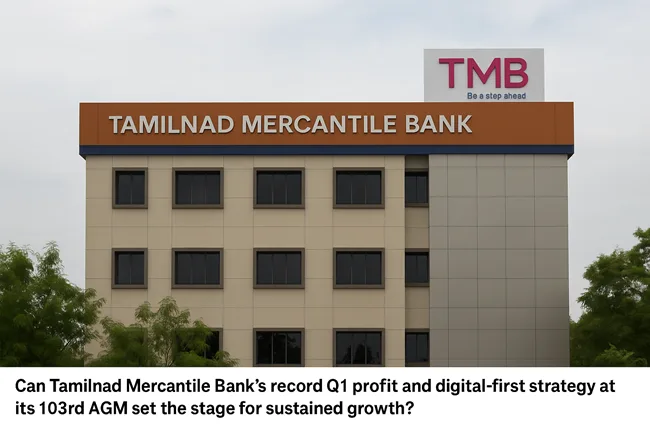
Tamilnad Mercantile Bank Limited (NSE: TMB, BSE: 543596), one of India’s oldest private sector lenders, has combined a historic milestone with a forward-looking pivot, reporting its highest-ever quarterly net profit for Q1 FY26 while unveiling an ambitious operational and digital transformation blueprint at its 103rd Annual General Meeting (AGM). The announcements, made in Thoothukudi on August 8, 2025, alongside earlier quarterly results released on July 25, 2025, underline a strategic shift toward technology-driven customer engagement, structural segmentation, and long-term balance sheet resilience.
The bank’s shares closed on August 8 at ₹429.40, down 0.42% from the previous day, with a traded volume of 0.30 lakh shares and turnover of ₹1.31 crore. The market capitalisation stood at ₹6,799.61 crore, with a free float value of ₹4,989.28 crore. The stock continues to trade comfortably above its 52-week low of ₹401.00, recorded on April 7, 2025, though still some distance from the high of ₹513.55 seen on December 9, 2024.
How strong was Tamilnad Mercantile Bank’s Q1 FY26 performance and what underpinned the profit surge?
For the quarter ended June 30, 2025, Tamilnad Mercantile Bank posted a net profit of ₹305 crore, an increase of 6.27% year-on-year from ₹287 crore. This was supported by steady growth in core lending and deposit businesses, tighter asset quality controls, and a continued focus on the retail, agriculture, and MSME (RAM) segments. The gross non-performing asset (NPA) ratio fell to 1.22% from 1.44%, while net NPA improved to 0.33% from 0.65%. Provision coverage ratio rose to 94.32%, reflecting a more conservative risk posture, and the capital to risk-weighted assets ratio (CRAR) climbed to 31.55% from 29.21%, reinforcing the bank’s capital adequacy buffer.
Total deposits expanded 9.38% year-on-year to ₹53,803 crore, while advances grew 10.44% to ₹45,120 crore. The RAM portfolio’s share of gross advances increased to 93.31%, up from 92.07% in the same quarter last year, signalling deeper penetration into priority-sector lending. Net interest income for the quarter reached ₹580 crore compared with ₹567 crore in Q1 FY25, a more modest 2.29% growth, but one that came alongside improved asset yields and lower slippages. Net worth rose 13.15% to ₹9,328 crore.
Institutional observers point out that the bank’s ability to grow advances while simultaneously improving asset quality metrics is a key differentiator in the current credit cycle, especially when several mid-sized peers are battling pressure from rising delinquencies. Analysts also note that the high proportion of RAM lending could shield Tamilnad Mercantile Bank from volatility in large-ticket corporate loan performance.
What strategic initiatives were unveiled at the 103rd AGM to drive the next phase of growth?
Managing Director and CEO Salee S. Nair described the past year as one of measured expansion and accelerated digitalisation, with a focus on stability, scalability, and service excellence. The AGM introduced a number of structural changes aimed at sharper business segmentation and more targeted service delivery.
One such move was the formation of the Transaction Banking Group, dedicated to institutional and corporate customers with customised cash management and trade finance solutions. To strengthen ties with the diaspora, the bank launched its Global NRI Centre, offering specialised services to non-resident clients. It also introduced the Elite Service Group, designed to provide high-value individual customers with tailored banking experiences, signalling a push into premium retail banking.
On the digital transformation front, the bank announced it was building a Digital Engagement Hub in collaboration with EdgeVerve, a subsidiary of Infosys. This upgrade is expected to significantly enhance internet banking capabilities and enable a seamless omnichannel experience. Another operational milestone was the establishment of a centralised Credit Management Centre to handle the full loan lifecycle—excluding jewel loans—allowing branch staff to focus more on deposit mobilisation and direct customer engagement.
The bank also deepened its technology partnerships by working with Oracle and Deloitte India to deploy Oracle Fusion Cloud Applications. These are being used to manage end-to-end sales and service functions through Oracle CX, as well as to streamline expense tracking and vendor payments through a Vendor Management System. This integration is designed to improve transparency, reduce manual processing, and create a single digital backbone for both front-end customer interactions and back-office functions.
How is Tamilnad Mercantile Bank expanding its product portfolio and digital payment capabilities?
The AGM saw the announcement of a partnership with Bajaj Broking to launch a 3-in-1 account, which combines savings, demat, and trading services into a single platform—marking the bank’s first foray into integrated investment solutions. The lender has also enabled CBDT and GST payment facilities through its channels, aligning with its ambition to be a full-spectrum, tech-enabled financial services provider.
These steps build on earlier Q1 FY26 developments, including the rollout of Oracle CX for integrated customer lifecycle management and the adoption of straight-through processing to speed up service request turnaround. A Business Process Management framework has also been introduced to digitise workflows and reduce paper-based processes, which the bank expects will boost operational efficiency and shorten processing times across departments.
What does the current market and investor sentiment indicate about Tamilnad Mercantile Bank’s strategy?
Market sentiment toward Tamilnad Mercantile Bank remains cautiously positive. The bank’s consistent dividend policy—underscored by the board’s proposal for a final dividend of ₹11 per equity share, representing 110% of face value—reinforces its appeal among income-focused investors. The combination of record quarterly profit, strong capital ratios, and a clearly articulated technology strategy has been viewed favourably by institutional investors, even if short-term stock price movements have been muted.
However, analysts are also flagging areas to watch. The modest growth in net interest income despite double-digit loan expansion suggests that competitive pressure on lending rates could constrain margin expansion in the near term. Additionally, while the high RAM exposure is a strength in terms of asset quality, it also means the bank is heavily reliant on sectors that can be sensitive to rural consumption cycles and government policy changes.
What is the medium-term outlook for Tamilnad Mercantile Bank in the context of the evolving banking landscape?
Looking ahead, Tamilnad Mercantile Bank’s management has emphasised that its transformation initiatives are designed not merely to digitise existing processes, but to create new revenue lines and improve customer stickiness. The introduction of the 3-in-1 account is expected to generate higher non-interest income through brokerage and securities services, while the Digital Engagement Hub could open cross-selling opportunities across retail, NRI, and SME segments.
Its ongoing expansion—seven new branches opened in Q1 FY26—combined with technology-backed scalability could allow the bank to deepen penetration in underbanked geographies without significantly increasing cost-to-income ratios. At the same time, the strong CRAR and improved provisioning levels mean the bank has room to grow its balance sheet without immediate capital-raising pressure.
The main execution risks lie in integrating its multiple new technology systems, ensuring uniform adoption across its 587 branches, and managing cyber risk as digital channels expand. Competitive pressures from larger private sector peers and nimble fintech entrants will also require continuous innovation in product design and service delivery.
Yet, with over 5.3 million customers across 17 states and four union territories, Tamilnad Mercantile Bank’s scale, century-old trust factor, and now-aggressive technology agenda suggest that it is well-positioned to capture market share in both traditional and emerging banking segments. If its current momentum holds, analysts believe the bank could not only sustain but potentially accelerate its growth trajectory into FY27, with its share price regaining upward momentum toward its 52-week high.
Discover more from Business-News-Today.com
Subscribe to get the latest posts sent to your email.