

In psoriatic disease care, the treatment paradigm is no longer content with symptom suppression alone. Increasingly, clinicians and patients are aligning around a higher standard—zero disease activity, achieved in one or more domains of the condition. This evolving goal is reshaping not only the clinical approach to psoriatic arthritis and psoriasis but also the way pharmaceutical companies, regulators, and payers define therapeutic success.
Whether targeting skin lesions, joint inflammation, enthesitis, axial involvement, or nail disease, the focus is now shifting toward total remission—defined domain-by-domain. This shift is grounded in both real-world clinical need and industry momentum, with emerging biologics and composite outcome frameworks converging to raise the bar. The zero disease activity paradigm is no longer aspirational; it is becoming the new standard of care.
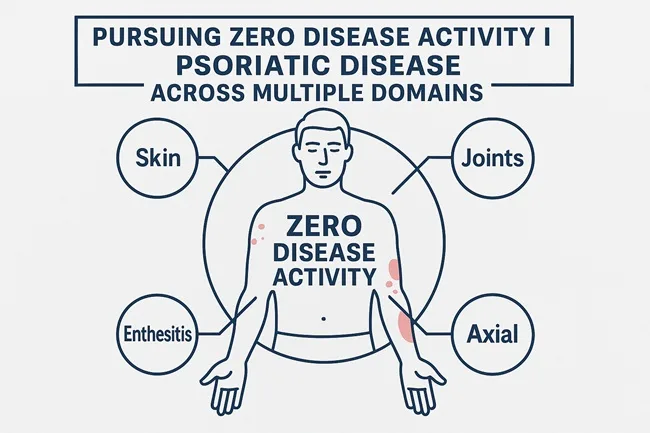
What does zero disease activity in psoriatic disease actually mean in clinical terms?
Zero disease activity in psoriatic disease reflects the absence of clinical signs and symptoms across relevant domains. In psoriatic arthritis, this includes peripheral joints, entheses, dactylitis, spine, and skin. In plaque psoriasis, it means complete clearance of lesions with no residual erythema or scaling.
The shift from minimal disease activity to a zero-tolerance framework builds upon composite indices such as the Disease Activity index for Psoriatic Arthritis (DAPSA), Psoriatic Arthritis Disease Activity Score (PASDAS), and Composite Psoriatic Disease Activity Index (CPDAI). These tools integrate both physician assessments and patient-reported metrics to determine remission at the domain level.
Therapies like bimekizumab, marketed under the brand name BIMZELX® by UCB, have begun positioning themselves specifically around the goal of “zero disease activity in one or more domains.” This represents a notable departure from traditional positioning that emphasized only global improvements in composite scores or response percentages. The emphasis on domain-level resolution reflects a more targeted and measurable approach to disease management.
Why is achieving ZDA in one or more domains becoming the new treatment standard?
There is a growing body of evidence suggesting that patients who achieve stringent disease control—particularly domain-specific remission—experience better long-term outcomes, reduced joint damage, improved quality of life, and lower overall disease burden. Trials like the TICOPA study have validated treat-to-target strategies in psoriatic arthritis, demonstrating that predefined disease activity goals improve both clinical and functional metrics.
Importantly, psoriatic disease is characterized by heterogeneity in domain involvement. Some patients may experience skin-dominant disease with minimal joint symptoms, while others present primarily with axial inflammation or enthesitis. Achieving zero disease activity across one or more active domains, even if not all, represents a clinically meaningful milestone.
This domain-based approach also allows greater flexibility in setting treatment goals tailored to individual patients. It recognizes that controlling the domains most responsible for a patient’s disability or discomfort can substantially improve outcomes—even when other domains remain quiescent or subclinical.
How are dermatologists and rheumatologists coordinating care for multi-domain disease?
The co-management of psoriatic disease has become increasingly important, particularly as more patients present with overlapping skin and musculoskeletal symptoms. Dermatologists are often the first point of contact, but many patients have subclinical joint involvement or enthesitis that may go unrecognized without rheumatologic evaluation.
Composite tools such as the CPDAI or Minimal Disease Activity (MDA) criteria encourage clinicians to assess each domain independently and escalate therapy accordingly. However, real-world adoption remains inconsistent. Clinical studies have shown that physicians often underestimate residual disease activity when relying on clinical impression alone, particularly in domains like axial involvement and enthesitis.
Multidisciplinary clinics, referral protocols, and shared outcome frameworks are gradually being adopted to improve care coordination. These models are essential for ensuring timely diagnosis, domain-specific assessment, and treatment escalation based on treat-to-target principles. With zero disease activity now serving as an aspirational benchmark, unified management becomes critical.
How is the patient voice reshaping what zero disease activity means in practice?
Patients increasingly view partial control as insufficient. For many, zero disease activity represents a return to baseline function and well-being—free from chronic flares, disfigurement, or disability. The term carries stronger semantic weight than “low disease activity” or “clinical response,” and it aligns more closely with patient expectations in an era of advanced therapies.
Patient-reported outcomes such as pain, fatigue, function, and global assessment are now central components of disease activity indices. In fact, research shows that global patient scores can be stronger predictors of treatment success than clinical markers alone. This reinforces the importance of aligning physician-defined remission targets with patient-defined quality-of-life indicators.
Patients achieving domain-specific ZDA are more likely to remain adherent to treatment, engage with monitoring protocols, and report satisfaction with their care journey. As such, domain-specific remission has not only clinical relevance but also behavioral and economic implications in long-term disease management.
What therapies and innovations are enabling these multi-domain ZDA ambitions?
The development of newer biologic therapies and targeted synthetic disease-modifying antirheumatic drugs (tsDMARDs) has enabled clinicians to more precisely target specific domains. Bimekizumab, a dual IL-17A and IL-17F inhibitor developed by UCB, is among the first therapies to explicitly anchor its efficacy claims in achieving zero disease activity in one or more domains.
Other agents—including guselkumab from Johnson & Johnson, secukinumab from Novartis, and deucravacitinib from Bristol Myers Squibb—are also being evaluated in terms of domain-based performance. Trials increasingly include co-primary endpoints or post-hoc analyses focused on skin, joint, and enthesis outcomes separately. This reflects the growing expectation that efficacy should be demonstrated across clinically relevant areas, not just in aggregate scores.
Digital tools, including ePRO apps, remote joint monitoring, and AI-supported image analysis, are also contributing to this domain-specific tracking. These tools are expected to play a significant role in enabling treat-to-target implementation in real-world settings—particularly in remote or resource-limited care environments.
How is the shift toward zero disease activity across multiple psoriatic disease domains influencing pricing, reimbursement, and competitive positioning in the biologics market?
The shift toward zero disease activity presents a strategic inflection point for the pharmaceutical industry. Drugs that can achieve domain-level remission now have a clearer pathway to differentiate themselves in crowded therapeutic categories. Claims of efficacy are no longer limited to PASI75 or ACR20; domain-by-domain outcomes create room for premium positioning and broader patient inclusion.
At the same time, health technology assessment bodies and payers are demanding higher evidentiary standards. Demonstrating real-world achievement of zero disease activity—particularly across high-impact domains like joints or axial skeleton—is becoming essential for formulary access and reimbursement. Value-based pricing models may increasingly hinge on sustained remission, not just response.
This trend is also pushing biopharma companies to align their clinical development strategies with multi-domain frameworks. Endpoints must now capture disease activity across multiple areas, and trial designs are being adjusted accordingly. For newer entrants, success in one domain may not be enough to establish a meaningful presence unless broader disease impact can be demonstrated.
What does zero disease activity mean for future treatment standards and commercial positioning?
Zero disease activity in one or more domains is rapidly being integrated into clinical guidelines, regulatory endpoints, and commercial narratives. Across both psoriatic arthritis and plaque psoriasis, the ability to induce and sustain domain-specific remission is becoming a core performance metric for advanced therapies.
This has direct implications for how therapies are priced, promoted, and assessed in both clinical and economic terms. Payers are beginning to expect measurable value in the form of long-term disease suppression and reduced healthcare utilization. Providers are under pressure to adopt treat-to-target frameworks and deliver individualized care plans that reflect patient-specific disease burdens.
At the systems level, implementing ZDA as a care standard will require investment in multidisciplinary infrastructure, specialist training, and monitoring technologies. However, early data suggest that achieving disease inactivity—even in a subset of domains—can improve long-term outcomes and reduce cost of care by lowering flare frequency, preserving joint function, and improving adherence.
In this context, therapies that consistently achieve zero disease activity in one or more domains are likely to play a central role in future treatment algorithms, health system protocols, and reimbursement structures. The ability to deliver domain-specific control—reliably, sustainably, and safely—is now a leading benchmark for clinical utility and commercial viability.
Key takeaways: How zero disease activity is transforming psoriatic disease care
- Zero disease activity, measured in one or more domains, is now a clinically and commercially relevant goal in psoriatic arthritis and psoriasis management.
- The shift is supported by growing clinical evidence, stronger patient demand, and more precise therapies targeting skin, joints, spine, and entheses.
- Multidisciplinary care coordination between dermatologists and rheumatologists is essential to effectively implement treat-to-target strategies.
- Biopharma companies are aligning product claims and trial designs with domain-based outcome frameworks to strengthen differentiation and market access.
- Payers are recalibrating value assessments based on domain-specific remission and long-term cost offsets, moving beyond aggregate response metrics.
- Future adoption of ZDA strategies will depend on digital monitoring, personalized treatment plans, and integration of patient-reported outcomes into care pathways.
Discover more from Business-News-Today.com
Subscribe to get the latest posts sent to your email.