




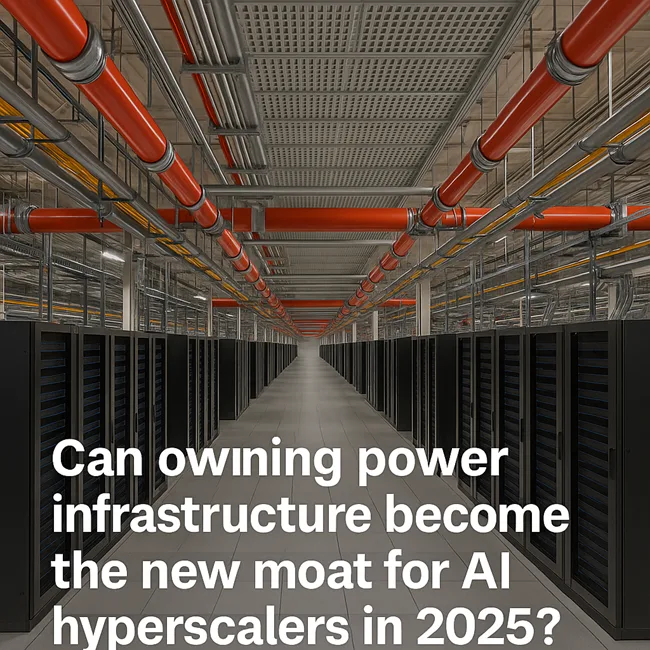
Why is vertical integration into power and data centers becoming critical for AI infrastructure leaders in 2025?
In 2025, as generative AI platforms push global compute demands to unprecedented levels, power has become the defining constraint—and the defining opportunity. Infrastructure-focused AI cloud providers like CoreWeave and Crusoe Energy are leading a new wave of vertical integration, where owning energy assets and data center land is no longer a cost center but a competitive moat.
CoreWeave’s $9 billion acquisition of Core Scientific and Crusoe Energy’s recent 4.5 GW expansion demonstrate how these companies are using infrastructure ownership to control costs, eliminate leasing dependencies, and secure future capacity. This shift is particularly significant in an environment where hyperscaler GPU access is no longer enough—energy availability and pricing may now determine AI cloud success.
How are AI cloud firms like CoreWeave and Crusoe Energy reshaping the power procurement playbook?
CoreWeave and Crusoe are rewriting the rules of cloud infrastructure by aligning compute expansion with physical power ownership. Crusoe Energy, for example, deploys modular AI data centers powered by stranded flare gas and renewables through its Crusoe Spark platform. In June 2025, Crusoe added 4.5 GW of natural gas capacity via a major infrastructure partnership, enabling it to scale AI workloads off-grid and at lower energy costs.
CoreWeave, meanwhile, is acquiring Core Scientific’s national power footprint—including 1.3 GW of gross capacity and over 1 GW in future expansion rights. The deal eliminates $10 billion in lease obligations and allows CoreWeave to directly control utility access and capital deployment. These moves aren’t just about savings—they allow these firms to lock in the right to build where GPUs can run at full throttle, unconstrained by public utilities or third-party landlords.
This integrated approach is turning power from a fixed input cost into a scalable asset class. Rather than compete on cloud APIs, these companies are competing on kilowatts and cooling systems—architecting infrastructure that’s GPU-first, power-optimized, and deployment-ready.
Can hyperscalers like AWS and Azure keep pace with infrastructure-first challengers focused on generative AI?
While hyperscalers like Amazon Web Services, Microsoft Azure, and Google Cloud have invested billions in renewable energy procurement and greenfield data centers, they still rely on traditional utility timelines and vendor ecosystems for power provisioning. That model works well for general-purpose compute—but increasingly struggles to keep pace with AI-specific workloads that require dense, power-hungry GPU clusters.
In contrast, firms like Lambda Labs, which raised $480 million in a Series D round in 2025, are following the CoreWeave–Crusoe model—building their own modular data centers with early access to energy contracts and flexible power distribution design. These challengers are sacrificing breadth (storage, databases, networking) for depth: optimized environments for training and inferencing large language models, with lower costs and faster deployment cycles.
Unless traditional hyperscalers pivot quickly to control their energy inputs with the same aggressiveness as their infrastructure-native rivals, they risk losing market share in the fastest-growing and most profitable tier of cloud: GPU-dense AI compute.
What are the long-term risks and ESG challenges of owning power-intensive AI data center infrastructure?
Owning power at hyperscale brings clear financial and operational benefits—but also regulatory and sustainability risks. Crusoe Energy, for instance, uses flare gas as a transitional fuel source while developing renewable overlays and battery integration. This repurposing of carbon-intensive sources could face scrutiny from ESG investors or state regulators unless offset through emissions tracking or green capacity matching.
CoreWeave will likely face similar challenges in converting Core Scientific’s former crypto mining facilities into AI-optimized, ESG-compliant sites. Cooling upgrades, emissions compliance, and water management will be necessary to meet investor expectations and local permitting requirements.
Still, early moves suggest these firms are taking sustainability seriously. Crusoe has integrated Redwood’s recycled batteries into its Crusoe Spark systems, and Lambda Labs is building solar-ready facilities in California and Texas. ESG alignment may become not just a risk management tool, but a competitive differentiator—especially as customers like Meta, Apple, and enterprise SaaS firms increasingly require carbon disclosures in AI infrastructure sourcing.
How does power control translate into pricing power, margin stability, and growth visibility in AI infrastructure?
The economics of AI cloud services are shifting. Compute used to be priced around GPU scarcity and orchestration software. Now, margin compression and capital costs are forcing providers to find stability in physical infrastructure ownership.
By controlling energy input costs and site development timelines, CoreWeave and Crusoe can lock in long-term pricing strategies and capture larger profit margins across workload cycles. Crusoe’s modular AI data centers, for instance, are reportedly operating at 30% lower energy costs than typical colocation-based setups. Similarly, CoreWeave expects its Core Scientific integration to deliver over $500 million in annual cost savings by 2027—driven largely by owning rather than leasing its power infrastructure.
This allows these firms to not only outprice hyperscalers on certain AI workloads but also provide guaranteed deployment timelines for customers—a key selling point for enterprises racing to implement LLM-based services.
What are investors watching as infrastructure ownership becomes a competitive moat in AI cloud services?
Investors are increasingly treating power ownership as the new signal of defensibility in AI infrastructure. Crusoe’s $600 million in funding, including a Macquarie-led credit facility, reflects confidence in its vertically integrated model. CoreWeave’s $9 billion all-stock acquisition of Core Scientific—its largest deal to date—was backed by Nvidia-aligned institutional capital seeking exposure to the long-term infrastructure layer of AI.
Beyond topline growth, investors are watching three key indicators: (1) capacity utilization of owned power assets; (2) margin progression across infrastructure-first deployments; and (3) ESG compliance trajectory. As infrastructure deals become larger and more capital-intensive, execution discipline will separate sustainable hyperscaler challengers from speculative plays.
Ultimately, power control offers these firms pricing power, capital efficiency, and strategic visibility. It’s not just about scale—it’s about resilience and readiness.
Why energy ownership may define AI infrastructure winners this decade
In the evolving AI infrastructure landscape, vertical integration into power may become the defining marker of hyperscaler strength. Companies like CoreWeave, Crusoe Energy, and Lambda Labs are not merely data center builders—they are energy architects, constructing the foundation for AI economies that need to operate at petawatt scale.
As GPU demand continues to outpace grid availability, the ability to generate, manage, and deploy power at speed may outweigh software abstractions or ecosystem lock-in. If AWS, Azure, and other hyperscalers fail to match the energy-focused aggression of these challengers, they risk becoming generalists in a domain now dominated by specialists.
The infrastructure race is no longer just about chips or cloud—it’s about who controls the electricity behind the intelligence.
Discover more from Business-News-Today.com
Subscribe to get the latest posts sent to your email.