

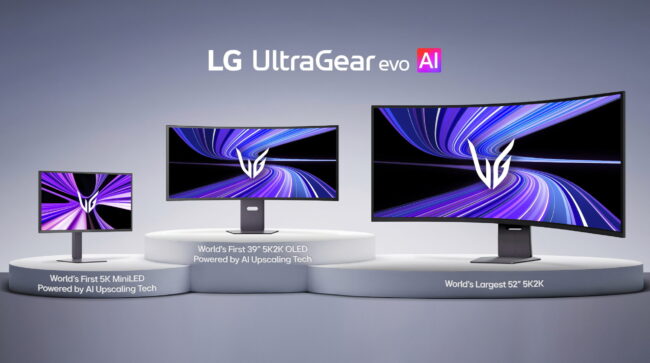
LG Electronics (KRX: 066570) has announced the global debut of UltraGear evo, a new premium monitor sub-brand designed to redefine the top end of the gaming display market. The launch, centered around three flagship monitors featuring the world’s first 5K AI upscaling, signals LG’s renewed push for high-margin innovation in OLED and MiniLED formats heading into CES 2026.
The UltraGear evo launch directly targets discerning gamers and professionals who have resisted upgrading amid high GPU costs and limited 5K content. By shifting the performance bottleneck away from the graphics card and into the display itself, LG Electronics is attempting to reposition the monitor as the central engine of visual enhancement—effectively decoupling performance from GPU cycles in mainstream setups.
This strategic emphasis on on-device artificial intelligence aligns with broader trends across consumer electronics, where premium margins are increasingly derived from differentiated silicon and vertically integrated feature stacks rather than raw panel size or refresh rate alone. The UltraGear evo range introduces three new models: the 39GX950B (OLED), 27GM950B (MiniLED), and 52G930B (large-format OLED), all engineered to deliver 5K-and-above resolution, AI-enhanced image fidelity, and dual-mode operation to toggle between ultra-resolution and ultra-speed.

How does LG’s new UltraGear evo lineup redefine the balance between resolution, speed, and GPU independence?
LG Electronics is positioning the UltraGear evo line not as incremental upgrades but as foundational shifts in display logic. The centerpiece is a proprietary on-device AI engine that enables real-time 5K upscaling and scene-specific audio-visual optimization. Crucially, this occurs without additional strain on the user’s graphics card, effectively removing a key upgrade barrier for gamers and creators alike.
In the 39GX950B, a 39-inch 5K2K OLED with 1500R curvature, the AI pipeline processes input before it reaches the panel, allowing content originally rendered at lower resolutions to be upscaled to near-native 5K clarity. LG’s RGB Tandem OLED panel further augments this with improved brightness, pixel longevity, and perfect black rendering—an area where LG already leads due to its dominance in OLED TV manufacturing.
Dual Mode functionality enables the monitor to switch between a 165Hz refresh rate at full 5K2K resolution and a blistering 330Hz at WFHD, accommodating both high-fidelity cinematic gaming and low-latency competitive scenarios. A sub-0.03ms response time further cements the monitor’s positioning at the bleeding edge of speed.
What competitive advantage does LG claim with the world’s first 5K MiniLED monitor?
With the 27GM950B, LG becomes the first manufacturer to commercialize a 5K MiniLED display explicitly optimized for gaming. The 27-inch monitor leverages 2,304 local dimming zones to minimize halo effects and blooming—longstanding weaknesses in MiniLED backlighting. By combining Zero Optical Distance panel engineering with a 1ms response time and up to 1,250 nits of peak brightness, LG aims to eliminate perceptual compromises that often plague high-resolution MiniLEDs.
Here, the AI enhancements are again crucial. The monitor replicates the 5K upscaling, scene optimization, and AI-powered soundstage of the OLED sibling, giving the MiniLED model functional parity with superior HDR brightness. This positions LG to pull demand from both OLED purists and users who require sustained brightness, such as competitive FPS players or streamers who work under bright lighting conditions.
Dual Mode returns in this model as well, with refresh rates up to 330Hz at QHD resolution—offering configuration flexibility across genres and workloads.
How does the 52-inch G9 model reflect LG’s push into the large-format immersive gaming segment?
The 52G930B represents the boldest play in the UltraGear evo lineup. As the largest 5K2K gaming monitor in the world, it redefines the spatial expectations of a desktop gaming setup. With a vertical viewing height equivalent to a 42-inch 16:9 screen and a panoramic 12:9 aspect ratio, the 52-inch display is designed to envelop the player’s peripheral vision, simulating the immersive effect of a three-monitor rig on a single panel.
A 1000R curvature and 240Hz refresh rate confirm LG’s intent to dominate the large-format competitive category—not just the productivity or simulation niche. This is backed by VESA DisplayHDR 600 certification, ensuring that visual performance is not sacrificed at scale.
While not explicitly marketed as a B2B product, the design of this monitor, along with the medical display reference in LG’s press statement, suggests a crossover appeal for industrial simulators, AI training environments, and surgical suites where ultrawide, high-density visuals matter.
What does this launch tell us about LG’s long-term gaming display and AI integration strategy?
By embedding AI directly into its displays, LG Electronics is taking a page from its appliance and smart TV strategy—where the chip increasingly defines the value proposition, not just the form factor. This model fits within a broader industry shift where high refresh rates and HDR certifications are no longer enough to command premium pricing or justify replacement cycles. AI becomes the new differentiator.
It also allows LG to address the plateauing of GPU innovation. With chip prices high and innovation slowing after the RTX 40 series, many gamers remain locked into older GPUs. LG’s 5K AI upscaling effectively unlocks next-gen visual fidelity for legacy systems, creating an upgrade incentive that bypasses Nvidia and AMD’s cadence.
Additionally, LG is placing this evolution in the context of Reddit-inspired setups and SimCraft simulators at CES 2026—implying that the company understands and is directly targeting the enthusiast community where form, function, and fandom converge.
This is not just about panel specs. It is about controlling more of the rendering pipeline, which was previously dominated by GPU vendors, and creating a stickier, more upgradeable user base.
Why is LG linking consumer display innovation with enterprise-grade precision markets?
LG Display’s dual positioning, serving both the B2C gaming monitor segment and precision-dependent B2B markets such as healthcare, suggests the company is seeking scale advantages across verticals. By refining AI-enhanced upscaling and OLED/MiniLED precision for gamers, LG can cross-deploy these technologies into surgical monitors, broadcast reference displays, and industrial design workflows where pixel-perfect performance is critical.
This horizontal integration mirrors broader tech sector moves. Apple uses SoC development across iPhones, iPads, and Macs. NVIDIA applies AI accelerators across gaming, datacenter, and automotive. LG may be doing the same for its AI display controllers.
Such synergy also opens the door for longer product lifecycles, firmware-upgradeable features, and a future software monetization layer that could bring LG into a more service-oriented model—beyond just display sales.
Key takeaways on what this development means for LG Electronics, its competitors, and the broader display industry:
- LG has launched the UltraGear evo sub-brand with 5K AI upscaling, signaling a premium shift in the gaming monitor market ahead of CES 2026.
- The new AI features allow high-resolution performance without GPU upgrades, appealing to users with mid-cycle graphics cards.
- The 27GM950B MiniLED and 39GX950B OLED bring differentiated capabilities to two distinct user bases while maintaining parity in AI features.
- The 52-inch 5K2K model positions LG in the growing large-format immersive gaming category, potentially extending into industrial use cases.
- Dual Mode refresh options across all models give users control over resolution-speed trade-offs, further broadening appeal.
- LG is using its monitor division to drive AI innovation that could be repurposed for enterprise-grade applications like medical and simulation displays.
- The launch is part of a broader industry pivot where displays, not GPUs, become the focal point of visual processing enhancements.
- If successful, LG’s approach may challenge Nvidia and AMD’s dominance in dictating high-end visual experiences.
Discover more from Business-News-Today.com
Subscribe to get the latest posts sent to your email.