





Karo Healthcare has confirmed that it will formally acquire Perrigo Company plc’s Dermacosmetics brand portfolio, following the completion of KKR’s acquisition of Karo on August 27, 2025. The transaction, which was first announced on July 14, remains unchanged in terms and is scheduled to close in the first quarter of 2026. The portfolio generated more than €120 million in net sales in 2024 across the Nordics, Netherlands, and Poland, and includes widely recognized skin health brands such as ACO, Cosmica, Emolium, and Iwostin.
This acquisition adds further momentum to Karo Healthcare’s strategy to build a science-backed, omnichannel consumer healthcare powerhouse in Northern and Central Europe. Institutional observers described the deal as a “transformational pivot” that consolidates Karo’s leadership in the skin health segment while giving it a stronger footprint in Poland—a market analysts note is primed for growth in dermatology and OTC skincare.
How will the Perrigo brand acquisition reshape Karo Healthcare’s skin health strategy in Europe?
The acquisition includes a portfolio of leading dermacosmetic and medicated skincare brands, notably ACO (including Cosmica, Canoderm, Cliniderm, and Miniderm), Emolium, Biodermal, and Iwostin. These brands have longstanding reputations for efficacy, science-backed formulations, and consumer trust—factors that align with Karo Healthcare’s positioning around “smart choices for everyday healthcare.”
Karo Healthcare, headquartered in Stockholm, is a pan-European player with products in more than 90 countries and a workforce of 470 people spread across 13 international hubs. With this transaction, the Swedish consumer healthcare firm deepens its brand presence in the Nordics while simultaneously expanding its addressable market in Central Europe, particularly in Poland—a country where dermocosmetics are among the fastest-growing consumer healthcare segments.
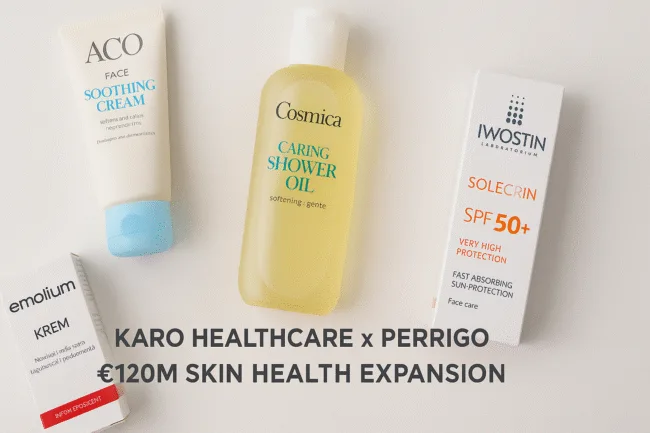
From a product mix perspective, the acquired portfolio spans face care, body care, sun protection, and therapeutic skincare, allowing Karo to tap into multiple growth levers. Equally significant is the fact that the acquisition also includes a fully functional operating unit—covering supply chain, sales, and marketing resources—which Karo intends to integrate into its future-proofed operating model.
What are the financial and strategic implications of the €120M Dermacosmetics business transfer?
In financial terms, the Perrigo Dermacosmetics business generated more than €120 million in net sales in 2024. While specific transaction values were not disclosed, analysts view the size and scope of the portfolio as “material enough to shift competitive dynamics” in Northern European consumer healthcare. The acquisition was initially negotiated and announced by a KKR-affiliated entity prior to the close of the Karo Healthcare deal, and now officially transfers to Karo post-close.
Strategically, the move helps Karo build a more resilient and diversified brand portfolio while increasing operational leverage in existing markets. By absorbing high-margin, science-led skincare products into its pipeline, Karo enhances both its brand equity and retail shelf share in a fiercely competitive category.
CEO Christoffer Lorenzen emphasized that the deal represents a major inflection point in the company’s ambition to be a European leader in multi-channel consumer health. He added that the skin health category will now become one of the pillars of Karo’s long-term growth model, driven by expert endorsement, brand trust, and scientific credibility.
How are institutional investors and analysts viewing Karo Healthcare’s acquisition momentum under KKR?
With the ink barely dry on KKR’s acquisition of Karo Healthcare, institutional sentiment toward the firm’s expansion strategy has been broadly positive. Analysts view KKR’s operational expertise in carveouts and its historical success in healthcare roll-ups as strong tailwinds for Karo’s execution capabilities.
Hans Arstad, Managing Director at KKR, remarked that Karo is the “ideal strategic partner” for Perrigo’s Dermacosmetics portfolio, given its dominant presence in the Nordic region and the support of KKR’s investment platform. He further stated that this combination of platform strength and portfolio compatibility sets up the newly acquired assets for sustainable success.
Industry observers point out that Karo’s growth-through-acquisition model aligns closely with private equity playbooks—combining top-line brand synergies with backend integration to optimize profitability. In this context, the integration of a fully functioning Dermacosmetics unit—complete with skilled personnel and existing customer relationships—significantly reduces the operational risk often associated with corporate carveouts.
What future growth opportunities could this deal unlock for Karo Healthcare beyond Northern Europe?
While Karo’s base remains strongly Nordic, this transaction opens a clear path into the Polish market, which experts regard as a high-growth corridor in the European consumer healthcare landscape. Poland’s OTC Dermacosmetics segment has expanded rapidly in recent years, with rising consumer awareness, dermatological demand, and digital penetration driving double-digit growth.
By acquiring Emolium and Iwostin—both of which have strong Polish consumer loyalty and clinical heritage—Karo instantly builds brand credibility in a new geography. This is consistent with the company’s stated ambition to create omnichannel distribution models that include pharmacies, e-commerce, and retail outlets.
Moreover, the emphasis on healthcare professional endorsement within the acquired portfolio offers a cross-functional halo effect across Karo’s existing and upcoming launches. Analysts expect further bolt-on acquisitions or digital expansion in adjacent categories like wellness, OTC therapeutics, and functional beauty in the medium term.
How does this acquisition align with Karo’s broader portfolio and recent brand expansion initiatives?
The acquisition comes just months after Karo added several global wellness brands such as AlphaFoods and Nutravita to its portfolio, further broadening its footprint in the consumer health space. The Dermacosmetics deal complements existing flagship products like E45®, Lamisil®, and Locobase®—creating a tiered structure of brand offerings across price points, conditions, and consumer segments.
Unlike some of Karo’s earlier deals which focused on Western Europe and the UK, the Perrigo acquisition skews toward Central and Northern Europe, marking a strategic rebalancing of its geographic priorities. It also strengthens Karo’s skin health category—a segment with recurring revenue potential, high consumer loyalty, and favorable gross margins.
The transaction is expected to close in Q1 2026, pending regulatory approvals and customary closing conditions. Karo has retained Morgan Stanley & Co. International Plc as its financial advisor, with legal support from Kirkland & Ellis, Simpson Thacher & Bartlett, and White & Case. PwC and Alvarez & Marsal are supporting financial due diligence and integration efforts.
Is Karo becoming the new consolidator in European consumer healthcare?
Karo Healthcare’s latest move underscores its ambition to be more than just a Nordic player. With KKR’s backing and a series of targeted acquisitions under its belt, the firm is fast becoming a serious consolidator in the European consumer healthcare space. Analysts believe that Karo’s strategy of acquiring high-trust, science-driven brands with regional strongholds could make it a blueprint for PE-led healthcare roll-ups in Europe.
With the Dermacosmetics deal from Perrigo on track to close in early 2026, all eyes are now on how effectively Karo can integrate the portfolio and leverage cross-market synergies. If successful, this could serve as the launchpad for deeper Central European expansion—and potentially a pipeline of future bolt-on deals across wellness, women’s health, and OTC therapeutics.
Discover more from Business-News-Today.com
Subscribe to get the latest posts sent to your email.
