


Johnson & Johnson (NYSE: JNJ) reported fresh data from its Phase 2 MajesTEC-5 study showing that an immune-based induction regimen combining TECVAYLI (teclistamab-cqyv) and DARZALEX FASPRO (daratumumab and hyaluronidase-fihj) achieved deep responses in transplant-eligible patients newly diagnosed with multiple myeloma (NDMM). In updated results, 100 percent of evaluable patients achieved minimal residual disease (MRD) negativity, a milestone rarely seen in clinical oncology and one that could reshape the treatment landscape for the disease.
Why does the MajesTEC-5 trial matter for the multiple myeloma treatment landscape?
Multiple myeloma has long been one of the most challenging blood cancers to treat because of its relapsing nature and resistance to existing therapies over time. Traditional induction regimens have relied on steroid-heavy approaches and combinations of proteasome inhibitors, immunomodulatory drugs, and CD38 antibodies. The MajesTEC-5 trial, conducted by the German-Speaking Myeloma Multicenter Group (GMMG) and Deutsche Studiengruppe Multiples Myelom (DSMM) in collaboration with Johnson & Johnson, is testing whether immune-based doublets such as TECVAYLI and DARZALEX FASPRO can change this paradigm.
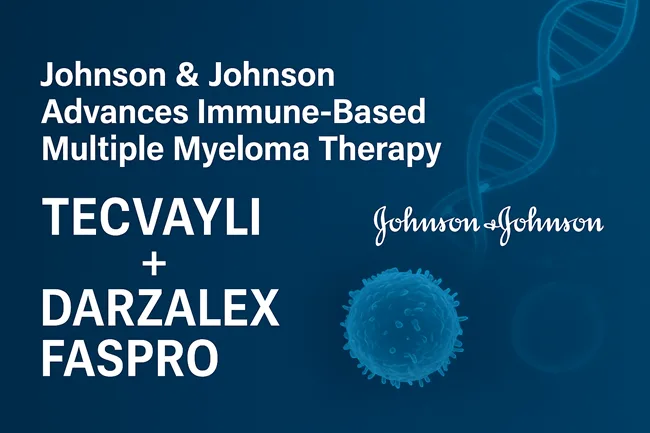
The trial enrolled 49 transplant-eligible patients across three steroid-sparing treatment cohorts. Regardless of the regimen, all patients achieved an overall response of at least partial remission following induction therapy. More significantly, every one of the 46 MRD-evaluable patients tested negative for residual cancer cells by sensitive next-generation assays, underscoring the regimen’s potential as a frontline standard.
How do TECVAYLI and DARZALEX FASPRO work together to fight multiple myeloma?
TECVAYLI is a first-in-class bispecific T-cell engager that binds to the CD3 receptor on T-cells and to the B-cell maturation antigen (BCMA) on myeloma cells. This dual engagement activates the immune system, directing it to eliminate malignant plasma cells. DARZALEX FASPRO, on the other hand, is a CD38-directed antibody with an established track record across newly diagnosed and relapsed patient populations.
Used together, the therapies target two critical immune pathways: one mobilizing T-cell activity against myeloma cells and the other blocking survival mechanisms that allow cancer to persist. Physicians involved in the study described this as a synergistic effect that leads to deep responses, with potential for durable remission even at early treatment stages.
What do the response rates and safety data reveal about the potential of this doublet?
Beyond the headline result of 100 percent MRD negativity, 85.7 percent of patients achieved a complete response or better after six treatment cycles. Stem cell mobilization, a critical step before transplantation, was successful in 96 percent of patients, indicating the regimen does not compromise eligibility for subsequent interventions.
Safety remains a key consideration in immune-based oncology. In the MajesTEC-5 trial, the most common adverse events were hematologic. Grade 3/4 infections occurred in 36.7 percent of patients, and 53 percent experienced serious adverse events. Importantly, none of these led to study discontinuation, and no Grade 5 events were observed. Cytokine release syndrome was seen in 65 percent of patients but was limited to Grade 1 or 2 events. Notably, no cases of immune effector cell-associated neurotoxicity syndrome (ICANS) were reported.
This safety profile, while not without risks, suggests the doublet can be managed clinically, making it a viable option for use in frontline care if further trials confirm efficacy.
How does this development fit into the broader history of Johnson & Johnson’s multiple myeloma portfolio?
Johnson & Johnson has steadily expanded its oncology franchise in multiple myeloma through both DARZALEX and TECVAYLI. DARZALEX first gained U.S. FDA approval in 2015 and quickly became a backbone therapy, now used in more than 618,000 patients worldwide across 10 approved indications. Its subcutaneous formulation, DARZALEX FASPRO, has improved convenience and broadened uptake since its 2020 approval.
TECVAYLI, meanwhile, was approved by the FDA in 2022 for patients with relapsed or refractory multiple myeloma who had already exhausted four lines of therapy. More than 15,900 patients globally have received the drug since then. Both the FDA and the European Commission have updated their approvals to allow reduced dosing frequencies for patients in sustained remission, a move that has improved quality of life and adherence.
By combining these therapies earlier in the treatment pathway, Johnson & Johnson is signaling its intention to dominate not just the relapsed space but also the first-line market, where long-term patient benefit and commercial value are greatest.
What does investor sentiment suggest about Johnson & Johnson’s oncology strategy?
Johnson & Johnson’s stock (NYSE: JNJ) has traded with relative stability in 2025, reflecting its diversified business model spanning pharmaceuticals, medtech, and consumer health. Oncology accounts for a growing share of its Innovative Medicine division revenues, which surpassed $60 billion globally last year. While investors often weigh pipeline risks against the stability of its consumer and medtech units, sentiment has generally been positive toward the company’s ability to defend market share against rivals such as Bristol Myers Squibb and Amgen in the hematology space.
Institutional flows around JNJ in recent quarters have shown steady accumulation by long-term funds, reflecting confidence in its dividend-paying, blue-chip profile. Analysts covering the stock noted that trial updates like MajesTEC-5 add incremental value by strengthening J&J’s oncology portfolio narrative. However, they cautioned that commercial success depends on Phase 3 confirmation, regulatory decisions, and payer willingness to reimburse high-cost immunotherapies in newly diagnosed settings.
What comes next for TECVAYLI, DARZALEX, and the MajesTEC program?
The MajesTEC-5 trial remains ongoing, and Johnson & Johnson is expected to advance its immune-based combinations into larger confirmatory Phase 3 studies. If replicated, the 100 percent MRD negativity milestone could redefine induction standards for transplant-eligible multiple myeloma patients worldwide.
Looking ahead, analysts expect Johnson & Johnson to integrate TECVAYLI and DARZALEX FASPRO into a broader treatment ecosystem that includes CAR-T therapies, bispecifics targeting other myeloma antigens, and maintenance regimens designed to prolong remission. With multiple competitors racing to secure frontline market share, including Bristol Myers Squibb’s Abecma (idecabtagene vicleucel) and GSK’s Blenrep (belantamab mafodotin), J&J’s ability to demonstrate durability of response and a manageable safety profile will be crucial.
For investors, the trial underscores Johnson & Johnson’s ability to deliver innovation while balancing risk with its diversified revenue base. Buy-side sentiment currently leans toward holding the stock as a defensive healthcare play, with upside optionality from oncology pipeline catalysts like MajesTEC-5.
Discover more from Business-News-Today.com
Subscribe to get the latest posts sent to your email.