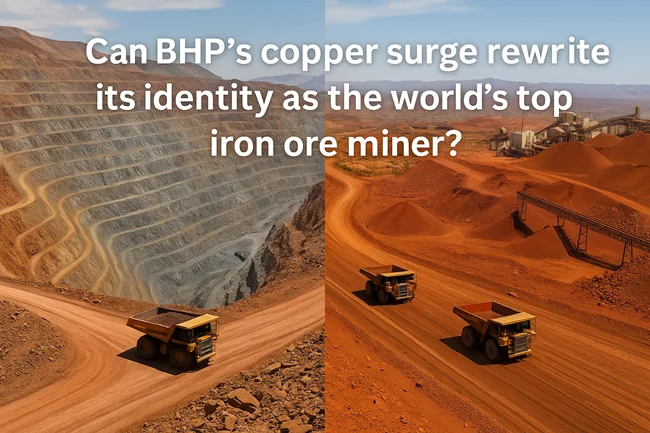
BHP Group Limited (ASX: BHP, LSE: BHP, NYSE: BHP) has long been synonymous with iron ore, its Western Australia Iron Ore (WAIO) division dominating the Pilbara and underwriting shareholder returns for two decades. But FY25 results have shifted the narrative: copper, once the junior partner in BHP’s portfolio, is now almost neck-and-neck with iron ore as the company’s core earnings driver.
In FY25, copper contributed 45% of BHP’s underlying EBITDA, compared with 29% the year before. Iron ore’s share fell to 44%, the closest the two commodities have been in BHP’s history. Copper’s contribution surged to US$12.3 billion, while WAIO generated US$11.5 billion. For the first time, copper may be on the verge of eclipsing iron ore as the defining pillar of the world’s biggest miner.
How did copper overtake iron ore in driving BHP’s earnings momentum in FY25?
Operational performance explains part of the story. Copper output hit a record 2,017 kilotonnes, an 8% rise year-on-year, as Escondida delivered its best volumes in 17 years. Spence and Copper South Australia added further gains, with South Australia setting a half-year production record.
By contrast, iron ore output was steady at 263 million tonnes, with prices sliding to an average of US$100 per dry metric tonne, down from around US$120 last year. WAIO remains the lowest-cost major supplier at US$17/t, but pricing pressure limited earnings.
Copper pricing trends went the opposite way. Average realized prices climbed to US$4.25/lb from US$3.98/lb in FY24, reflecting supply tightness and demand linked to electrification and renewables. This price tailwind, combined with record volumes, gave copper the edge over iron ore in profitability.
What does copper dominance mean for BHP’s identity as an iron ore superpower?
For decades, investors have valued BHP primarily as an iron ore play, with Pilbara production dictating earnings through the cycle. The company’s dividend strength, debt discipline, and investor base have all been tied to iron ore cash flow. But FY25’s numbers challenge that framing.
Copper is now the growth story, iron ore the cash engine. Institutional sentiment is already shifting: analysts suggest BHP’s portfolio is evolving toward a “copper growth stock” profile, supported by megatrends such as electrification, AI-driven data center buildouts, and renewable infrastructure.
In contrast, iron ore is increasingly seen as mature and cyclical, exposed to Chinese steel demand and policy volatility. The long-term structural growth belongs to copper. If FY26 repeats FY25’s performance, markets may start valuing BHP through the lens of copper expansion rather than iron ore stability.
How is BHP investing to cement copper as its future growth engine?
Management is betting heavily on copper. Around 70% of capital expenditure in FY25 went to copper and potash, with copper projects dominating the growth pipeline.
Key initiatives include optimization at Escondida and expansions at Prominent Hill and Carrapateena in South Australia. BHP is also advancing the Vicuña joint venture in Argentina and Chile, home to the Filo del Sol and Josemaria deposits, which are regarded as some of the largest copper finds in the past three decades.
The miner also maintains a 45% stake in the Resolution Copper Project in Arizona, a potential game-changer for North American supply once regulatory hurdles clear. Combined, these projects could lift attributable copper production toward 2 million tonnes annually in the 2030s.
How do investors balance copper’s growth story against iron ore’s steady cash flow?
Investor sentiment is split between short-term cash and long-term growth. Iron ore remains the foundation of BHP’s dividend machine, producing reliable cash to fund buybacks and distributions. Copper, however, is the growth engine with structural upside.
Market reaction in August 2025 reflected this balance. BHP’s stock traded at A$42.11, with a market capitalization of A$213.75 billion, a dividend yield of 4.51%, and a price-to-earnings ratio of 12.20. The share price delivered a 5.99% one-year return, signaling investor comfort with the evolving mix.
Analysts broadly categorize sentiment as “accumulate”, noting that copper provides BHP with growth leverage rarely available to global megaminers, while iron ore continues to underpin returns. The key question is whether the market begins pricing BHP more like a copper stock, which could lift valuation multiples, or continues treating it as an iron ore cyclical.
Can copper truly redefine BHP’s valuation, or will iron ore keep its dominance?
Copper has momentum, but iron ore is unlikely to fade soon. WAIO’s margins remain unmatched, and with Chinese demand still central to global steel, iron ore will continue to deliver steady cash. The likely outcome is a dual identity: BHP as both the world’s largest iron ore supplier and the emerging leader in copper growth.
The transition does, however, reshape investor narratives. For a generation, BHP was valued as a Pilbara iron ore powerhouse. Now, the question is whether copper’s rise can push markets to treat BHP less as a cyclical miner and more as a growth stock aligned with electrification and energy transition megatrends.
That pivot — from cash cow to growth story — may become the defining shift in BHP’s identity over the next decade.
Discover more from Business-News-Today.com
Subscribe to get the latest posts sent to your email.