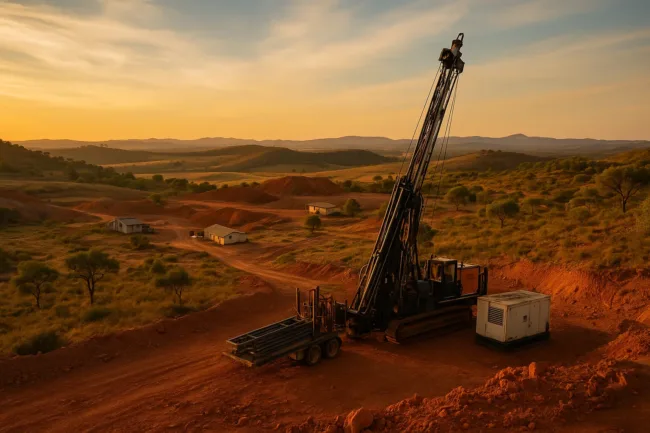



Bezant Resources Plc (AIM: BZT) has formally initiated shareholder approval proceedings for a proposed acquisition that could significantly reshape the future of its copper-gold development strategy in Namibia. The London-listed resource development firm released a circular on 19 November 2025, along with a notice convening a general meeting on 8 December 2025, to seek consent for the purchase of a 90 percent shareholding in Namib Lead and Zinc Mining (Proprietary) Limited. This transaction, if approved, would grant Bezant Resources operational control of the NLZM Processing Plant, a facility located approximately 190 kilometers from its Hope and Gorob Project site.
The NLZM Processing Plant, which had previously processed lead and zinc from the NLZM Project until operations ceased in 2020, is being positioned as a crucial piece of infrastructure to support pre-concentrate treatment for the Hope and Gorob ore body. According to Bezant Resources’ board, this strategic acquisition would allow the company to avoid the capital intensity, permitting delays, and infrastructure burdens typically associated with constructing a new processing facility in a remote location.
The circular highlights that the proposed acquisition is not only cost-effective and time-saving, but also essential for meeting key conditions of the project’s mining licence and related financing and offtake agreements. Failure to obtain shareholder approval would prevent the company from acquiring the processing plant, which could in turn delay or jeopardize the execution of the Hope and Gorob development timeline.
Why is the NLZM Processing Plant central to Bezant Resources’ project timeline?
Bezant Resources, which received its mining licence for the Hope and Gorob Project earlier this year, conducted a rigorous evaluation of mineral processing alternatives before arriving at the decision to pursue the NLZM Processing Plant acquisition. The facility, located in a more accessible region compared to the remote Hope and Gorob mine site, offers the advantage of being pre-permitted, grid-connected, and historically operational. These attributes make it an ideal candidate for retrofitting to process copper-gold pre-concentrate.
An external technical audit further validated the feasibility of using the plant with minor modifications. The pre-concentrate, once trucked from the Hope and Gorob site, would be processed at the NLZM facility to produce a marketable concentrate, thereby closing a critical operational loop for the project. In addition, the plant’s access to a state-operated water pipeline and grid power infrastructure significantly reduces the technical and financial risks associated with processing ore in remote areas.
What key financial, logistical, and regulatory gains does Bezant expect from acquiring the NLZM plant?
The acquisition is expected to lower capital costs dramatically. Constructing a greenfield processing facility for a copper-gold project typically requires substantial investment in engineering, procurement, construction, and commissioning. By acquiring an existing plant, Bezant Resources avoids this expense, thereby improving capital efficiency and enhancing the internal rate of return for the project.
The time-to-production cycle would also be significantly reduced. Greenfield developments often face delays due to regulatory processes, construction timelines, and supply chain bottlenecks. The NLZM facility, already built and previously in operation, could be adapted quickly to commence processing, potentially enabling first concentrate production on an accelerated schedule.
Regulatory efficiency is another critical advantage. Building a new facility would require extensive environmental, safety, and operational permitting, a process that is both time-consuming and uncertain. The NLZM facility already holds the necessary permits, eliminating the risk of permitting-related delays and fast-tracking the development pipeline.
From an infrastructure standpoint, the remote location of the Hope and Gorob Project presents significant challenges. A new facility would need access roads, energy generation, water supply, and a skilled workforce, all of which are harder to mobilize in an underdeveloped area. The NLZM plant, by contrast, is located in a region with existing access to transportation routes, grid electricity, water supply, and mining-related services.
Power availability is another often underestimated challenge in mining operations. Many junior miners struggle with the high cost and technical hurdles of securing reliable energy. The NLZM plant’s grid connection provides stable power access without requiring diesel-based or solar-hybrid microgrids, reducing both cost and carbon footprint. Additionally, its connection to a government water pipeline gives it a competitive edge over other potential processing locations.
The overall economic logic of the acquisition rests on a hybrid model where ore is sorted at the mine site and then trucked to the NLZM plant for final concentration. This approach is expected to maximize recovery, minimize transportation and processing costs, and deliver a higher net smelter return, thereby boosting project-level profitability.
How would a failed shareholder vote impact Bezant’s mining licence conditions, financing agreements, and the overall Hope and Gorob development timeline?
The shareholder circular is unambiguous in laying out the risks of not proceeding with the acquisition. If the resolution is not passed, Bezant Resources will lose access to the processing facility identified in its mining licence application. This would represent a direct breach of conditions set by the Namibian Ministry of Mines and Energy and would also invalidate certain terms of the company’s project financing and offtake agreements.
The lack of processing infrastructure would force Bezant Resources to revisit its development strategy from scratch, likely triggering delays of at least 18 to 24 months. Moreover, reinitiating site studies, permitting, and engineering for a greenfield facility could significantly inflate the project’s capital expenditure and extend the timeline for revenue generation.
While the rejection of the resolution would not result in an immediate break fee, the strategic implications are clear. Without a processing route, the Hope and Gorob Project cannot move into execution phase, placing its funding and long-term viability at risk.
How is director voting intent shaping investor sentiment as Bezant approaches the general meeting for the NLZM acquisition?
The board of directors, including Executive Chairman Colin Bird, has unanimously endorsed the resolution. Directors and connected parties together hold approximately 1.5 billion shares, equivalent to 8.81 percent of the company’s existing ordinary shares. These shares will be voted in favor of the acquisition.
Such board alignment signals strong internal conviction and sends a positive signal to retail and institutional investors. In small-cap mining companies, board participation often acts as a barometer for shareholder confidence, particularly when tied to tangible project execution milestones.
How is Bezant’s share price trending in 2025 and what does recent market activity reveal about investor sentiment?
Bezant Resources Plc has seen a dramatic rebound in its share price during 2025. As of 19 November 2025, the share price stood at 0.08 GBX, registering a daily gain of 5.63 percent. Over the past 12 months, the stock has appreciated over 400 percent from sub-0.02 GBX levels in late 2024 to highs exceeding 0.10 GBX in October 2025.
While recent trading shows a slight pullback from its October peak, the current price range indicates that investors are factoring in the value of the Hope and Gorob development pathway and the potential upside from the NLZM acquisition. With a bid-offer spread of 0.07–0.08 GBX and regular trading volume on the AIM market, Bezant Resources continues to show signs of rising liquidity and investor attention.
Analysts tracking small-cap copper and gold plays in Africa note that strategic processing solutions can be a major value unlocker. Investor appetite for copper, in particular, remains robust, with forward demand driven by energy transition technologies, grid electrification, and green infrastructure buildouts.
What post-vote milestones will investors monitor as Bezant moves to execute Hope and Gorob using the NLZM plant?
If shareholders approve the acquisition on 8 December 2025, attention will shift to execution metrics. These will include the timeline for plant modifications, integration updates, transportation logistics for ore trucking, and the commencement of commissioning work.
Bezant Resources is also expected to update the market on financing drawdowns, compliance filings, and progress against offtake agreements. Any delays or setbacks in repurposing the NLZM facility may be scrutinized closely by shareholders, particularly given the stock’s recent re-rating.
If the integration proceeds smoothly, Bezant Resources could potentially transition from an exploration-stage company to a pre-production developer by the end of 2026, a status that could significantly alter its valuation trajectory.
What are the key takeaways from Bezant Resources’ NLZM plant acquisition plan?
- Bezant Resources Plc (AIM: BZT) is seeking shareholder approval on 8 December 2025 to acquire a 90% stake in Namib Lead and Zinc Mining (Proprietary) Limited, which owns the NLZM Processing Plant in Namibia.
- The NLZM facility is intended to process copper-gold pre-concentrate from Bezant’s Hope and Gorob Project, located about 190 km away.
- The acquisition offers major benefits including lower capital expenditure, shorter time-to-production, streamlined permitting, and access to grid power and water infrastructure.
- The transaction is critical for compliance with the firm’s approved mining licence and is tied to conditions in its financing and offtake agreements.
- Failure to approve the acquisition may jeopardize project execution, delay production timelines, and breach licence conditions.
- Bezant’s directors, who control around 8.81% of outstanding shares, have pledged support for the resolution.
- Shares of Bezant Resources have risen more than 400% year-to-date, reflecting increased market confidence in the Hope and Gorob project.
- Investors will closely watch post-vote milestones such as plant retrofitting, ore logistics planning, financing drawdowns, and updated timelines for concentrate production.
Discover more from Business-News-Today.com
Subscribe to get the latest posts sent to your email.