

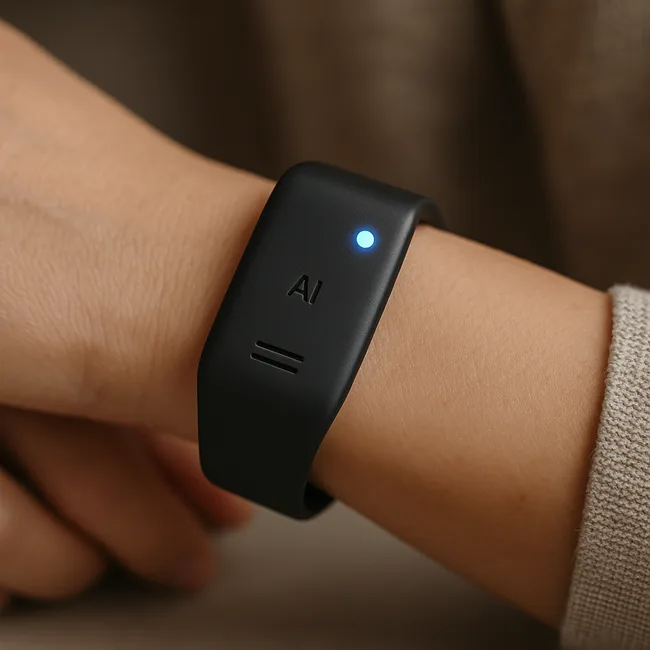
Amazon.com Inc’s (NASDAQ: AMZN) agreement to acquire Bee, the San Francisco-based startup behind an AI-enabled bracelet, is being seen as a calculated second attempt to capture wearable AI success. At just $49, Bee’s transcription-first device enters a market where Humane’s AI Pin faltered despite early hype. With longer battery life, lower pricing, and a privacy-first approach, the question is whether Amazon can transform Bee into a mainstream success where Humane failed to win trust or traction.
Why did Humane’s AI Pin stumble despite its first-mover advantage in wearable AI devices?
Humane’s AI Pin entered the market in 2023 positioned as a revolutionary, screenless smartphone alternative. At nearly $700, it carried premium pricing, but users were quick to point out its shortcomings. The device struggled to last a full day on a single charge, with some reporting battery drain in under eight hours. Heat generation and sluggish response times undermined its real-time assistance pitch.
Institutional observers believe Humane overpromised on replacing smartphones with holographic interfaces and gesture controls, but underdelivered on reliability. Even more damaging were privacy concerns—always-on cameras and microphones left consumers uneasy about who had access to their data. By 2024, Humane’s sales had plateaued, layoffs followed, and the AI Pin became a cautionary tale about overhyping early-generation wearables.
What makes Bee’s bracelet more appealing to early adopters of wearable AI technology?
Bee takes a narrower, utility-driven approach, focusing exclusively on speech transcription and productivity rather than lifestyle replacement. At $49 plus a $19 monthly subscription, it costs a fraction of the AI Pin, lowering the barrier for trial among budget-conscious professionals.
The device offers over 160 hours of battery life per charge, enabling several days of use before recharging—a key differentiator when compared to the AI Pin’s less-than-24-hour cycle. By avoiding power-hungry holographic features, Bee minimizes hardware strain and prioritizes reliability.
Its dual-microphone system with local noise filtering converts speech to text directly on the device, reducing dependency on cloud processing. This approach ensures faster delivery of meeting notes, to-do lists, and summaries, giving it a functional edge for workers, students, and content creators who value instant, searchable transcripts over flashy AR projections.
How do privacy safeguards differ between Bee’s AI bracelet and Humane’s AI Pin?
Bee was built with privacy as a core principle, an area where Humane faced criticism. Instead of retaining raw audio files, Bee’s bracelet processes speech locally and stores only text transcripts. Users have manual mute options and can delete conversation logs directly through its companion app.
Humane’s AI Pin, on the other hand, relied heavily on cloud-based storage, raising questions about unauthorized data access and third-party sharing. Privacy watchdogs in Europe and the U.S. flagged its lack of transparent consent protocols, limiting its global expansion.
Industry analysts expect Bee’s privacy-first design to give Amazon a regulatory advantage in markets governed by stricter consent laws such as the EU’s GDPR. The fact that transcripts, not audio files, are processed also aligns better with consumer expectations of minimal data exposure.
Can Amazon turn Bee into a mainstream success where Humane failed?
Institutional investors view Amazon’s entry as a low-risk but potentially high-impact bet on wearable AI. Unlike Humane, Amazon has the distribution power, marketing expertise, and Alexa ecosystem to scale quickly. If integrated with Alexa+, Bee could automate grocery lists, manage reminders, or control smart home devices, giving it utility beyond standalone transcription.
However, analysts warn that public skepticism around always-on devices remains a challenge. Amazon’s past privacy controversies, including Ring’s sharing of doorbell footage, have left some consumers wary. While Bee’s safeguards address these concerns, Amazon will need to reinforce trust with transparent policies and regular privacy audits to avoid regulatory backlash.
If Amazon succeeds in positioning Bee as a productivity tool rather than a lifestyle gadget, analysts believe the bracelet could penetrate niche markets—corporate meeting rooms, educational institutions, and even legal transcription—before moving into mass consumer adoption. Humane’s failure, in contrast, stemmed from trying to sell a radical lifestyle shift too early.
Discover more from Business-News-Today.com
Subscribe to get the latest posts sent to your email.