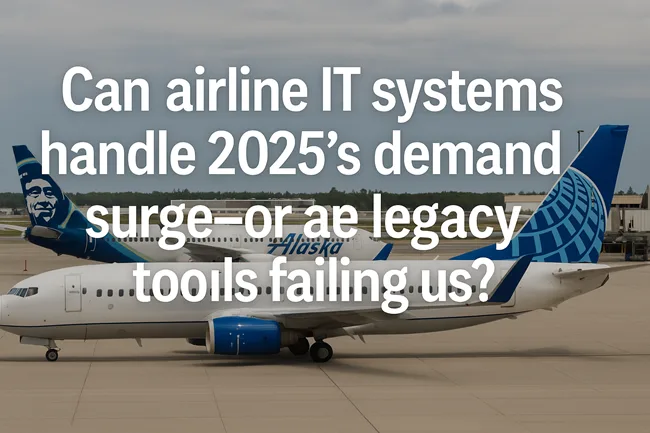
In a span of just weeks, two major U.S. carriers—United Airlines and Alaska Airlines—were forced to ground large portions of their fleets due to IT system failures. On August 6, 2025, United Airlines halted all mainline flights nationwide following a crash in its Unimatic system, which handles vital pre-flight calculations such as aircraft weight and balance. Less than a month earlier, Alaska Airlines experienced its own meltdown, citing a systemwide IT outage that disrupted hundreds of flights across North America.
These incidents aren’t isolated. They are the latest in a troubling pattern of technology-related airline disruptions that includes Delta Air Lines’ CrowdStrike-induced outages in 2024 and Southwest’s infamous 2022 holiday meltdown triggered by crew scheduling software failures. Taken together, they point to a critical question in the aviation industry today: Can airline IT systems actually handle 2025’s post-COVID demand surge, or are outdated tools creating an operational time bomb?
The context is clear. Global air travel demand has rebounded with force. According to the International Air Transport Association (IATA), passenger volumes in 2024 reached 94% of 2019 levels and are projected to exceed pre-pandemic benchmarks by the end of 2025. U.S. carriers have responded by scaling up route networks, staffing, and capacity—but many have done so on top of legacy IT stacks built decades ago.
United Airlines’ Unimatic system, for example, dates back to the 1980s. While modernized incrementally, it remains a mainframe-based tool with limited real-time flexibility. When the system failed on August 6, United’s crews were left without the weight and balance data needed for safe departures. Approximately 1,038 United flights were delayed that day, and nearly three dozen were cancelled, despite the airline insisting the glitch was not related to a cyberattack.
Alaska Airlines saw similar chaos in mid-July, when its IT network suffered a widespread failure. Though the company has not disclosed the precise cause, the outage grounded flights and forced mass rebookings. Customers posted on social media that they were “stuck on tarmacs,” and the airline had to issue flexible travel waivers across multiple airports in the western United States.
Why are airlines still relying on systems prone to single-point failures in 2025?
Industry analysts argue that legacy systems persist because replacing them is costly, risky, and complex. Many major U.S. airlines still rely on mainframe or Unix-based systems for mission-critical functions such as flight dispatch, crew scheduling, load planning, and passenger services. Overhauling these platforms would involve not only massive capital investment but also years of migration and retraining.
Yet, the risks of doing nothing are becoming more apparent. Research from aviation consultancy CAPA shows that each hour of major flight disruption can cost an airline between $150,000 and $400,000 in lost revenue, compensation, and operational recovery. When IT failures stretch into multi-hour or multi-day events, the financial impact becomes severe—and reputational damage can be long-lasting.
At a regulatory level, the Federal Aviation Administration (FAA) currently does not mandate IT resilience benchmarks for carriers, though it works closely with airlines during operational outages. In the wake of the United incident, Transportation Secretary Sean Duffy emphasized that the glitch did not compromise safety, but offered no indication of new oversight plans. Still, there is growing public and institutional pressure on the FAA and Department of Transportation to step in, particularly as digital systems now underpin nearly every aspect of flight operations.
Private-sector players are beginning to respond. Major cloud providers like Amazon Web Services and Microsoft Azure have launched tailored solutions for aviation data, while startups in the aviation software space are pushing API-first, cloud-native tools for scheduling, weight distribution, and gate management. However, adoption has been uneven. While low-cost carriers and newer international players are quicker to adopt cloud-native architectures, U.S. legacy carriers are often constrained by the complexity of their existing systems.
From an investor perspective, there is concern but little panic. United Airlines’ stock (NASDAQ: UAL) remained relatively stable following the August 6 disruption, signaling that markets view the event as a short-term operational glitch rather than a long-term risk. Still, institutional investors have flagged IT resilience as a governance issue in earnings calls, and some may press for greater disclosure in future quarterly reports.
For travelers, though, the consequences are immediate and personal. Delays, cancellations, and opaque communications during IT failures erode trust in the reliability of air travel—especially when they occur with increasing frequency.
If there is one lesson emerging from this pattern of digital failures, it’s that the aviation industry’s modernization problem is no longer theoretical. It’s grounded in real disruptions, affecting real passengers, with real costs. And unless airlines accelerate their shift to resilient, cloud-based, and decentralized systems, 2025 may not be the peak of post-COVID recovery—but the tipping point of avoidable collapse.
Discover more from Business-News-Today.com
Subscribe to get the latest posts sent to your email.