



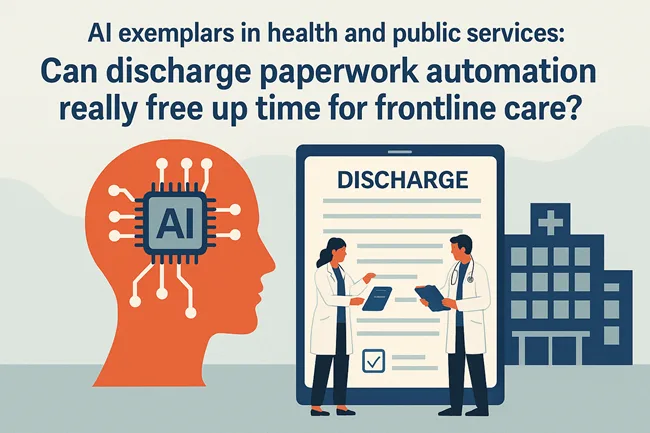
Patients across England could soon return home from hospitals faster thanks to a government-backed artificial intelligence programme designed to cut paperwork delays. The initiative, part of the Prime Minister’s AI Exemplars strategy, is being trialled at Chelsea and Westminster NHS Trust, where a new discharge summary tool is using large language models to draft patient documents that once took doctors hours to complete.
The project is one of several being fast-tracked under the AI Exemplars scheme, which is pitched as a cornerstone of the government’s Plan for Change. Alongside healthcare, other pilots span justice, education, planning, and civil service functions. Together, these initiatives are being framed by policymakers as proof that artificial intelligence can modernise frontline services, reduce inefficiencies, and free professionals to focus on tasks that require human judgment.
How does the AI discharge tool work and why is it seen as a breakthrough for NHS hospitals struggling with waiting lists?
The discharge tool extracts key patient information — diagnoses, test results, and treatment details — from medical records and automatically generates draft summaries. These are then reviewed by the attending doctor before being signed off for use in hospital systems and referrals.
At present, the process is paper-heavy and frequently subject to delays, as overworked clinicians often postpone administrative tasks until later in the day. That lag keeps patients waiting on wards longer than medically necessary, preventing beds from being freed up for new admissions.
The pilot is expected to cut waiting times by enabling clinicians to finalise discharge documents more quickly, while also reducing clerical errors. Mistakes in discharge notes — such as omissions in medication changes or inaccurate treatment records — have been cited in past NHS safety reports as a cause of avoidable risk.
Institutional sentiment around this development has been cautiously optimistic. Healthcare analysts suggest that if implemented successfully at scale, the tool could improve patient flow across hospitals, help reduce England’s widely publicised waiting list crisis, and give doctors more direct time with patients rather than with forms.
What are the wider implications of AI Exemplars across justice, planning, education, and the civil service?
Beyond healthcare, the AI Exemplars programme is introducing several sector-specific pilots.
In the justice system, the “Justice Transcribe” tool has been tested with probation officers to automatically transcribe and summarise post-release meetings with offenders. The pilot reportedly halved the time officers spent organising case notes, a change expected to improve officer availability for supervision and reduce administrative burdens. The Ministry of Justice plans to roll out the system to all 12,000 probation officers if final evaluations confirm its effectiveness.
In urban planning, another project named “Extract” is digitising decades-old, handwritten planning documents and maps. Officials estimate that manual checking consumes around 250,000 officer hours annually. Automating this process would accelerate housing approvals and infrastructure development pipelines, both politically sensitive areas where delays have long been criticised by developers and local councils.
In schools, the “AI Content Store” will assist teachers by standardising grading models and lesson planning tools. The government has framed this initiative as supporting its commitment to breaking down educational barriers by giving teachers more classroom-facing time with students rather than assessment paperwork.
Civil service reforms are being anchored around “Humphrey,” a suite of AI tools that includes “Consult,” designed to quickly analyse thousands of responses from public consultations and provide policy teams with structured dashboards. Independent testing under a new “social readiness” standard suggested broad public acceptance, with 82% of participants reporting a positive or neutral view of its use after structured focus groups conducted by Nesta.
How is the government positioning AI Exemplars within its broader plan for change and public sector productivity targets?
Officials, including Technology Secretary Peter Kyle, have described the programme as a blueprint for how technology can reshape government operations. Kyle pointed out that the government inherited a public sector marked by years of underinvestment, and said that AI exemplars were being used to demonstrate a pathway toward efficiency and smarter service delivery.
Health and Social Care Secretary Wes Streeting positioned the NHS pilot as part of the 10 Year Health Plan, promising that patients would spend less time in wards while doctors spend more time delivering direct care. Both officials highlighted that if scaled successfully, AI applications across government could unlock up to £45 billion in productivity gains.
The political narrative is also clear: by linking AI to tangible service improvements in hospitals, courts, schools, and local authorities, the government aims to shift public discourse away from abstract debates about artificial intelligence and toward practical examples where AI is seen as a service enabler.
What is the role of the NHS federated data platform and how does it enable the scaling of discharge automation?
The AI discharge summary tool is hosted on the NHS Federated Data Platform, a national system built to connect IT systems across healthcare services. This architecture allows discharge notes to be securely transferred between hospitals, community care providers, and general practitioners.
For policymakers, this integration is critical: it means the AI-assisted tool could be scaled beyond pilot sites without requiring bespoke local IT adjustments, significantly reducing deployment costs and timelines. If successful, analysts expect broader adoption across the NHS to become a central plank in efforts to digitise patient administration and reduce chronic waiting list pressures.
What has been the early institutional sentiment and what are the risks of overreliance on AI in public service delivery?
Institutional observers remain broadly supportive, noting that early pilots show measurable productivity gains. However, they caution that AI tools must not introduce new risks, such as biased outputs, data inaccuracies, or overreliance on automation without human oversight.
Healthcare unions and policy groups have stressed the importance of retaining clinician authority over final discharge documentation. In justice, some probation staff raised early concerns about whether automatic transcription could inadvertently capture sensitive or misinterpreted dialogue, requiring clear guardrails for confidentiality.
Despite these reservations, the general sentiment across institutional investors tracking government tech initiatives is that AI exemplars demonstrate a tangible move toward digital-first public services. While not directly tied to listed companies in the short term, suppliers of AI infrastructure, health IT platforms, and natural language processing technologies could see increased procurement activity if projects are rolled out nationally.
Could AI Exemplars reshape procurement opportunities for enterprise and health tech vendors in the UK market?
The programme is expected to generate significant procurement opportunities across both healthcare IT and broader enterprise software. Vendors with expertise in natural language processing, secure data integration, and sector-specific workflow automation may benefit from government tenders linked to exemplar scaling.
Investors watching UK-listed health technology and IT service firms have noted that successful deployment of these tools could accelerate adoption rates for cloud-based hospital systems, AI diagnostic support, and federated data platforms. That could, in turn, fuel revenue growth in a segment that has traditionally been slow to modernise due to budget constraints and legacy IT hurdles.
Institutional analysts suggest that while short-term investor gains will likely depend on contract awards, the long-term trajectory points toward deeper public-private partnerships in AI-enabled service delivery.
What is the outlook for AI adoption across the UK public sector following the exemplars programme?
The exemplars are being positioned as a proof-of-concept for the broader AI strategy across government. If pilots prove scalable, officials intend to roll them out across entire departments, with healthcare, justice, and planning seen as immediate priorities.
Over the next year, additional exemplar projects are expected to be announced, covering areas such as tax compliance and diagnostics. If successful, these could reinforce the government’s message that AI is not only a driver of growth but also a tool to alleviate strain on frontline services.
For the NHS specifically, the discharge tool represents one of the most concrete applications of AI yet trialled in daily clinical operations. If waiting lists begin to fall meaningfully, public sentiment toward AI-enabled healthcare may turn more favourable, giving policymakers political cover to expand adoption further.
Discover more from Business-News-Today.com
Subscribe to get the latest posts sent to your email.