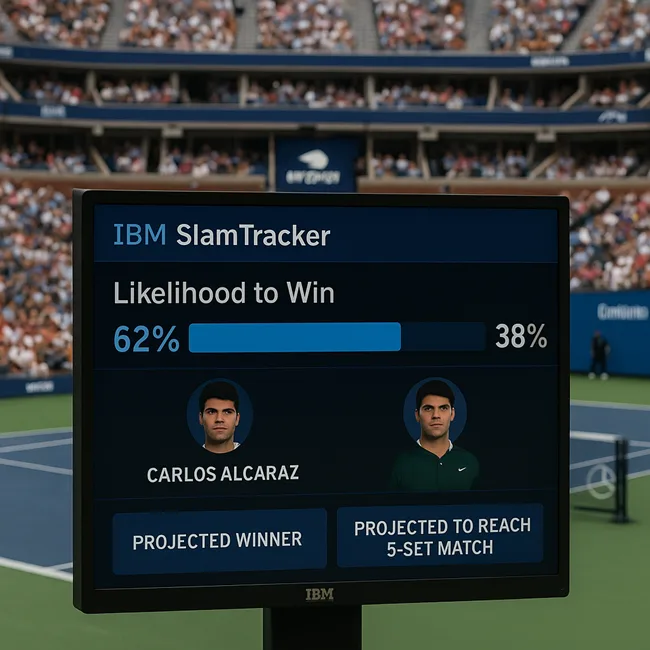
When IBM (NYSE: IBM) and the United States Tennis Association (USTA) rolled out their latest set of AI-powered features for the 2025 US Open, one tool in particular caught the spotlight: the enhanced IBM SlamTracker. Unlike traditional match stats, SlamTracker now delivers “Likelihood to Win” projections that shift in real time with every rally, serve, and break point. For tennis fans glued to their screens, this kind of predictive insight could make the sport more interactive than ever. But it also raises a bigger question — does algorithmic commentary make tennis more watchable, or does it risk taking some of the human drama out of the game?
How does SlamTracker’s win probability model change the way fans follow matches in real time?
The new SlamTracker doesn’t just churn out percentages — it blends player performance metrics, historical data, and momentum analysis to generate probabilities that adjust with the flow of a match. For instance, if a player like Carlos Alcaraz converts a crucial break point early in the third set, the projected odds of him winning may spike dramatically.
This feature isn’t new to tennis, but it is more advanced than before. SlamTracker first appeared at the US Open in 2012, offering fans a dashboard of serve percentages and unforced errors. A decade later, the tool has evolved into a fully predictive model powered by IBM’s watsonx AI. That leap reflects not just advances in machine learning but also the shift in audience expectations — fans no longer just want raw stats, they want probabilities and predictive context.
Are predictive analytics making sports feel more like Wall Street trading than pure competition?
The comparison to financial markets isn’t just a metaphor. Predictive tools like SlamTracker mirror the same algorithmic dashboards used by traders and analysts — rapid shifts, probabilistic outcomes, and data visualizations that encourage constant recalibration of expectations.
Some fans love this transparency. For them, tennis becomes less of a mystery and more of an interactive experience, where numbers confirm or challenge what they’re seeing on court. But others argue that tennis, at its core, thrives on unpredictability — the moment when a player defies expectations and momentum flips on its head. By quantifying every twist with a probability model, AI risks reducing drama into math, potentially flattening the “anything can happen” feeling that makes sport so gripping.
Does AI commentary enhance or distract from the authenticity of live sport?
Beyond SlamTracker, IBM is also deploying AI Commentary to generate audio and subtitle recaps of highlights. This ensures fans scrolling on mobile get instant summaries, but it also raises another authenticity dilemma. Can AI, no matter how well-trained, replicate the passion of a seasoned commentator capturing the emotion of a 20-shot rally or a five-set thriller?
Some argue that AI-generated highlights are simply a practical necessity. With hundreds of matches running in parallel during the US Open, no human broadcast team could possibly keep up at scale. For global fans, AI-generated commentary fills a real gap, offering access where live announcers may not be available. But when it comes to the flagship matches, purists may find it hard to accept machine-rendered narration over the voice of a legendary broadcaster.
How does SlamTracker compare with AI-driven fan tools in other global sports?
Tennis isn’t alone in this experiment. Formula 1 viewers already see AWS-powered graphics projecting tyre degradation, pit stop strategies, and race-win probabilities. Microsoft has brought predictive dashboards to the NBA, showing how player lineups influence win chances. In cricket, win predictors have become a staple of live broadcasts across India.
By comparison, IBM’s SlamTracker aims to keep tennis competitive in the attention economy — ensuring the sport doesn’t feel behind when younger fans expect the same data-rich overlays they get from other leagues. The message is clear: to attract new viewers, tennis must modernize how it tells the story of a match.
What does this mean for IBM’s AI credibility with investors and enterprises?
While the US Open deployment won’t dramatically shift IBM’s revenue, it serves as a showcase of watsonx’s scalability. For institutional investors, seeing IBM’s AI deliver real-time outputs for millions of fans strengthens confidence in its enterprise readiness. The brand value of being the “AI behind the US Open” is not trivial — it positions IBM alongside other global tech giants vying for dominance in applied sports analytics.
Investors have broadly welcomed IBM’s pivot to AI-driven solutions, and SlamTracker is part of the narrative that IBM’s technology is not theoretical but already working at scale. For enterprises in finance, healthcare, or retail, the connection is obvious: if watsonx can track live probability shifts in a five-set thriller, it can also power real-time risk models or customer insights.
What does this mean for the future of watching tennis and other live sports?
The USTA’s bet on IBM’s watsonx-powered features is not just about keeping score — it’s about redefining the very experience of being a fan. For younger audiences accustomed to interactive TikTok feeds and personalized content, predictive insights and AI-driven highlights feel natural, even expected. For traditional fans, however, there may be resistance to anything that looks like technology encroaching on the purity of sport.
In the long run, the likely reality will be a hybrid. SlamTracker and AI commentary will coexist with traditional broadcasters, giving fans the choice of depth or drama, numbers or narrative. What matters is that IBM has successfully positioned AI not as a futuristic gimmick but as a present-day tool that already reshapes how fans engage with tennis.
Discover more from Business-News-Today.com
Subscribe to get the latest posts sent to your email.