




Israel’s Prime Minister Benjamin Netanyahu delivered one of his most defiant speeches yet at the United Nations General Assembly on September 26, 2025. But instead of the usual applause that punctuates world leader addresses, the moment was defined by a wave of walkouts. Dozens of delegations left the chamber in protest, while Netanyahu’s remarks were simultaneously broadcast into Gaza using loudspeakers and mobile networks commandeered by Israel. The episode encapsulated both Israel’s diplomatic isolation and the prime minister’s determination to project strength on the global stage.
Why did delegates walk out during Netanyahu’s speech at the United Nations and what message did it send?
The exodus of diplomats as Netanyahu spoke underscored the growing gap between Israel and much of the international community. Delegations from Latin America, Europe, Africa, and the Middle East reportedly stood up and left the hall when he began criticizing recent recognitions of Palestinian statehood. Among the countries that remained were the United States and the United Kingdom, though senior representatives were notably absent and replaced by lower-level staffers.
The symbolism was stark. Walkouts during General Assembly speeches are rare and usually reserved for moments of high protest, such as speeches by Iran’s Mahmoud Ahmadinejad or Russia’s more recent UN interventions. In Netanyahu’s case, the mass departure highlighted how Israel’s conduct in Gaza has triggered mounting diplomatic backlash. It also signaled frustration with Israel’s refusal to engage with proposals for a ceasefire or humanitarian corridor, even as civilian suffering dominates international headlines.
For Israel, the optics were damaging. Netanyahu stood largely alone at the podium, delivering his message to rows of empty seats. For protestors, the walkout was a way to deny legitimacy to what they saw as incendiary rhetoric.
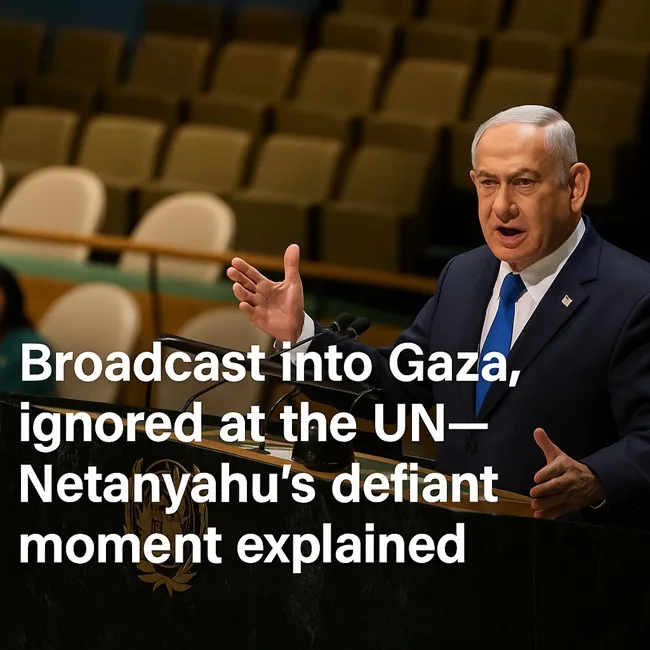
How did Netanyahu use the speech to directly address Palestinians in Gaza and the hostages held there?
What set this address apart from past speeches was not just its defiance, but its delivery method. Netanyahu’s office confirmed that his speech was relayed into Gaza using loudspeakers placed along the border, while Israeli forces temporarily hijacked mobile phone signals to broadcast the address directly to residents.
The tactic was designed to serve multiple audiences. To Palestinians in Gaza, Netanyahu framed the speech as both a warning and a reassurance. He declared that Israel would continue its military operations until Hamas was “finished,” but also insisted that Israel had not forgotten the hostages still held inside the enclave. His message was meant to bypass Hamas’s control of local media and speak directly to ordinary residents, appealing to them to see Hamas as the cause of their suffering.
At the same time, the broadcast was aimed at Israelis watching from home. By showing that he was speaking directly into Gaza, Netanyahu reinforced his domestic image as a leader unwilling to compromise or be constrained by global criticism. The speech therefore doubled as psychological warfare against Hamas and a performance of political strength for his base.
What role did recognition of Palestinian statehood play in the controversy surrounding the speech?
In his remarks, Netanyahu lashed out at nations such as France, Canada, the United Kingdom, and Australia, all of which recently moved toward formal recognition of a Palestinian state. He argued that such actions were effectively rewarding terrorism by legitimizing Hamas and undermining Israel’s security.
His choice of words triggered the walkouts. For many countries, recognition of Palestinian statehood is seen as a step toward reviving the two-state solution after decades of stalemate. For Israel’s leadership, however, it is framed as a betrayal that emboldens militants.
The divide is not merely rhetorical but strategic. Countries recognizing Palestine are betting that pressure on Israel is the only way to push negotiations forward, while Netanyahu has doubled down on the belief that only military victory will bring security. His speech made it clear that he has no intention of yielding to external diplomatic moves, positioning Israel as an embattled but defiant state.
What has been the reaction from Palestinian leaders and institutions to Netanyahu’s UN strategy?
Reactions from Palestinian leaders were swift and predictably hostile. Hamas-run outlets dismissed Netanyahu’s remarks as propaganda, accusing Israel of using the broadcast tactic to mask war crimes in Gaza. Hamas spokespeople argued that commandeering phone lines to force people to listen was a form of psychological coercion rather than outreach.
Meanwhile, Palestinian Authority President Mahmoud Abbas sought to distance his government from Hamas but also doubled down on calls for international recognition of Palestinian statehood. In his own address to the General Assembly, Abbas argued that the two-state solution remained the only viable path to peace and urged countries to formalize recognition.
For Palestinians, Netanyahu’s broadcast was less a direct communication and more a demonstration of control. The perception that Israel could cut into communications reinforced anger over blockades, infrastructure destruction, and the broader humanitarian crisis. Instead of persuading, the tactic may have deepened resentment.
How does this speech fit into Israel’s broader diplomatic standing and what does it reveal about global sentiment?
Israel’s current diplomatic posture is increasingly fragile. While it retains strong backing from the United States and maintains military support agreements, its broader international alliances are fraying. The walkouts showed that even traditional partners are keeping Netanyahu at arm’s length, wary of being associated with policies widely seen as contributing to humanitarian catastrophe.
European Union states are split between solidarity with Israel and sympathy for Palestinians. Latin American governments, long vocal critics of Israeli policy, are now joined by African and Asian states pressing for accountability. The United Nations, where symbolic gestures carry political weight, is becoming a stage where Israel’s isolation is amplified.
Institutional sentiment reflects this divide. While U.S. defense contractors and Israeli defense equities continue to benefit from military support, global investors are increasingly concerned about geopolitical risk. Sovereign wealth funds in the Middle East are under pressure not to engage with Israeli entities, and European pension funds have flagged Israel’s war conduct as an ESG liability.
What challenges remain for Israel as it seeks to balance domestic resilience with international pressure?
Netanyahu’s biggest challenge is the dual front of military necessity and diplomatic fallout. Domestically, his message of strength plays well with right-leaning voters who see concessions as dangerous. Yet internationally, Israel’s narrative is losing traction. The United States remains its most important shield at the UN Security Council, but even Washington is grappling with internal divisions over continued support.
The humanitarian cost of the war is also shifting sentiment. Civil society organizations, academic institutions, and NGOs are increasingly critical, creating reputational risks for companies and governments aligned with Israel. If the war continues without visible progress on hostages or Hamas, Netanyahu risks turning isolation into long-term estrangement.
What does Netanyahu’s UN speech and Gaza broadcast reveal about Israel’s diplomatic future and its struggle to balance security with global isolation?
The walkouts at the United Nations and the decision to broadcast directly into Gaza encapsulate the contradictions of Israel’s current moment. Netanyahu sought to project dominance, showing that Israel would neither bow to international opinion nor soften its military stance. Yet the empty seats at the UN revealed the limits of that defiance.
Israel now faces a precarious balancing act: maintaining deterrence against Hamas while avoiding complete alienation on the world stage. For investors and institutions, the episode is a reminder that Israel’s geopolitical risks remain deeply tied to leadership choices and war outcomes. For Palestinians, the broadcast highlighted both Israel’s technological reach and its unwillingness to offer a political path forward.
Ultimately, Netanyahu’s gamble is that military success will outlast diplomatic costs. Whether that calculation holds depends not only on battlefield outcomes but on how long Israel’s allies, and its citizens, are willing to accept global isolation as the price of security.
Discover more from Business-News-Today.com
Subscribe to get the latest posts sent to your email.