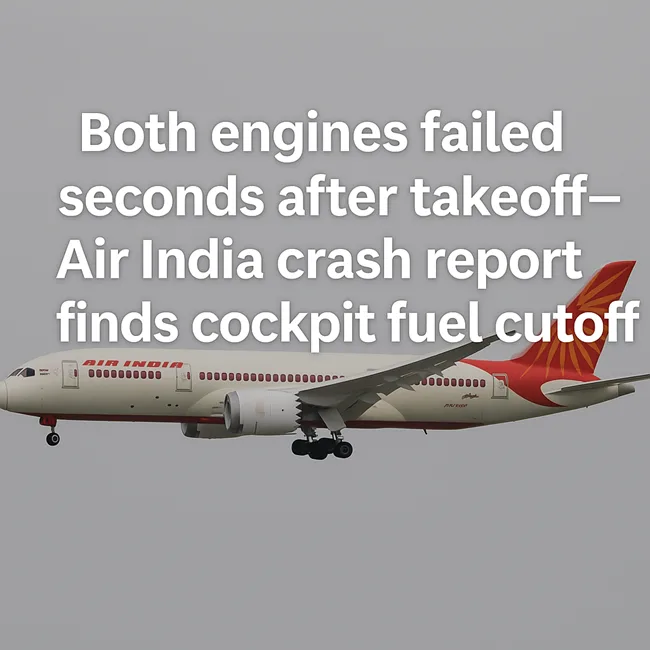
On June 12, 2025, just three seconds after liftoff, both fuel-control switches on Air India Flight AI 171 were moved from “RUN” to “CUTOFF,” triggering an immediate dual engine failure that led to a deadly crash near Ahmedabad. The Boeing 787‑8 Dreamliner, flying from Ahmedabad to London Gatwick, lost all thrust within seconds and struck a medical college building, killing 260 people—241 onboard and 19 on the ground. Only one passenger survived.
Flight AI 171 had reached approximately 180 knots when cockpit data recorded a manual movement of the left and right engine fuel switches. These actions, taken one second apart, effectively halted fuel supply to both engines. The Aircraft Accident Investigation Bureau (AAIB) stated that there was no mechanical fault, engine fire, or external emergency to justify such a maneuver. The flight’s trajectory collapsed within seconds, with a distress call issued before impact 29 seconds after takeoff.
Cockpit voice recordings revealed a startling exchange between the pilots. One asked, “Why did you cut off?” to which the other replied, “I did not.” This has intensified scrutiny as aviation experts argue that the toggles cannot be switched unintentionally. The switches are housed with protective guards, making accidental activation nearly impossible.
What led to the fuel cutoff switch activation just seconds into the flight?
According to the AAIB’s 15-page preliminary report, there were no indications of fire, bird strike, or system malfunction. Instead, both switches were physically toggled from RUN to CUTOFF in a space of one second, three seconds into the flight. No cockpit alarms were triggered before the switches were moved, nor were there any engine alerts. The incident resulted in total thrust loss at a dangerously low altitude. The crew attempted to recover one engine by resetting the switch, but the aircraft had already entered a terminal descent.
Investigators confirmed that emergency systems such as the ram air turbine deployed correctly and one engine briefly reignited. However, the aircraft crashed before any lift could be regained. Aviation experts have emphasized that even a single fuel switch movement would require a conscious and physically deliberate action, let alone two within such a narrow window.
Why is the Air India crash raising international pressure on Indian aviation oversight?
The crash is the deadliest involving an Indian carrier in decades and the first fatal accident involving a Boeing 787 aircraft. It comes at a time when India is projecting itself as a fast-growing aviation market, led by the Tata Group’s consolidation of full-service and low-cost brands under the Air India banner. The AI 171 tragedy has drawn global attention to regulatory oversight, pilot training, and safety enforcement.
India’s Directorate General of Civil Aviation (DGCA) is conducting parallel checks across Air India’s widebody fleet, including fuel systems, engine control logic, and cockpit switch mechanisms. Tata-owned Air India has suspended use of the flight number and initiated ₹1 crore compensation per victim under Montreal Convention terms. Independent legal firms, particularly in the UK, have urged families not to accept preliminary payouts until full accountability is established.
British Prime Minister Keir Starmer called the incident “deeply distressing” and confirmed 53 UK citizens were among the deceased. King Charles III acknowledged the tragedy with a moment of silence during the Trooping the Colour ceremony. The UK’s Air Accidents Investigation Branch is participating in the probe, along with experts from the FAA, NTSB, and GE Aerospace, under ICAO guidelines.
What does the AAIB’s preliminary report tell us about pilot actions and flight deck procedures?
The report highlights that both Captain Rajeev Mehta and First Officer Priyanka Singh were fully qualified, recently cleared on Boeing 787 proficiency checks, and had logged over 8,000 hours of combined flying experience. Neither had active medical or disciplinary flags. Yet, the recorded dialogue and timing of fuel switch activations suggest either an intentional human input or an unexplainable procedural deviation.
Industry experts such as Captain Mohan Ranganathan argue that “those switches do not move unless someone makes them move.” Aviation safety analyst Terry Tozer described the actions as “absolutely bizarre,” citing that in 30+ years of flying he has never seen fuel switches toggled during a normal climb. U.S. aviation specialist John Cox concurred, stating that unintentional movement was virtually impossible given the design of the switches and their protected enclosures.
What broader safety reforms could this incident trigger across global aviation?
Aviation regulators worldwide are watching closely. The use of manual fuel cutoff switches, their accessibility, and their response behavior under different flight conditions are expected to be reviewed. Airlines operating Boeing 787 Dreamliners have been advised to reinforce standard operating procedures for takeoff and cockpit configuration audits.
Experts say more airlines may now explore adding hardware interlocks or real-time cockpit monitoring tools that prevent critical toggles from being misused or manipulated without system prompts. In addition to mechanical reviews, this event is likely to renew calls for pilot mental health screening and real-time analytics on inflight crew activity.
The European Union Aviation Safety Agency has issued a watch advisory, though it has stopped short of recommending operational restrictions. Air India has committed to a complete review of cockpit protocols, aircraft interface design, and pilot workflow documentation.
When can families and the public expect answers and systemic accountability?
The AAIB has stated that the final investigation report will be released within 12 months, as mandated under ICAO norms. This final report is expected to delve into pilot behavior, training documentation, mental and physical health records, maintenance cycles, and mechanical reliability. The bureau has not yet issued interim safety recommendations, citing the need for complete analysis. Critics argue this delay may weaken public trust and safety culture during a critical period of airline expansion.
Meanwhile, the only survivor, Vishwash Kumar Ramesh, a British-Indian national, has told investigators that the aircraft felt “stuck in the air” before a rapid descent. His testimony has become central to survivor rights groups and aviation lawyers pushing for criminal investigations and pilot accountability.
As Indian aviation recovers from this blow, public confidence remains fragile. Political leaders, including Civil Aviation Minister Ram Mohan Naidu, have assured transparency, but critics demand quicker reforms and interim findings to reassure passengers and families. The broader conversation now includes regulatory independence, airline consolidation risks, and how cockpit decision-making should evolve in an era of growing global traffic.
Discover more from Business-News-Today.com
Subscribe to get the latest posts sent to your email.