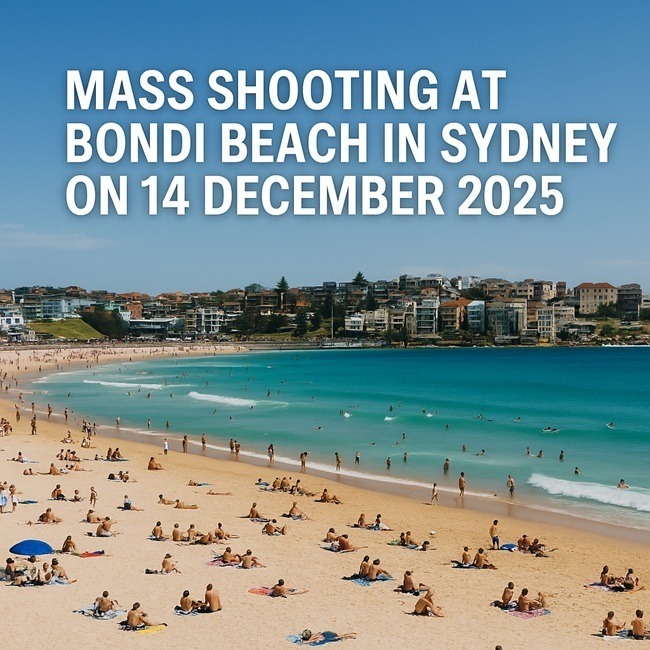
A mass shooting at Bondi Beach in Sydney on 14 December 2025 disrupted a public Hanukkah gathering known as Chanukah by the Sea, prompting a large-scale emergency response. The attack took place near Campbell Parade in the eastern suburbs of Sydney and prompted an immediate response from the New South Wales Police Force and emergency medical services. Authorities confirmed that the incident resulted in at least twelve deaths, including one of the alleged attackers, and left at least twenty nine people injured. Two police officers were among those wounded while responding to the scene. The attack was formally designated a terrorist incident by Australian authorities.
Police confirmed that two individuals opened fire on the crowd during the event, which was attended by hundreds of people marking the first night of Hanukkah. One of the attackers was shot and killed by police at the scene. The second suspect was taken into custody in critical condition. Law enforcement units secured the surrounding area and urged members of the public to avoid Bondi Beach while specialist teams conducted searches for additional threats. A suspected improvised explosive device was located in a vehicle linked to the suspects and was removed for examination by bomb disposal specialists.
The New South Wales Police Force stated that the attack was treated as a targeted act of terrorism. Senior officials confirmed that evidence indicated the Jewish community gathered for the religious celebration was deliberately targeted. The investigation was handed over to counterterrorism units operating under state and federal frameworks.
What exactly happened during the Bondi Beach terror attack targeting a Hanukkah celebration in Sydney
The shooting began in the early evening as families and community members gathered along the beachfront for a public religious event. Witnesses reported hearing multiple gunshots, triggering panic as people fled toward nearby streets, businesses, and residential buildings. Emergency responders arrived within minutes, establishing a security perimeter and administering first aid to the injured before transferring victims to hospitals across Sydney.
Police confirmed that the attack unfolded over a short period before armed officers engaged the suspects. One attacker was neutralized at the scene. The second was restrained and later transferred under guard to a medical facility. Authorities conducted a coordinated evacuation of the surrounding precinct, including sections of the beachfront and nearby transport routes, as a precaution while investigations continued.
Why Australian authorities classified the Bondi Beach shooting as a terrorist incident
Australian officials classified the attack as terrorism based on the intent, target selection, and circumstances of the assault. New South Wales Premier Chris Minns stated that the evidence clearly pointed to an intentional attack on a religious gathering. Prime Minister Anthony Albanese described the incident as an act of antisemitic terrorism, confirming that national security agencies were involved in the investigation.
The Australian Security Intelligence Organisation had previously identified antisemitism as a significant domestic security concern. Law enforcement officials stated that one of the suspects had been known to authorities prior to the attack, though not assessed as posing an immediate threat at the time. Investigators have not publicly confirmed any formal organizational affiliations linked to the suspects.
How the Bondi Beach attack fits into Australia’s broader antisemitism and security context
The Bondi Beach attack occurred amid a documented increase in antisemitic incidents across Australia over the past two years. Jewish community organizations and federal authorities have reported rising cases of harassment, vandalism, and threats targeting synagogues, schools, and public events. This trend has coincided with heightened global tensions linked to conflicts in the Middle East, which Australian security agencies have acknowledged as a contributing factor to domestic polarization.
In response to these developments, the Australian Government established a national antisemitism task force and strengthened coordination between federal, state, and local authorities. The Bondi Beach attack represents the most lethal act of ideologically motivated violence in Australia in decades, intensifying scrutiny of existing counterterrorism and community protection measures.
How emergency services and civilians responded during the Bondi Beach shooting
Emergency medical teams treated dozens of victims at the scene before transferring them to major hospitals across Sydney. Police confirmed that multiple ambulances were deployed and that trauma services were placed on high alert. Authorities later acknowledged acts of civilian intervention during the attack, including a bystander who subdued one of the attackers before police engagement.
Bomb disposal units conducted systematic searches of nearby areas following the discovery of a suspected explosive device. Police maintained road closures and security cordons throughout the night as forensic teams processed the scene and collected evidence.
Why the Bondi Beach attack is historically significant for Australia’s national security framework
Australia has experienced relatively few mass casualty attacks since the introduction of comprehensive gun control reforms following the 1996 Port Arthur massacre. The Bondi Beach shooting now stands among the deadliest acts of violence in the country’s modern history. Its classification as a terrorist incident highlights evolving security challenges associated with lone actor and small cell attacks motivated by ideological extremism.
Security analysts note that the use of firearms in a highly visible public location underscores the difficulty of fully mitigating risks posed by determined attackers, even within strict regulatory environments. The incident has renewed focus on intelligence coordination, community reporting mechanisms, and protective security for public religious events.
How domestic institutions and international governments responded to the Bondi Beach terror attack
Australian political leaders across party lines issued statements condemning the attack and expressing condolences to victims and their families. The Prime Minister convened security briefings with federal and state agencies, while the New South Wales Government committed additional resources to support affected communities.
International reactions followed swiftly. Leaders from the United Kingdom, Germany, France, Italy, and Switzerland issued formal statements condemning the attack and expressing solidarity with Australia. Officials from the European Union reiterated opposition to antisemitism and terrorism. Israeli government representatives described the incident as part of a broader global rise in antisemitic violence and emphasized the need for continued international cooperation to protect Jewish communities worldwide.
What investigative and public safety priorities remain after the Bondi Beach attack
Australian authorities continue to conduct forensic analysis, witness interviews, and background investigations related to the suspects. Police have appealed for additional video and photographic evidence from members of the public. Security presence remains elevated around places of worship and major public venues in Sydney and other Australian cities.
Officials have emphasized that the investigation remains ongoing and that findings will be released in accordance with legal and security protocols. Authorities have reiterated their commitment to transparency and public safety while cautioning against speculation during the investigative process.
Key takeaways on what the Bondi Beach terror attack means for Australia and the global security environment
- Australian authorities formally classified the Bondi Beach shooting as a terrorist attack targeting a Jewish religious gathering, triggering state and federal counterterrorism investigations.
- The incident represents one of the deadliest acts of mass violence in Australia in decades and has intensified scrutiny of domestic extremism and antisemitism risks.
- Federal and state institutions activated enhanced security measures around religious and public sites following the attack.
- International governments and multilateral institutions issued coordinated condemnations, reinforcing global concern over rising antisemitic violence.
- The attack has underscored ongoing challenges in preventing ideologically motivated violence in open public spaces, even in countries with strict gun control frameworks.
Discover more from Business-News-Today.com
Subscribe to get the latest posts sent to your email.