





BASF SE (Frankfurt: BAS, OTC: BASFY) has taken a major step forward in its sustainable intermediates strategy with the commissioning of a new neopentyl glycol (NPG) production facility at its Zhanjiang Verbund site in southern China. The new plant, which has begun customer deliveries, adds 80,000 metric tons of annual capacity to the German chemical giant’s global NPG output. This brings BASF’s total global NPG production capacity to 335,000 metric tons per year, reinforcing its position as one of the world’s largest producers of the specialty intermediate.
The milestone also marks the market debut of NEOL Neopentylglycol Solution 90% rPCF AP, a reduced product carbon footprint (rPCF) variant of NPG developed for the Asia Pacific region. The Zhanjiang-made NEOL variant is BASF’s first rPCF-classified NPG to be manufactured using 100 percent renewable electricity and designed to offer a quantifiable reduction in lifecycle emissions relative to the company’s own benchmarks across its existing Asian plants.
This dual announcement—capacity expansion and low-carbon innovation—signals an aggressive regional push by BASF SE to meet the growing demand for high-performance, low-emission materials across construction, automotive, appliances, electronics, and general manufacturing sectors in Asia Pacific.
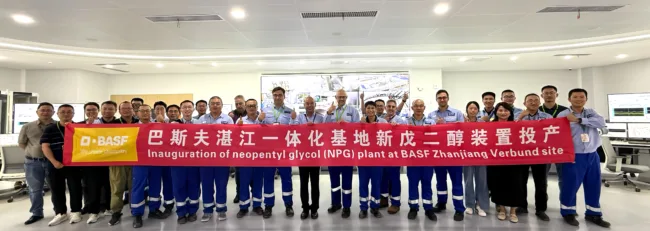
How BASF SE is responding to Asia Pacific’s demand for low-emission coatings and specialty intermediates
Powder coatings, a key application for NPG, have gained traction as an eco-friendlier alternative to traditional liquid coatings. With significantly lower volatile organic compound (VOC) emissions, powder coatings support manufacturers in complying with tightening environmental standards while maintaining surface durability and finish quality. BASF SE’s expansion in China comes at a time when regulators across the region—from China to India to Southeast Asia—are increasingly enforcing VOC limits in both industrial and consumer applications.
Michael Becker, Senior Vice President of Intermediates Asia Pacific at BASF SE, stated that the plant enhances BASF’s local production footprint and speed to market. He noted that faster, more reliable delivery of eco-friendly intermediates is now essential to meet rising customer expectations. Becker added that the Zhanjiang plant is a cornerstone in the company’s broader goal of becoming the partner of choice for sustainable intermediates in the Asia Pacific region.
Institutional sentiment around the announcement has been generally favorable, especially among analysts tracking the coatings and advanced materials sectors. Given Asia’s position as a major manufacturing hub and its accelerating shift toward low-carbon procurement strategies, BASF SE’s investment in localized, sustainable chemical production is being seen as a proactive and demand-aligned growth move.
What makes NEOL NPG different from conventional NPG and why it matters for decarbonization
The new NEOL Neopentylglycol variant—classified as rPCF—reflects BASF SE’s strategy to embed carbon transparency and sustainability metrics into its core intermediates portfolio. The rPCF designation stands for “reduced product carbon footprint,” and signifies at least a 10 percent reduction in cradle-to-gate greenhouse gas emissions compared to the company’s standard NPG offering in the region.
The NEOL product is manufactured at Zhanjiang using a combination of 100 percent renewable electricity, advanced feedstocks with lower embedded emissions, and high-efficiency production technologies. These efficiencies are made possible in part by the Verbund site’s integrated design, which allows for optimized energy flows, material reuse, and emissions control.
BASF SE has stated that preliminary lifecycle analyses conducted under ISO 14067:2018 show a lower product carbon footprint for Zhanjiang-made NEOL compared to NPG produced at its other Asian sites. However, these figures are currently based on internal calculations and have not yet been certified by a third-party panel. The company has committed to ongoing verification and transparency as part of its broader sustainability reporting.
From a market perspective, the NEOL launch provides industrial buyers with a differentiated offering that supports their own ESG and Scope 3 emission reduction goals. In categories like powder coatings, automotive primers, and electronics coatings—where VOCs and embodied carbon are now scrutinized by regulators and customers alike—having access to low-PCF feedstock can offer both compliance advantages and reputational benefits.
Why the Zhanjiang Verbund model enhances both operational efficiency and sustainability outcomes
The Zhanjiang Verbund site represents BASF SE’s commitment to smart, scalable, and climate-aligned production infrastructure in Asia. As a fully integrated facility, it follows the Verbund principle pioneered by the company to maximize resource efficiency and reduce emissions through co-located production lines, shared utilities, and waste reuse loops.
By integrating the new NPG unit within the Verbund structure, BASF SE is able to reduce energy consumption, minimize raw material losses, and capture byproducts for use in adjacent processes. This systemic efficiency is especially valuable in producing intermediates like NPG, where energy intensity and feedstock emissions have traditionally posed cost and environmental challenges.
Operationally, the site design also allows BASF SE to respond more flexibly to demand surges, shorten lead times, and localize supply chains. These are key concerns for customers in the region, especially in the wake of recent global supply chain disruptions and mounting geopolitical pressure to regionalize critical chemical inputs.
Institutional analysts covering Asian manufacturing and materials sectors have pointed out that Verbund-enabled sites like Zhanjiang could give BASF SE a long-term competitive edge, not only on cost and sustainability but also on supply chain reliability and localization—factors increasingly weighted in B2B contract awards across Asia.
What the expansion means for BASF SE’s Intermediates business and investor outlook
The Intermediates division at BASF SE includes over 600 products ranging from amines, diols, polyalcohols, and acids to pharmaceutical ingredients and agricultural solutions. The division has been an active focus of sustainability-linked investment, particularly in the areas of recycled content, renewable inputs, and carbon footprint reduction.
The Zhanjiang NPG expansion positions BASF SE to capture growth in several high-value verticals. Beyond powder coatings, NPG is also used in the production of lubricants, plasticizers, and pharmaceutical active ingredients such as ibuprofen. With the NEOL variant offering an emissions advantage, it may also gain traction among pharmaceutical manufacturers looking to decarbonize their supply chains.
Financial analysts believe that the move may support gradual margin improvement in the Intermediates segment over the next few quarters, particularly if demand holds steady in end markets like construction and automotive, which are rebounding in several key Asian economies. Although BASF SE has not disclosed the CAPEX value or expected payback period for the new plant, market sentiment suggests that Verbund cost efficiencies may allow for faster returns compared to standalone greenfield facilities.
How BASF SE’s sustainability focus is impacting its stock performance and institutional sentiment
BASF SE shares (Frankfurt: BAS) have shown stable performance in Q4 2025, reflecting investor confidence in the group’s strategic focus on decarbonization and circular chemistry. In the United States, BASFY—the American Depositary Receipt—has also seen moderate inflows, with ESG-focused institutional investors and sustainable ETF funds adding exposure in recent weeks.
Investor sentiment toward BASF SE’s Intermediates division has generally improved following the Zhanjiang commissioning, especially among analysts tracking sustainability-adjusted EBITDA metrics. With regulatory pressure mounting in Asia and customer preferences shifting toward lower-carbon alternatives, BASF SE’s ability to offer independently verified rPCF products is expected to improve its pricing power and customer retention in premium industrial segments.
However, some buy-side analysts remain cautious regarding macroeconomic headwinds in Europe, which continue to affect BASF SE’s broader Chemicals and Materials divisions. As a result, the Zhanjiang project is being viewed not only as a regional growth story but also as a critical piece of BASF SE’s global resilience strategy.
What comes next for BASF SE’s low-carbon product strategy in Asia Pacific and beyond?
Looking ahead, the successful ramp-up of the Zhanjiang NPG plant and the commercial availability of NEOL NPG may serve as a model for future low-carbon product rollouts across BASF SE’s portfolio. Industry insiders expect further rPCF-designated offerings across other intermediate categories, especially in sectors where end users are facing aggressive net-zero targets and emissions disclosure mandates.
Analysts believe that customer feedback and early adoption data for NEOL in Asia will inform similar launches in Europe and North America, potentially reshaping how carbon performance is benchmarked and monetized in the chemicals sector.
With Asia Pacific projected to remain the fastest-growing region for powder coatings and performance intermediates, BASF SE’s proactive investment in localized, sustainable production is seen as a strategic hedge against both carbon pricing volatility and global trade fragmentation.
What are the most important takeaways from BASF SE’s Zhanjiang NPG plant launch and NEOL rollout?
- BASF SE has inaugurated a new 80,000 metric ton per year neopentyl glycol (NPG) facility at its integrated Verbund site in Zhanjiang, China, increasing its global NPG capacity to 335,000 metric tons.
- The expansion strengthens BASF SE’s position as a leading supplier of NPG, a key ingredient in powder coating resins used across construction, automotive, home appliances, and electronics.
- BASF SE simultaneously launched NEOL Neopentylglycol Solution 90% rPCF AP, a reduced product carbon footprint (rPCF) variant manufactured at the Zhanjiang site for the Asia Pacific market.
- The NEOL product benefits from 100% renewable electricity, lower-emission feedstocks, and highly efficient production technologies—delivering at least 10% less CO₂ footprint compared to standard NPG.
- The Zhanjiang Verbund model enables energy efficiency, localized supply chains, and emissions reduction by integrating co-located chemical processes and utility sharing.
- NEOL® targets customers seeking ESG-compliant materials amid tightening VOC and Scope 3 emission regulations in Asia’s industrial sectors.
- Investor sentiment is favorable, with BASF SE (Frankfurt: BAS; OTC: BASFY) viewed as strategically positioned to benefit from sustainable procurement trends and regulatory tailwinds.
- Institutional analysts see the project as a potential margin driver in BASF SE’s Intermediates division and a blueprint for future low-carbon product launches globally.
Discover more from Business-News-Today.com
Subscribe to get the latest posts sent to your email.
