



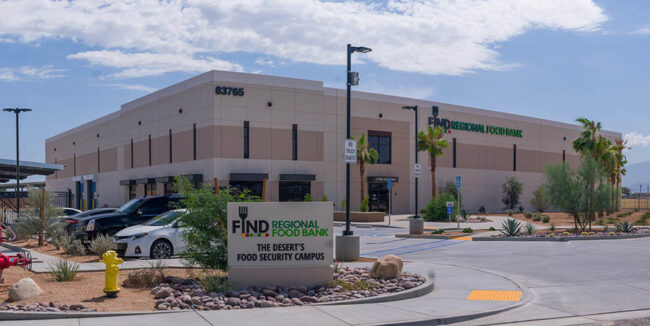
Bank of America Corporation (NYSE: BAC) has awarded a $500,000 grant to FIND Regional Food Bank, completing the nonprofit’s capital campaign for a 40,000-square-foot food security facility in Indio, California. The investment adds capacity for cold storage, workforce training, and disaster resiliency, supporting FIND’s role as a critical logistics node across Riverside and San Bernardino counties.
The grant was announced at FIND’s 2026 State of Hunger address, underscoring Bank of America’s ongoing role in regional development and signaling a broader strategic push to fund physical infrastructure that underpins community resilience in high-risk zones.
Why does this community infrastructure bet by Bank of America matter now?
While community philanthropy is not uncommon among large U.S. banks, the scale, timing, and specificity of Bank of America’s half-million-dollar grant to FIND Regional Food Bank stands out. Rather than a symbolic donation or generic food access initiative, this award functioned as a capstone investment that unlocked FIND’s full warehouse buildout—tripling capacity and eliminating reliance on expensive third-party storage across a 100-mile radius.
Bank of America Corporation’s support goes beyond crisis response. The facility integrates climate-contingent logistics (solar energy and cold chain upgrades) and economic mobility programming through workforce development, positioning the food bank as a regional resiliency platform rather than just a food redistribution site.
This is increasingly relevant in an era of climate-exacerbated food insecurity. With wildfires, droughts, and flooding threatening California’s food logistics corridors, localized food storage and distribution capacity has become a functional element of disaster planning. Bank of America appears to be aligning its community capital flows with real-world critical infrastructure—not just ESG optics.
For FIND, the expanded 40,000-square-foot facility enables a 60 percent increase in fresh produce distribution and a strategic shift toward owning last-mile logistics. This is a sharp evolution from its earlier model, which depended on three leased warehouses to meet pandemic-era surges in demand.
FIND now serves 125,000 people per month across 155 distribution sites. The new footprint will help it meet record-level food insecurity in the region, where nearly 11 percent of residents experience hunger—particularly in eastern Riverside County and southern San Bernardino County.
What does this grant reveal about Bank of America’s strategic posture on community capital?
Bank of America Corporation has been notably aggressive in targeting systemic poverty and hunger through large-scale philanthropic commitments. Its previously announced $250 million national hunger initiative includes direct grants, volunteer hours, and network-wide funding to Feeding America member banks, such as FIND.
But the FIND capital campaign represents a shift from short-term food aid to long-term, infrastructure-led resiliency. The inclusion of rooftop solar arrays and in-house training centers signals a form of banking-enabled economic infrastructure investment—not unlike traditional real estate, logistics, or utilities projects—just delivered through nonprofit intermediaries.
Sherri Anderson, president for Bank of America in the Inland Empire, contextualized the move as support for economic mobility ecosystems, not just hunger relief. The emphasis on wraparound services, training pipelines, and disaster continuity shows Bank of America framing community grants as risk-mitigation investments.
For policymakers and investors focused on ESG and climate-resilient communities, the FIND example may function as a replicable model: enabling financial institutions to underwrite regional logistics hubs that serve both humanitarian and environmental goals.
This could become more pronounced as climate-linked natural disasters intensify and states like California push for distributed, community-anchored disaster response capacity.
How could this reshape expectations for nonprofit capital campaigns and bank partnerships?
For regional nonprofits, FIND’s success in securing a half-million-dollar check from a Tier 1 financial institution offers a new blueprint for capital campaigning—one that frames cold storage, solar energy, and disaster response as infrastructure-grade investment cases, not just charitable needs.
In turn, banks may use such projects as testbeds for blended finance approaches that combine ESG capital with low-risk, high-impact community outcomes. While still rare, this overlaps with emerging models in Europe and Asia, where commercial banks participate in “resiliency bonds” or co-financing for local infrastructure.
The grant also expands FIND’s positioning beyond food distribution. With the Workforce Development Training Center embedded in the new warehouse, FIND can now attract funding from labor development programs, educational grants, and even climate resilience funds—blurring the lines between food bank, training facility, and disaster logistics center.
The philanthropic arms of other financial institutions may be watching. If Bank of America’s model leads to measurable outcomes in food access, employment, and climate response, peer banks could be pressed to step up not only in funding levels but in infrastructure-centric approaches.
What execution risks or blind spots could emerge despite this milestone?
While the warehouse expansion and grant closeout are significant, FIND still faces typical execution risks tied to nonprofit scaling: talent retention for training programs, funding continuity beyond the grant cycle, and maintenance of cold-chain infrastructure under California’s volatile power grid conditions.
There’s also the question of operational complexity. Moving from a food bank to a multi-purpose hub with workforce training, disaster prep, and solar generation means FIND now straddles multiple regulatory and funding silos. This increases administrative load and demands a higher caliber of strategic and financial governance—an area where many nonprofits lack sufficient bench strength.
Bank of America’s grant has effectively raised FIND’s profile and expanded its remit. But this also sets a higher bar for performance, particularly as regional media, donors, and municipalities begin to evaluate ROI across multiple vectors: food security, job training, and disaster resilience.
What second-order implications could this have on public-private disaster response?
California’s ongoing decentralization of disaster logistics—favoring local, nonprofit, and regional actors over top-down state systems—makes FIND’s upgraded facility an even more strategic node. The state’s designation of FIND as the official disaster food bank for Riverside County is not symbolic; it is a policy choice shaped by climate realities and funding constraints.
The trendline suggests that public disaster preparedness in high-risk zones will increasingly rely on fortified nonprofits as first-line responders. This opens new questions for infrastructure investors, ESG-focused philanthropies, and logistics companies: Where else might such public-private hybrids be seeded? And who funds the physical plant and training pipelines to support them?
In that light, Bank of America’s grant becomes less about charity and more about sector leadership. It signals a willingness to invest in community infrastructure where the public sector has limited reach—and where future crises are all but guaranteed.
Key takeaways on what this development means for Bank of America, FIND, and the food security sector
- Bank of America Corporation awarded a $500,000 grant to FIND Regional Food Bank to complete its warehouse expansion and capital campaign.
- The 40,000-square-foot facility triples FIND’s food storage capacity and eliminates the need for remote warehousing.
- Cold chain upgrades and rooftop solar installations position FIND as a key disaster resilience hub for Southern California.
- Bank of America is using philanthropy as infrastructure investment, targeting food security, workforce development, and climate resilience.
- This marks a shift from short-term food aid toward durable, logistics-based models of hunger mitigation.
- The grant elevates FIND into a hybrid role: food bank, workforce trainer, and disaster logistics platform.
- Public agencies are increasingly relying on such nonprofits as decentralized disaster responders amid strained budgets.
- The model may prompt other banks and ESG investors to rethink community capital deployment strategies.
- Execution risks remain around operational complexity, program sustainability, and regulatory alignment.
- FIND’s evolution could become a benchmark for integrated community resiliency models nationwide.
Discover more from Business-News-Today.com
Subscribe to get the latest posts sent to your email.