


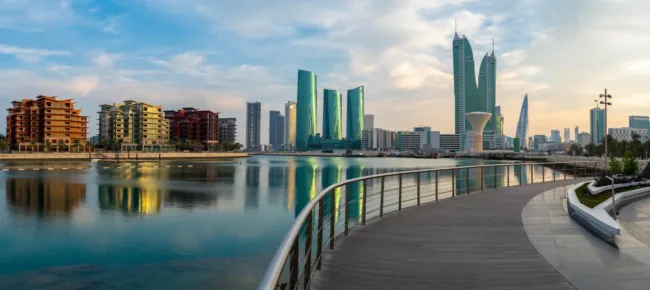
Bahrain has reduced the minimum real estate investment required to obtain its Golden Residency to USD 345,000 (BHD 130,000), significantly down from the earlier threshold of USD 530,555 (BHD 200,000). The change was formally announced by the Nationality, Passports and Residence Affairs (NPRA) under the Ministry of Interior and is positioned as part of a broader push to position Bahrain as a more competitive hub for long-term foreign residency and inward investment.
The move is timed to coincide with Bahrain’s participation in the regional “Cityscape” exhibition, reinforcing its efforts to elevate the country’s real estate and investment visibility within the Gulf Cooperation Council. By lowering the investment threshold while maintaining the exclusive criteria of the program, Bahrain aims to create a more inclusive investment framework without diluting its premium positioning.
According to His Excellency Shaikh Hisham bin Abdulrahman Al Khalifa, Undersecretary for Nationality, Passports and Residence Affairs, the adjustment demonstrates Bahrain’s intent to foster a stable, enabling environment for foreign investors and professionals pursuing long-term residency options in the region.
How Bahrain’s new USD 345,000 investment threshold compares with UAE and Saudi residency programs
The Kingdom’s move comes at a time when Gulf nations are expanding their economic diversification strategies and revisiting residency frameworks to attract high-net-worth individuals, professionals, and retirees. While the United Arab Emirates has already established a global reputation for its golden visa schemes, and Saudi Arabia has launched its own Premium Residency initiative, Bahrain’s recalibration is designed to open its program to a broader base while preserving high financial and social contribution requirements.
Unlike many programs globally that focus solely on investment, Bahrain’s Golden Residency also allows eligibility based on professional tenure, income levels, and pension earnings. Individuals who have lived and worked in Bahrain for five years and earn a monthly salary above BHD 2,000 (USD 5,306) can qualify, as can retirees with at least 15 years of local experience and a pension of the same threshold. For non-resident retirees, the bar is set higher at BHD 4,000 (USD 10,624) per month.
In addition, the program extends to entrepreneurs, skilled professionals, and others making meaningful contributions to Bahrain’s economic or social development. This multi-tiered approach expands the appeal of the program beyond just investors, capturing a wider swath of global talent and mobile capital.
What long-term residency benefits Bahrain offers investors under the updated golden visa policy
Golden Residency holders receive a comprehensive set of benefits aimed at simplifying long-term stay and integration in Bahrain. These include multi-entry privileges, long-term residency status, the ability to sponsor family members, and streamlined processes for establishing businesses.
The inclusion of such rights places Bahrain among the more flexible residency-by-investment destinations in the GCC. Analysts following real estate capital flows in the Gulf believe the lower threshold, combined with Bahrain’s low cost of living, could tip the scale in its favor for certain investors who previously focused on Dubai, Abu Dhabi, or Doha.
While Bahrain’s real estate market is smaller in volume compared to the UAE, it offers a stable regulatory framework, strong financial services infrastructure, and proximity to Saudi Arabia’s Eastern Province. These advantages are expected to support investor confidence and possibly catalyze new residential and mixed-use developments catering to foreign buyers.
Why Bahrain expects the real estate market to gain momentum after the golden visa update
The reduction in the real estate threshold is part of a wider national strategy to drive sustainable investment, unlock underutilized economic potential, and deepen Bahrain’s integration into global capital flows. The real estate sector in particular is expected to benefit from renewed interest, especially in upscale zones like Amwaj Islands, Reef Island, and Diyar Al Muharraq, where developers are increasingly tailoring offerings toward expatriates and global investors.
By easing access to its long-term residency program, Bahrain is also responding to global trends that see mobility and residency preferences shifting toward stable, open economies with attractive living standards. Bahrain’s emphasis on high-quality healthcare, education, and lifestyle infrastructure is likely to play a key role in how the updated program resonates with foreign retirees and professionals.
Financial analysts expect that Bahrain’s real estate segment could witness higher transaction volumes in 2026, with a notable uptick in high-end properties priced between BHD 130,000 and BHD 200,000. Industry insiders suggest developers are already recalibrating their offerings and marketing strategies to align with the updated golden residency requirements.
What institutional investors and wealth advisors are saying about Bahrain’s policy change
Institutional responses to the policy change have so far been optimistic. Real estate consultancies and private wealth advisory firms in the Gulf region view the new threshold as more aligned with global investor expectations, especially those looking for cost-effective alternatives to the UAE.
Some experts, however, caution that policy momentum must be matched with supportive infrastructure and regulatory clarity to sustain investor interest. That includes efficient processing times, transparent title systems, and investor protection mechanisms. Bahrain’s regulatory authorities have historically maintained strong compliance frameworks, which could provide an edge as institutional investors consider portfolio diversification across the Gulf.
Investment managers focusing on GCC real estate suggest that Bahrain could become an attractive option for middle-tier investors from Asia, Europe, and Africa seeking exposure to the Gulf region without committing to the higher entry barriers seen in neighboring jurisdictions.
How the new golden residency policy reflects Bahrain’s post-oil economic diversification strategy
This policy shift also reflects Bahrain’s evolving stance on immigration, investment, and its post-oil economic trajectory. The country has been progressively repositioning itself as a hub for financial services, fintech, and diversified urban development. The updated Golden Residency threshold is consistent with its Vision 2030 blueprint, which emphasizes sustainability, human capital, and open-market policies.
Longer term, the policy could support more permanent forms of foreign economic participation, including small business formation, property ownership, and educational investment. The government’s continued commitment to economic openness is likely to support broader development goals, even as competition for investor attention intensifies across the Middle East.
What investors can expect next from Bahrain’s real estate and residency strategy in 2026
Looking ahead, real estate developers and public policy analysts expect Bahrain’s property sector to gain modest but steady momentum as awareness of the new threshold spreads across investor networks and international real estate forums.
Analysts tracking Gulf migration policies suggest that Bahrain’s strategy may prove especially effective among high-income individuals looking for second residency in a politically stable, well-connected location. They also note that further enhancements to the visa scheme such as simplified renewal mechanisms or added tax incentives could further differentiate Bahrain in the crowded residency-by-investment marketplace.
Bahrain’s policy reset places it in a stronger position to attract talent, retirees, and long-term investors seeking a permanent presence in the Gulf without the high thresholds or saturated real estate markets seen in regional peers.
Key takeaways from Bahrain’s updated golden residency investment threshold policy
- Bahrain has reduced its minimum real estate investment requirement for golden residency from USD 530,555 (BHD 200,000) to USD 345,000 (BHD 130,000), aiming to attract more foreign investors.
- The revised threshold coincides with Bahrain’s participation in the “Cityscape” exhibition and is part of its broader effort to strengthen competitiveness in the regional investment residency landscape.
- The Golden Residency is also open to professionals earning over BHD 2,000 per month, retirees with long-term work histories in Bahrain, and non-resident retirees with pensions above BHD 4,000.
- Qualifying residents receive long-term stay privileges, multiple-entry access, business setup support, and the ability to sponsor family members.
- Bahrain’s real estate market is expected to see increased interest in properties priced near the new threshold, particularly in upscale developments like Amwaj Islands and Diyar Al Muharraq.
- The policy aligns with Bahrain’s Vision 2030 economic diversification strategy and reflects an evolving approach to permanent foreign capital and talent attraction.
- Analysts believe Bahrain’s lower entry point could appeal to mid-tier investors seeking alternatives to higher-cost markets like Dubai or Abu Dhabi.
- Institutional players and advisors have responded positively, though stress the importance of regulatory efficiency and property market readiness.
- Bahrain is positioning itself as a financially accessible, politically stable residency option within the Gulf Cooperation Council.
- Further enhancements to the program could include streamlining renewals or offering tax-linked incentives to boost competitiveness.
Discover more from Business-News-Today.com
Subscribe to get the latest posts sent to your email.