




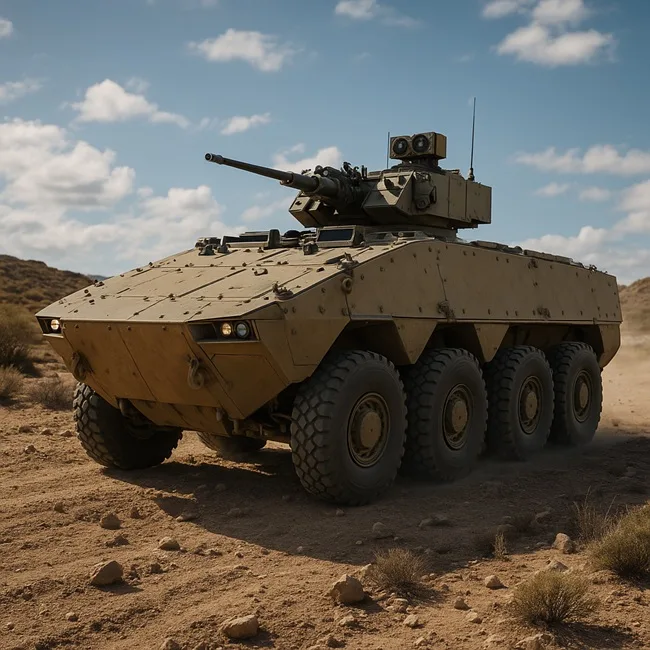
BAE Systems plc (LON: BA.) has entered a high-impact partnership with Forterra Inc., an American autonomous-vehicle developer, to co-create the first self-driving Armored Multi-Purpose Vehicle (AMPV) for the U.S. Army. This collaboration is a breakthrough for next-generation defense mobility, merging BAE Systems’ combat-vehicle expertise with Forterra’s advanced AI-driven navigation stack. The joint prototype aims to demonstrate full autonomous capability by 2026, cutting development cycles that usually take decades into months.
This partnership follows BAE Systems’ recently launched “capability kit” program—a modular upgrade initiative designed to infuse existing AMPV variants with digital intelligence and mission-specific adaptability. The new initiative marks the first external collaboration under this roadmap, signaling that the defense major is intent on proving its modernization plans through tangible, rapid-cycle innovation.
How does the BAE Systems–Forterra alliance fit into the U.S. Army’s modernization push toward autonomous warfare?
The Armored Multi-Purpose Vehicle is central to the U.S. Army’s long-term modernization goals, replacing the half-century-old M113 fleet that has served as a logistics and support platform since the Vietnam War. BAE Systems has already achieved full-rate AMPV production and is currently scaling deliveries across Armored Brigade Combat Teams. Each vehicle variant—from mission command to medical evacuation—is built on a unified chassis, which simplifies upgrades and lowers the lifecycle cost.
Integrating autonomous navigation is the next logical leap. Within the Army Futures Command framework, the Pentagon’s modernization strategy emphasizes reducing crew risk through unmanned teaming, AI-assisted decision systems, and digital connectivity across the battlefield. The Forterra partnership directly supports this vision by enabling the AMPV to perform supply convoys, casualty evacuation, and reconnaissance tasks with minimal crew involvement.
Industry observers note that the partnership represents a shift in how defense innovation happens—replacing long procurement cycles with “agile prototyping.” Institutional analysts described the collaboration as “a visible acceleration of BAE’s modernization pace,” allowing the company to test advanced technologies without waiting for multi-year contracting cycles.
What makes Forterra’s AutoDrive system critical for the next generation of armored mobility?
Forterra has built its reputation on AutoDrive, a full-stack autonomy software designed for mission-critical ground vehicles. The system integrates perception sensors, AI-based path planning, and adaptive control algorithms into a single modular platform. Unlike proprietary or closed architectures, AutoDrive is built for interoperability—meaning it can communicate with external command systems, integrate additional payloads, and function even in GPS-denied environments.
For this partnership, the AutoDrive suite will be embedded directly into the AMPV’s digital backbone. This will transform the AMPV into a self-navigating armored platform capable of operating independently in contested or low-visibility conditions. The system uses sensor fusion to process radar, LiDAR, and optical data in real time, enabling obstacle avoidance, dynamic routing, and convoy synchronization.
Forterra’s Vice President for Defense Growth, Patrick Acox, said that the company designs its systems for the world’s “most complex operational challenges.” While no financial terms were disclosed, industry insiders suggest this is structured as a cooperative development engagement—focused on rapid field validation rather than a full production award.
Acox added that AutoDrive provides “the necessary infrastructure to support smarter networks and resilient operations,” suggesting that the AMPV collaboration could evolve into a broader framework for multi-vehicle autonomy within the U.S. Army’s fleet.
How could the autonomous AMPV reshape the armored-vehicle landscape across global defense markets?
The collaboration between BAE Systems and Forterra reflects a wider transformation in military vehicle strategy—one where autonomy is emerging as a force multiplier rather than a technology demonstration. Autonomous vehicles can execute high-risk tasks such as ammunition resupply or medical evacuation without exposing human crews to danger, a capability increasingly relevant in modern combat scenarios like Eastern Europe and the Indo-Pacific.
BAE Systems Ground Maneuver product-line director Bill Sheehy emphasized that this project is “not about buzzwords but about tangible battlefield options.” The company aims to move beyond theoretical concepts to hardware demonstrations that can influence the U.S. Army’s acquisition roadmap. Sheehy added that combining BAE’s production experience with Forterra’s software agility enables the team to “move faster and think bigger.”
Analysts tracking the armored-systems market believe autonomy is the next big differentiator in defense manufacturing. While traditional combat vehicles focus on armor and firepower, the next generation is expected to compete on data intelligence, connectivity, and self-driving reliability. This trend aligns with BAE Systems’ broader transformation, which has seen the British defense group expand its investment in digital engineering and AI-enabled systems integration.
What are the financial and investor implications for BAE Systems’ defense portfolio?
From a financial standpoint, autonomy could become a multi-billion-pound driver for BAE Systems’ Land & Armaments division. In FY2024, the segment reported approximately GBP 2.4 billion in revenue, driven by programs such as the Bradley A4, the M109A7 Paladin, and the ongoing AMPV rollout. A successful demonstration of autonomous operation could make BAE a frontrunner in securing future U.S. modernization contracts through 2030.
Investor sentiment around the company remains strongly positive. Shares of BAE Systems have risen roughly 18 percent year-to-date on the London Stock Exchange, buoyed by increasing European defense budgets and long-term Pentagon procurement visibility. Institutional investors are treating modular autonomy programs as “optional upside,” seeing them as a way for BAE to secure high-margin technology extensions on existing vehicle platforms.
Analysts describe the partnership model as financially efficient. By teaming with specialized U.S. startups such as Forterra, BAE Systems minimizes its R&D exposure while gaining access to field-proven autonomy stacks. The approach also aligns with U.S. procurement preferences that favor hybrid collaborations between prime contractors and innovation-driven domestic partners.
Which other combat platforms could benefit from the AMPV’s autonomous capability kit?
BAE Systems has confirmed that the autonomy architecture being co-developed with Forterra will not be exclusive to the AMPV. The same modular “capability kit” can be adapted to the Bradley A4 Infantry Fighting Vehicle, the M109A7 Paladin self-propelled howitzer, and future hybrid-electric prototypes being evaluated by the Army.
This approach supports the Army’s concept of networked lethality, in which every platform—manned or unmanned—shares situational data across a digital mesh network. Forterra’s open-systems software is designed to fit within that model, enabling simultaneous convoy control, remote operation, and coordinated logistics.
Army research programs such as the Robotic Combat Vehicle (RCV) and the Optionally Manned Fighting Vehicle (OMFV) share similar autonomy objectives, and the AMPV initiative could serve as a bridge between these developmental efforts. With live demonstrations planned for 2026, analysts anticipate joint field evaluations by late 2027 under the Army’s Combat Capabilities Development Command (DEVCOM).
How soon could the U.S. Army field autonomous combat vehicles at scale?
The 2026 demonstration will provide the foundation for operational testing, but full deployment will likely occur later this decade. Field trials must pass rigorous cybersecurity validation, AI safety assurance, and electronic warfare resilience tests. Initial use cases are expected to focus on lower-risk operations such as resupply missions, base logistics, and casualty evacuation, before advancing to semi-autonomous combat roles.
Defense insiders estimate that partial autonomy could reach limited operational capability by 2028, in sync with other modernization milestones under the Army’s Next Generation Combat Vehicle program. Once validated, the capability kits could be integrated into both new production vehicles and legacy fleets already in service—a move that would accelerate adoption and extend the life of existing platforms.
Can the BAE Systems–Forterra partnership truly redefine how the U.S. Army designs and deploys next-generation armored vehicles?
The BAE Systems–Forterra collaboration is a statement of intent for how the defense industry plans to merge speed, software, and survivability in future vehicle design. It signals that innovation in armored warfare no longer relies on heavy metal alone but on digital intelligence layered into proven hardware.
By combining BAE Systems’ engineering heritage with Forterra’s AI-powered mobility software, the partnership demonstrates a model for “hybrid modernization”—one that connects traditional defense manufacturing with agile technology ecosystems. Even if the 2026 prototype remains a demonstration platform, it will set a precedent for how autonomy can be rapidly integrated into existing systems.
As militaries worldwide shift toward autonomous and optionally manned operations, this collaboration could become a defining case study in next-generation ground combat transformation—where the edge belongs to those who move fastest between the factory floor and the front line.
Discover more from Business-News-Today.com
Subscribe to get the latest posts sent to your email.