
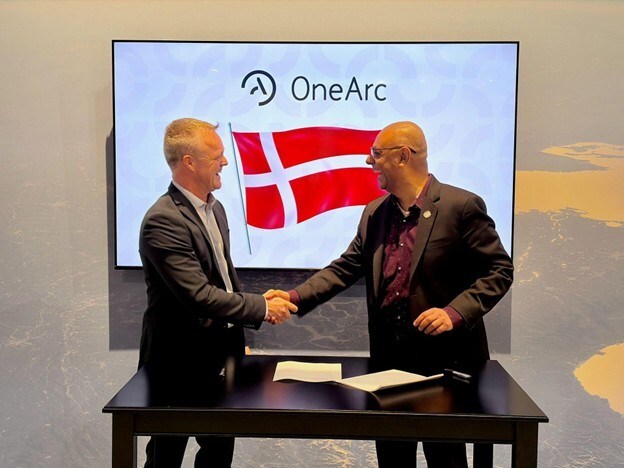
BAE Systems plc (LON: BA) has secured a seven-year agreement with the Danish Army to deploy its OneArc simulation platform as the foundation of Denmark’s next-generation enterprise virtual training environment. The contract covers VBS4, VBS Builder Edition, Blue IG, TerraTools Platinum, and supporting software maintenance and on-site training services, replacing a legacy VBS3 installation that has underpinned Danish Army synthetic training for years. The deal arrives as Denmark executes one of NATO’s steepest defence spending ramp-ups, with allocated expenditure commitments exceeding 3 percent of GDP following a 50 billion DKK Acceleration Fund established in 2025. For BAE Systems, whose Electronic Systems segment generated record underlying earnings of approximately GBP 3.32 billion in 2025, the contract reinforces OneArc’s position as the dominant simulation franchise across NATO and allied nations while building recurring revenue in a period of sustained European rearmament.
Why did the Danish Army choose BAE Systems OneArc VBS4 over competing simulation platforms for its enterprise training modernization?
The selection logic here is less about competitive procurement drama and more about architectural continuity. The Danish Army has operated VBS3 for an extended period, accumulating substantial libraries of scenario content, terrain data, and instructor training investment. Migrating that legacy infrastructure to a competing platform would require wholesale content reconstruction, retraining of simulation staff, and a multi-year transition gap during which training quality would likely deteriorate. OneArc’s claim of full backward compatibility with existing Danish Army simulation development is, therefore, not a minor feature note but the core decision driver. The Danish Ministry of Defence acquisition and Logistics Organisation, which executed the procurement, effectively validated that continuity of investment protection outweighed any potential marginal capability advantages offered by rival vendors.
VBS4 itself represents a meaningful generational step from VBS3, offering improved multi-domain fidelity, updated physics engines, and greater integration capacity for emerging training requirements including drone simulation and complex electromagnetic environment replication. TerraTools Platinum adds high-fidelity terrain generation capability, enabling Danish instructors to build operationally realistic environments aligned with the specific geographies where Danish forces might deploy, from the Baltic littoral to Arctic terrain across Greenland and the Faroe Islands. VBS Builder Edition extends content creation capability to unit-level instructors without requiring specialist simulation engineers, which reduces the per-scenario cost of synthetic training over the contract lifetime. The seven-year term locks in a substantial recurring maintenance and services revenue stream for BAE Systems.
How does the OneArc Danish Army contract connect to NORDEFCO interoperability goals and Nordic defence cooperation strategy through 2030?
The agreement explicitly invokes the Nordic Defence Cooperation (NORDEFCO) 2030 Vision, which identifies shared virtual training infrastructure as a mechanism for deepening operational interoperability among Denmark, Sweden, Finland, Norway, and Iceland. All of those nations already operate OneArc simulation technologies in some configuration, meaning Denmark’s upgrade positions the region to conduct high-fidelity collective exercises in shared virtual environments without the interoperability friction that arises when allied forces train on incompatible simulation architectures.
This regional standardisation dynamic is strategically significant for BAE Systems beyond the value of any single contract. Once a simulation platform achieves critical mass across a regional alliance structure, switching costs for any individual member become prohibitively high. Sweden’s 2023 NATO accession and Finland’s integration into the alliance architecture have accelerated demand for unified Nordic training infrastructure, since newly admitted allies are required to demonstrate interoperability across a range of collective scenarios. If Denmark is running VBS4 and Norway is running VBS4 and Finland is running a prior-generation OneArc product, the commercial and operational logic for Finnish and Norwegian upgrades strengthens considerably. The Danish contract functions, in part, as a reference win that advances that regional franchise consolidation.
What does Denmark’s 50 billion DKK defence acceleration fund mean for BAE Systems and the broader European training technology market?
Denmark’s decision to push defence spending above 3 percent of GDP in 2025 and 2026 through a dedicated Acceleration Fund is not an isolated national budget decision. It reflects a structural shift in European security posture driven by the Danish Defence Intelligence Service’s assessment that Russia could reconstitute sufficient offensive military capability within two years of any ceasefire in Ukraine to threaten one or more NATO member states. That threat calculus has produced a procurement environment in which speed and proven capability take precedence over competitive price pressure, a dynamic that systematically advantages incumbents with deployed solutions over challengers proposing unproven alternatives.
Virtual and synthetic training occupies a particular growth position within European defence budgets for two structural reasons.
First, live training is expensive, constrained by range availability, weather, equipment wear, and the political sensitivity of large-scale military exercises in certain border regions. Second, modern combined-arms operations involving drone swarms, electronic warfare, and multi-domain coordination simply cannot be rehearsed at scale in live environments without prohibitive cost and risk. Simulation therefore becomes not a cost-cutting substitute for live training but a force multiplier that extends the effective training throughput of a given unit budget. As European armies attempt to rebuild readiness rapidly after decades of post-Cold War hollowing, simulation procurement is likely to grow faster than the overall defence budget across most NATO members.
How does the OneArc platform compete against simulation vendors like Bohemia Interactive Simulations and Lockheed Martin for NATO training contracts?
A point of clarification on the competitive landscape is warranted here. VBS4 is developed by Bohemia Interactive Simulations, an Austria-headquartered company, and BAE Systems operates as the authorised distributor and integrator of the VBS product line through the OneArc commercial vehicle. This relationship means BAE Systems’ competitive advantage in this market is less about proprietary simulation technology and more about its capacity to integrate VBS with complementary products including Blue IG visual systems and TerraTools terrain generation into a coherent enterprise architecture, and to back that architecture with the programme management, government-facing relationships, and long-term support commitments that defence procurement authorities demand.
Lockheed Martin’s Prepar3D platform occupies a different market segment, focused primarily on aviation simulation, while Rheinmetall’s Virtual Reality Solutions subsidiary and various European defence electronics firms are expanding their synthetic training portfolios. The critical competitive barrier OneArc has established is the installed base: once an army has invested in VBS scenario libraries, instructor certification pipelines, and VBS-native terrain data across dozens of units, the full-system replacement cost exceeds anything a competing vendor can recover through marginal capability improvements. BAE Systems is effectively in the business of deepening that switching cost advantage with each successive contract renewal.
What are the execution risks in the BAE Systems OneArc Danish Army seven-year training modernization contract and how significant are they?
Seven-year government technology contracts carry inherent execution risk that deserves scrutiny. The most significant structural risk is technology obsolescence. The simulation landscape in 2033 will look materially different from today, particularly with respect to artificial intelligence-generated training environments, autonomous adversary modeling, and the integration of virtual reality hardware into collective training scenarios. A contract structured around VBS4 as the core platform must either build in sufficiently flexible upgrade provisions or risk delivering a solution that is technically dated relative to operational requirements in the contract’s later years.
On-site training services introduce a second category of execution risk: dependency on BAE Systems personnel availability and quality in a defence technology labor market that is tightening across Europe as rearmament accelerates. If BAE Systems cannot staff sufficient qualified simulation instructors and technical support personnel across the contract term, performance degradation becomes a genuine delivery risk. There is also a programme integration challenge in ensuring that VBS4 scenarios, Blue IG visual outputs, and TerraTools terrain data function coherently at enterprise scale across the Danish Army’s distributed training infrastructure. These are solvable problems, but the complexity of enterprise simulation integration should not be underestimated.
How does the Danish Army contract affect BAE Systems (LON: BA) stock trajectory as shares approach the 52-week high near 2,294 pence?
BAE Systems closed at 2,233 pence on March 9, 2026, up 0.77 percent on the session, placing it within striking distance of its 52-week high of 2,294 pence and well above the 52-week low of 1,394 pence. The 60 percent appreciation over the year reflects an investor re-rating of European defence primes as NATO spending commitments have accelerated, rather than any single contract catalyst. With a market capitalisation of approximately GBP 66.7 billion and a consensus buy rating from ten of twelve covering analysts, the market is already pricing in a sustained period of elevated order intake. Berenberg Bank recently moved its price target to 2,300 pence with a hold rating, suggesting consensus sees limited upside at current levels relative to fundamental valuation, even as order momentum remains strong.
The Danish Army contract is unlikely to move the stock materially in isolation. A seven-year agreement covering software, maintenance, and training services at enterprise scale for a single national army represents meaningful but not transformative revenue for a company generating over GBP 28 billion in annual sales. Its strategic significance to investors lies more in what it signals about the durability of OneArc’s NATO franchise and the recurring revenue characteristics of the simulation business than in its direct contribution to near-term earnings. For a company trading at above 20 times earnings, the market’s validation thesis rests on whether defence budgets remain elevated through the late 2020s. The Danish Acceleration Fund and NORDEFCO upgrade cycle provide evidence that they will.
Key takeaways on what the BAE Systems OneArc Danish Army contract means for defence simulation markets and NATO readiness investment
- BAE Systems has secured a seven-year enterprise simulation contract with the Danish Army for VBS4, VBS Builder Edition, Blue IG, and TerraTools Platinum, replacing a long-running VBS3 installation with a platform upgrade that maintains full backward compatibility for existing content libraries.
- The deal is strategically anchored by Denmark’s 50 billion DKK Acceleration Fund established in 2025, which has pushed Danish defence spending above 3 percent of GDP and created a procurement environment prioritising speed and proven capability over competitive price pressure.
- OneArc’s NATO installed base across more than 60 allied nations creates compounding switching-cost barriers that systematically advantage BAE Systems in renewal cycles, with the Danish win reinforcing that franchise positioning across the NORDEFCO region.
- The NORDEFCO 2030 Vision alignment adds a regional multiplier to the contract: Denmark, Sweden, Finland, and Norway operating the same simulation architecture strengthens the commercial logic for upgrade cycles across all NORDEFCO members as interoperability requirements tighten.
- BAE Systems’ competitive position in simulation is built on integration and programme management capability rather than proprietary simulation technology, with the VBS product line developed by Bohemia Interactive Simulations and distributed through the OneArc commercial vehicle.
- Execution risks over the seven-year term include technology obsolescence relative to AI-driven simulation advances, staffing pressures in a tightening defence technology labour market, and the complexity of enterprise-scale integration across distributed training infrastructure.
- BAE Systems shares (LON: BA) closed at 2,233 pence on March 9, within 3 percent of their 52-week high of 2,294 pence, reflecting a broad investor re-rating of European defence primes rather than any single contract catalyst; the Danish award adds incremental recurring revenue but is unlikely to shift consensus estimates materially.
- Virtual and synthetic training is structurally positioned to grow faster than overall European defence budgets as armies seek to maximise readiness throughput without the cost and logistical constraints of large-scale live exercises.
- The Danish contract demonstrates that enterprise simulation procurement decisions are driven primarily by total migration cost and installed-base continuity rather than platform-by-platform capability comparisons, a dynamic that entrenches incumbents across multi-decade time horizons.
- For BAE Systems, the simulation business represents a high-margin, recurring-revenue vertical with government switching costs that compound over time, making individual contract wins less important than the structural durability of the NATO franchise as a revenue engine through the 2030s.