




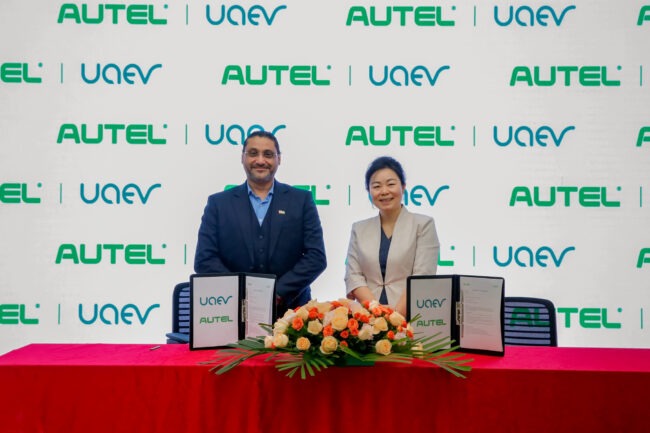
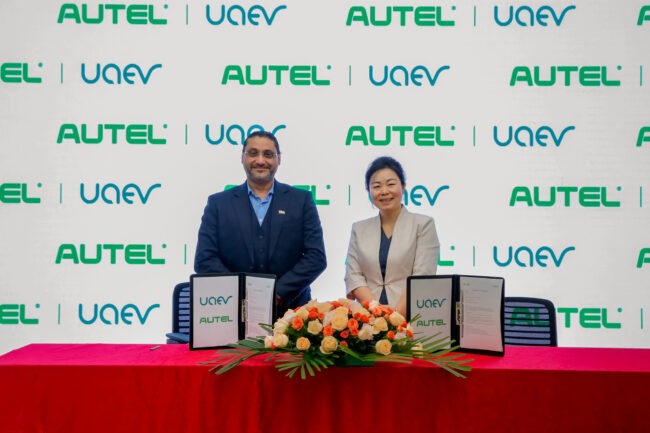
Autel Digital Power Co., Ltd has formalized a strategic Memorandum of Understanding with Emarat EV Charging Stations Company, widely known as UAEV, in a move designed to catalyze the United Arab Emirates’ electric vehicle infrastructure buildout. UAEV is the national Charge Point Operator overseeing EV charger deployment across the country. The agreement was signed at Autel’s global headquarters in Shenzhen, China, and aims to unlock a new era of heat-resilient, AI-driven, and scalable smart-charging systems tailored to the UAE’s operating environment.
The partnership is centered on three critical areas: ultra-fast charging solutions optimized for high ambient temperatures, integrated battery energy storage systems, and next-generation vehicle-to-grid (V2G) interaction platforms. These technologies will serve as the foundation for a nationwide charging ecosystem capable of managing peak demand, enhancing network uptime, and supporting the UAE’s broader clean mobility and Net Zero 2050 ambitions.
As part of the collaboration, Autel and UAEV will pursue joint research, local optimization pilots, and full-scale platform deployment efforts designed to ensure infrastructure reliability, software continuity, and user accessibility. This marks a significant step toward building a national backbone for electric mobility that is as advanced as it is climate-resilient.
How is this partnership redefining infrastructure readiness for high-temperature environments?
The UAE’s hot-climate conditions present unique engineering and operational challenges for EV charging, especially in remote or high-traffic areas. With summer temperatures regularly exceeding 50 degrees Celsius, traditional cooling systems and electrical components often face performance degradation or failure. Autel has addressed this risk through the development of ultra-fast direct current charging systems that maintain performance integrity above 55 degrees Celsius, while also offering embedded diagnostics and predictive maintenance capabilities.
This hardware durability is matched by an emphasis on intelligent energy management. Autel’s charging systems include cloud-based software orchestration tools that optimize power delivery, remotely monitor asset health, and dynamically balance load across multiple charging stations. These features are expected to significantly reduce downtime and improve the overall user experience.
The integration of V2G architecture and battery energy storage also elevates the strategic value of this MoU. Vehicle-to-grid technology enables bidirectional energy flow between EVs and the electrical grid, helping to smooth out energy demand spikes and improve grid stability during peak hours. Battery storage systems can further act as a buffer, allowing for energy arbitrage, renewable integration, and localized backup in case of supply interruptions.
What does this mean for UAEV’s national rollout and the UAE’s climate policy alignment?
Emarat EV Charging Stations Company, as the country’s designated Charge Point Operator, plays a central role in building the infrastructure backbone for the UAE’s EV future. The collaboration with Autel is designed to expand the scale, intelligence, and resilience of UAEV’s national network, which already includes a roadmap to deploy more than 1,000 high-speed direct current chargers by 2030.
Chief Executive Officer of UAEV, Ali Al Darwish, said the agreement marked a critical milestone in the country’s charging infrastructure roadmap. He emphasized that by combining UAEV’s infrastructure strategy with Autel’s technical depth, the nation could accelerate its shift toward intelligent, scalable, and climate-aligned EV platforms.
Autel Vice President Melody echoed this commitment, noting that the company is fully aligned with the UAE’s long-term mobility and sustainability strategies. She framed the MoU as a landmark step in delivering “advanced technologies that meet the UAE’s reliability and performance standards.”
This infrastructure expansion supports the UAE Energy Strategy 2050 and the wider goals set under the Net Zero 2050 framework. With road transport contributing significantly to urban carbon emissions, the transition to EVs remains a top priority in the country’s clean energy agenda. However, analysts point out that the bottleneck has often been infrastructure readiness rather than consumer demand. This is the gap the UAEV–Autel partnership aims to close.
How does this align with Autel’s broader global expansion in EV charging?
Autel’s growing international footprint offers important context to the UAE agreement. Earlier in November 2025, Autel launched a high-speed EV charging station at Bangkok’s CentralWorld in partnership with Evolt and Zeekr, a premium electric vehicle brand under Geely. The Bangkok deployment features the air-cooled MaxiCharger DS480, capable of delivering 400 kW output and enabling a full charge of a Zeekr 7X in just 15 minutes. The site integrates Autel’s smart charging management system for real-time status updates, payment processing, and route planning through the Evolt mobile application.
Just weeks prior, Autel showcased its most advanced charging and energy storage platforms at All Energy Australia 2025, including the launch of the liquid-cooled MaxiCharger DS600L cabinet. Designed for commercial and fleet-scale applications, the DS600L system can deliver up to 3 megawatts of total output per cluster, integrates with battery storage and solar PV systems, and includes AI-powered predictive maintenance as well as a 1+1 mainboard redundancy configuration. This product supports CCS and MCS standards, with flexible compatibility across passenger cars, heavy trucks, and electric buses.
Autel’s product suite also includes the Autel iGreen Charging Solution, a full-stack charging ecosystem that incorporates photovoltaic generation, energy storage, EV chargers, energy management systems, and charging station management software. This approach allows Autel to deliver dynamic charge-discharge coordination, optimize energy costs, and provide an end-to-end charging network tailored to commercial, residential, and fleet requirements.
Why are institutional stakeholders paying attention to Middle East EV infrastructure?
The Autel–UAEV partnership underscores growing regional investor appetite for climate-resilient infrastructure projects. While the MoU does not disclose financial terms, institutional sentiment around energy transition plays in the Gulf has been steadily strengthening. The inclusion of V2G and BESS features reflects a forward-looking grid strategy that aligns with emerging market trends in distributed energy systems.
Analysts tracking infrastructure flows in the Middle East believe partnerships between advanced tech vendors and nationally mandated rollout agencies offer a blueprint for successful electrification at scale. By combining proven international platforms with locally customized deployment, such partnerships help de-risk the capital expenditure curve while speeding up time-to-market.
For UAE stakeholders, the deal also sends a message of long-term intent to international clean-tech investors and original equipment manufacturers. It suggests that the UAE is not merely investing in EV adoption, but in grid-integrated mobility ecosystems that reflect global best practices and anticipate future interoperability standards.
Looking ahead, investors and developers will be watching how quickly Autel’s systems are integrated into UAEV’s rollout, and whether similar partnerships emerge across other Gulf Cooperation Council countries seeking to meet their clean energy commitments.
Key takeaways from Autel and UAEV’s new EV charging partnership
- Autel Digital Power Co., Ltd and Emarat EV Charging Stations Company (UAEV) signed a Memorandum of Understanding to co-develop the UAE’s national EV charging infrastructure.
- The partnership will focus on V2G integration, battery energy storage systems, and AI-enabled smart charging platforms optimized for desert conditions.
- Autel’s technical capabilities include ultra-fast DC chargers operating above 55°C, AI-based diagnostics, remote maintenance, and grid interaction features.
- UAEV is targeting the deployment of over 1,000 high-speed DC chargers by 2030, in line with the country’s Net Zero 2050 strategy.
- This partnership follows Autel’s recent international expansions in Thailand and Australia, where it launched next-gen chargers and integrated energy systems for fleet and commercial use.
- The UAE deal signals growing regional investment appetite for clean, grid-integrated, and software-defined EV infrastructure.
- Autel’s scalable platform design positions it as a potential enabler of large-scale public-private EV charging rollouts across the Middle East.
Discover more from Business-News-Today.com
Subscribe to get the latest posts sent to your email.