



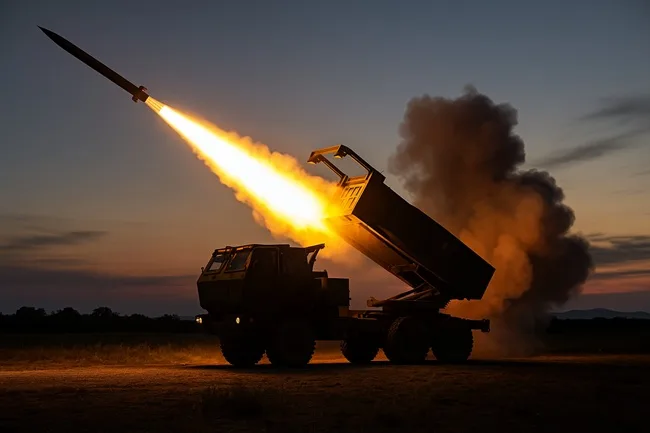
Australia is doubling down on long-range strike power with a $705 million proposal cleared by the U.S. State Department for the sale of 48 M142 High Mobility Artillery Rocket Systems (HIMARS) and associated support equipment. The deal, still awaiting Congressional approval, would rank among Canberra’s most consequential defense acquisitions in decades—one that could either strengthen its deterrence backbone or deepen its dependence on U.S. supply chains and doctrine. For Washington, the move cements Australia’s role as a critical ally in the Indo-Pacific defense network, while for Canberra, it raises the question of how much strategic autonomy remains when your firepower is built in America.
What does Australia’s $705 million HIMARS purchase include—and how does it expand the country’s long-range strike ecosystem?
Under the DSCA (Defense Security Cooperation Agency) notification to Congress, the Australian request includes more than just the HIMARS launchers themselves. The package encompasses non-major defense equipment such as HIMARS resupply vehicles (M1084A2), M1095 trailers, low-cost reduced-range practice rocket pods, communications and intercom mounting systems, spare parts, training, engineering support, program support, surveys, logistical services, technical assistance, and other sustainment components. Reports identify Lockheed Martin, L3Harris, Leonardo DRS, and Oshkosh Corporation as key contractors expected to execute parts of the sale.
Australia had previously ordered 42 HIMARS under its LAND 8113 program; this new tranche would bring its total HIMARS inventory to 90 systems, effectively more than doubling its launch capacity. (Wikipedia, Army-Technology) The delivery timetable, once approved, will likely span multiple fiscal years, given the complexity of integration and support.
Why is Australia doubling down on HIMARS systems now—and how do these rocket launchers fit into its evolving defense doctrine?
For Canberra, the push to acquire 48 more HIMARS is driven by several strategic imperatives. First, it enhances deterrence by significantly expanding its ability to strike high-value targets at extended ranges, including maritime targets, infrastructure, and staging areas. Second, the acquisition strengthens interoperability with U.S. and allied forces, aligning Australia with U.S. targeting doctrines, fire control procedures, and joint operations. Third, it helps Australia protect vast maritime approaches, support island defense, and defend critical infrastructure in a geography where long-range reach matters.
Australia has already taken steps to operationalize HIMARS: in July 2025, Australian forces fired HIMARS munitions for the first time during the Talisman Sabre exercise, alongside U.S. and Singapore forces. This live-fire event symbolized Australia’s intent to move from training to credible deployment. The new tranche would support serial deployment across multiple brigades, expand training throughput, and enable redundancy and surge capacity.
How does the U.S.–Australia HIMARS deal reshape deterrence architecture and alliance strategy across the Indo-Pacific region?
The approval of the HIMARS package to Australia is not merely a transaction — it is a strategic lever in the Indo-Pacific chessboard. As China continues to grow its military reach, particularly in the South China Sea and across maritime corridors, U.S. strategy has emphasized strengthening regional allies’ deterrence capabilities. By embedding Australia more deeply in U.S.-aligned precision strike networks, the sale tightens alliance cohesion.
Australia’s enhanced strike reach complements U.S. theater posture: Canberra becomes a more capable node, offering forward strike capacity against coercive maneuvers or threats to island chains, sea lines of communication, and partner territories. The deal also raises the bar for regional adversaries: extended range rocket systems can alter threat assessments of forward basing, naval tasking, or coercive interventions.
Another dimension is industrial and logistical entanglement. The sale deepens Australia’s reliance on U.S. supply chains, sustainment regimes, software upgrades, spares pipelines, and doctrinal updates—strengthening alignment but reducing sovereignty in lifecycle control. For the U.S., this arrangement helps maintain leverage and continuity in allied systems architectures.
What integration, training, and command challenges could limit Australia’s ability to operationalize HIMARS effectively?
While strategic rationale is strong, execution carries substantial challenges. First, securing Congressional approval is not guaranteed; budgetary pressures, amendments, or pushback may reshape or delay the package. Second, supply chains—especially for advanced electronics, sensors, communication modules, and guidance units—are stressed globally; delays or cost overruns could cascade into schedule risks.
Integration is a critical hurdle. HIMARS must interoperate with Australia’s existing C4ISR systems: sensor nets, radars, command networks, targeting feeds, and counter-battery systems. Any misalignment in timing, data latency, or doctrinal procedures can blunt the system’s effectiveness. Ensuring seamless communications, fire control alignment, and software compatibility is essential.
Training and doctrine development will also demand sustained investment. Australia needs to train operators, integrate new tactical procedures, revise joint fire doctrines, and develop logistics and maintenance pipelines. Suboptimal transition, training gaps, or logistical bottlenecks could delay full operational capability.
Finally, the escalation risk cannot be ignored. Introducing long-range strike capabilities in contested zones may alarm neighboring states or adversaries, who might respond with countermeasures, defensive postures, or provocative signaling. Canberra and Washington will need messaging strategies and arms control confidence-building measures to mitigate misperceptions.
How is Australia building a multi-domain rocket artillery ecosystem around HIMARS, LAND 8113, and emerging precision missile programs?
Australia’s defense modernization is increasingly driven by missile and rocket capabilities. Under LAND 8113, Canberra committed to acquiring 42 HIMARS and associated munitions (GMLRS, ATACMS variants) and integrating them with land-based maritime strike architectures. The new sale effectively accelerates and scales that trajectory.
Beyond HIMARS, Australia is exploring munition adaptability. There is interest in integrating Precision Strike Missile (PrSM), as well as indigenous missile development or licensed sustainment to reduce long-term reliance on U.S. supply chains. Reports suggest Canberra may pursue local production or co-development of certain components to bolster sovereign resilience.
The 2025 Talisman Sabre exercise demonstrated how Australia intends to employ HIMARS within joint, multi-domain operations—linking rockets, drones, air power, and sensor networks into coordinated strike webs. (Reuters) As Australia scales up, it will likely emphasize force posture flexibility, regional deterrence, and surge fire options for northern approaches and island chains.
What does the HIMARS sale mean for U.S. defense contractors, Australian industry participation, and global arms market momentum?
From a defense industry perspective, this FMS will generate downstream contracts in spares, sustainment, software updates, lifecycle support, and upgrades. Contractors named in the package—Lockheed Martin, L3Harris, Leonardo DRS, Oshkosh—are poised to benefit from multi-year revenue streams tied to maintenance, integration, and training.
The deal also signals growing demand across U.S. allies for advanced rocket artillery and precision strike systems. The trend has already manifested in European, Middle Eastern, and Indo-Pacific nations adopting HIMARS or variants. Australia’s move reinforces that momentum and could excite investor interest in defense export lines.
For Australia, the purchase may catalyze local industrial participation. Canberra might negotiate offsets, local assembly, or technology transfer clauses to spur domestic capability in missile, sensors, or communications. Over time, parts of the sustainment chain might localize to reduce dependence on foreign supply.
How might Australia’s HIMARS acquisition influence India’s deterrence calculus and reshape power equations in the Indo-Pacific?
While this sale is between the U.S. and Australia, it holds significance for India and other regional powers. First, it raises the bar of what “normal” deterrence posture could look like in the Indo-Pacific: allies deploying mobile, precision rocket artillery at maritime ranges.
India, already investing in indigenous systems such as the Pralay or Smerch upgrades, may feel strategic pressure to accelerate acquisition of long-range rockets, maritime strike missiles, or joint fire networks. The Australia deal could reinforce arguments for deepening partnerships in defense R&D, co-production, or joint missile architectures with allies.
Second, this deal strengthens the pattern of alignment around U.S.-led strategic architectures. India must weigh how to position itself relative to allied nodes and whether to link its strike and sensor systems into integrated webs with U.S., Australia, Japan, or others.
Third, the sale may affect regional deterrent calculations. Adversaries will factor in Australia’s enhanced reach when sizing coercion strategies against India or second- and third-tier states. India may face pressure to up its posture, extend strike reach, and refine missile defense foresight.
What comes next after U.S. approval—and how could Australia’s HIMARS deployment redefine allied defense planning over the next decade?
Assuming Congress approves, the HIMARS systems will be delivered in phases over multiple years. Australia will undertake extensive systems integration, training, joint drills, and connectivity with U.S. and allied forces. This is not just a one-time arms transfer—it is a long-term capability infusion with evolving doctrinal and operational implications.
Strategically, the sale cements Australia’s role as a more credible forward strike partner in the Indo-Pacific, while reinforcing U.S. alliance leverage. It introduces a higher level of deterrence complexity, offering Canberra options to influence regional calculus.
For India and regional states, this move underscores the accelerating pace of missileization in the Indo-Pacific and may recalibrate strategic planning. The rise of precision, range, and networked firepower is becoming a benchmark in defense modernization.
Australia’s $705 million HIMARS package is more than a procurement plan; it’s a signal of where Canberra intends to position itself in the Indo-Pacific power equation. While the proposal still awaits Congressional approval, the message is unmistakable—long-range precision strike is now central to allied deterrence strategy. The real test will be how effectively Australia, the United States, and their defense partners navigate the political, operational, and financial complexities that follow.
Discover more from Business-News-Today.com
Subscribe to get the latest posts sent to your email.