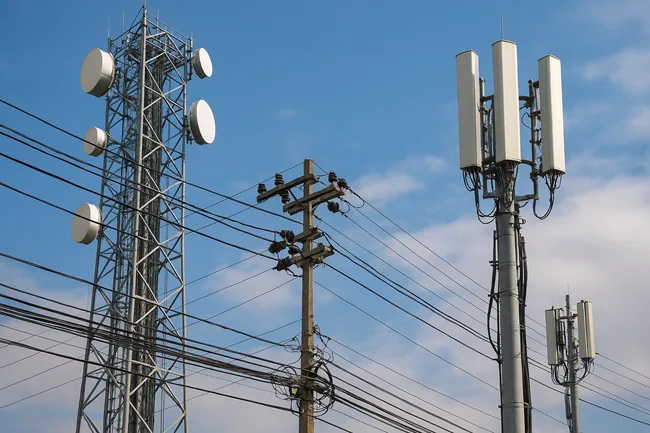
AT&T Inc. (NYSE: T) has agreed to acquire 3.45 GHz mid-band and 600 MHz low-band spectrum licenses from EchoStar Corporation (NASDAQ: SATS) for approximately $23 billion in cash. The agreement, announced on August 26, 2025, significantly bolsters AT&T’s wireless spectrum portfolio, covering virtually every U.S. market and cementing its strategy to dominate converged wireless and fiber connectivity.
The transaction also expands the partnership between AT&T and EchoStar through a hybrid mobile network operator (MNO) agreement. Boost Mobile subscribers will gain access to AT&T’s nationwide network while maintaining service continuity through EchoStar’s cloud-native 5G core. This dual structure ensures that EchoStar retains a role in the U.S. wireless sector while addressing long-standing Federal Communications Commission (FCC) concerns about spectrum utilization.
Institutional sentiment toward the deal has been largely constructive. Market observers described the $23 billion investment as both capital-intensive and strategically necessary, given escalating competition from Verizon Communications Inc. and T-Mobile US Inc. Analysts suggested that AT&T’s ability to integrate low- and mid-band spectrum with its growing fiber footprint could enhance long-term customer retention and expand its converged subscriber base.
Why is the spectrum acquisition critical for AT&T’s converged connectivity strategy in 2025 and beyond?
AT&T’s network leadership ambitions rest heavily on maintaining a balance of spectrum capacity across different frequency bands. With this acquisition, AT&T gains approximately 30 MHz of mid-band spectrum in the 3.45 GHz range and 20 MHz of low-band spectrum in the 600 MHz range. The mid-band holdings are particularly important because they align with global 5G standards and provide an optimal mix of coverage and capacity.
AT&T executives said the transaction supports accelerated deployment of fixed wireless services, particularly its AT&T Internet Air offering. In markets where fiber expansion is not immediately feasible, Internet Air customers could be migrated to AT&T Fiber over time, a dual approach that reduces churn and allows AT&T to transition legacy copper-based networks to modern connectivity solutions.
For consumers, the integration means broader availability of higher-speed 5G home internet, more resilient mobile services, and enhanced reliability for business and emergency services. Industry observers noted that the move positions AT&T to meet future demands from AI-driven devices, connected cars, and industrial IoT systems—areas where data consumption is expected to surge over the next decade.
How does the EchoStar hybrid MNO arrangement affect Boost Mobile and the competitive wireless market?
EchoStar’s decision to sell spectrum follows mounting pressure from the FCC to demonstrate effective utilization of its licenses. While the sale transfers ownership to AT&T, EchoStar retains a meaningful wireless presence through Boost Mobile. Under the hybrid MNO framework, Boost customers will connect primarily through AT&T towers while still having access to the T-Mobile network, ensuring uninterrupted service continuity.
Elements of Boost Mobile’s radio access network will be phased out, reducing capital intensity for EchoStar. The company said proceeds from the deal will be used to retire certain debt obligations and fund operational growth initiatives. EchoStar’s chairman, Charlie Ergen, described the agreement as a “critical step” in satisfying FCC inquiries while enabling long-term competitiveness.
This arrangement effectively recasts Boost Mobile as a virtualized operator, leaning on AT&T’s infrastructure but differentiating through its own 5G core and service model. Analysts said this could allow Boost to compete more effectively on pricing and niche consumer offerings, though its reduced control over infrastructure may limit innovation speed.
What are the financial implications of the spectrum purchase for AT&T and EchoStar investors?
AT&T plans to finance the $23 billion purchase through a mix of cash on hand and incremental borrowings. The company expects its net debt-to-adjusted EBITDA ratio to rise temporarily to the 3x range after closing, with a return to its 2.5x leverage target within three years. Management reiterated its 2025 financial guidance and confirmed a $20 billion share repurchase capacity for the 2025–2027 period, indicating confidence in balance sheet resilience.
For EchoStar, the deal represents a major liquidity event. By monetizing its spectrum assets, the company strengthens its financial footing and avoids prolonged regulatory battles over spectrum deployment. EchoStar confirmed that proceeds will go toward debt retirement and investments in its remaining operations, including DISH TV, Sling, and Hughes. These divisions, management emphasized, remain unaffected by the spectrum transaction.
On Wall Street, AT&T’s stock traded with modest gains following the announcement, with institutional investors highlighting the deal as a strategically necessary but debt-heavy move. EchoStar shares, meanwhile, rose more sharply on expectations of improved balance sheet health and operational clarity.
How are analysts evaluating the broader U.S. telecom market impact of this spectrum transaction?
Institutional investors and analysts largely framed the transaction as part of a broader consolidation of spectrum resources among the top three U.S. carriers. AT&T’s enhanced spectrum holdings could allow it to close coverage gaps with Verizon while challenging T-Mobile’s reputation as the 5G leader.
Some analysts suggested the deal reduces near-term uncertainty over EchoStar’s FCC compliance while opening the door for future public-private partnerships in spectrum management. Others pointed out that by leasing spectrum to AT&T during the interim period before closing, both companies benefit from immediate deployment gains.
From a consumer perspective, the transaction could accelerate access to bundled wireless and broadband offerings, a trend already reshaping household connectivity choices. For enterprises and government clients, AT&T’s expanded capacity provides a stronger foundation for next-generation services such as AI-native devices, remote industrial automation, and advanced emergency response networks.
What is the outlook for regulatory approvals and long-term growth tied to this acquisition?
The deal is expected to close by mid-2026, pending FCC and other regulatory approvals. While regulators will likely scrutinize the concentration of spectrum holdings, industry sentiment suggests that AT&T’s plan to enhance consumer access and integrate fiber with wireless could win approval.
Looking forward, AT&T is positioning itself to dominate converged connectivity by integrating nationwide 5G coverage with the largest fiber network in the United States. The company expects minimal impact on earnings per share and free cash flow in the first 24 months after closing, with accretion to both metrics expected in year three.
EchoStar’s long-term strategy will now hinge on leveraging its remaining spectrum assets through partnerships and ensuring Boost Mobile maintains relevance in a market dominated by three national carriers. Analysts expect further portfolio adjustments as EchoStar aligns with evolving FCC frameworks.
Discover more from Business-News-Today.com
Subscribe to get the latest posts sent to your email.