




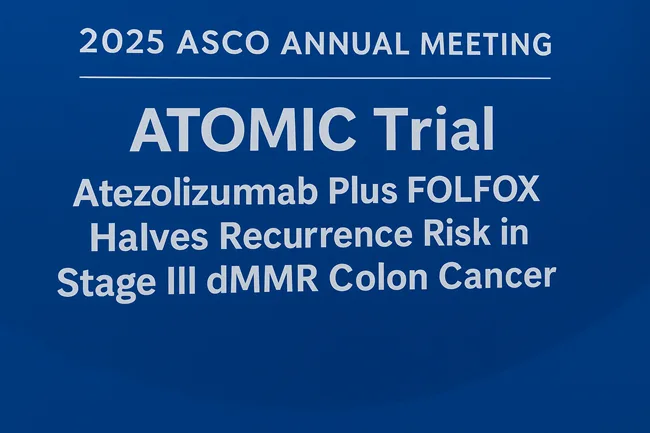
A landmark update from the 2025 ASCO Annual Meeting has signaled a major shift in the treatment paradigm for stage III colon cancer patients with deficient DNA mismatch repair (dMMR). Data from the phase 3 ATOMIC trial, presented by Mayo Clinic oncologist Dr. Frank A. Sinicrope, revealed that the addition of atezolizumab to standard FOLFOX chemotherapy significantly improves disease-free survival (DFS), cutting the risk of recurrence and death by half compared to chemotherapy alone.
These findings, delivered during the Plenary Session, position immunotherapy as a likely new standard in the adjuvant treatment of dMMR colon cancer—an area where conventional chemotherapy has long struggled due to innate resistance associated with the tumor subtype.
What Did the ATOMIC Trial Prove?
The ATOMIC trial enrolled 712 patients diagnosed with resected stage III dMMR colon cancer, a subset that accounts for approximately 10% to 15% of all nonmetastatic colorectal cancers globally. Patients were randomized into two arms: one received the conventional mFOLFOX6 regimen for six months, while the second arm received FOLFOX in combination with atezolizumab for six months, followed by atezolizumab monotherapy for another six months.
After a median follow-up of 37.2 months, patients in the combination therapy group showed a three-year DFS rate of 86.4%, compared to 76.6% in the FOLFOX-only arm. This translated to a hazard ratio of 0.50 (95% CI: 0.34–0.72; p < 0.0001), effectively indicating a 50% reduction in recurrence or death.
Notably, the benefit was consistent across key demographic and clinical subgroups—including age, sex, tumor location, N-stage, and T-stage—underlining the broad applicability of the approach within the dMMR cohort.
Why Is This Finding Clinically Significant?
Until now, adjuvant treatment for stage III colon cancer with dMMR relied heavily on chemotherapy protocols extrapolated from data in mismatch repair-proficient (pMMR) patients. However, dMMR tumors are known for resistance to fluoropyrimidines—making standard regimens less effective and prompting the need for tailored approaches.
The success of immune checkpoint inhibitors in metastatic dMMR colorectal cancers raised the possibility that these agents might offer similar advantages in earlier-stage disease. The ATOMIC trial is the first prospective phase 3 study to validate that hypothesis in an adjuvant setting, making it a breakthrough moment in gastrointestinal oncology.
Discussing the results, Dr. Myriam Chalabi of the Netherlands Cancer Institute emphasized that the study provides long-overdue clarity. She noted that previous adjuvant practices were largely based on pooled or post hoc analyses rather than prospective trials, making ATOMIC the first to offer direct evidence for this population segment.
How Was the Study Structured and Who Were the Patients?
The trial maintained a balanced design. Patients were nearly equally split between the arms: 355 received atezolizumab + FOLFOX and 357 received FOLFOX alone. The median age hovered around 64 years, and roughly half of all participants were female. Ethnically, around 85% were White—a demographic pattern consistent with most large oncology trials in this disease.
All patients received a median of 12 fluorouracil bolus and infusion cycles and 10 cycles of oxaliplatin, confirming consistency in chemotherapy exposure. In the atezolizumab arm, the median number of immunotherapy cycles was 23, administered over one year.
What About Overall Survival and Long-Term Outcomes?
While disease-free survival was the primary endpoint and showed strong statistical significance, overall survival (OS) data remain immature. As of now, the OS follow-up stands at 42.5 months. However, interpreting eventual OS will be complicated by post-trial crossover and the use of immunotherapy in recurrent cases.
Still, oncologists view DFS as a highly meaningful endpoint, especially in curative-intent settings. Given that most relapses in colon cancer occur within three years, the current DFS advantage could very well translate into long-term survival benefits with further follow-up.
Did Safety or Adverse Events Raise Any Red Flags?
Safety results revealed expected toxicity profiles. Grade 3 or higher adverse events occurred more frequently in the combination arm, particularly fatigue, nausea, anorexia, leukopenia, and elevated liver enzymes. Specifically, grade 4 neutropenia was seen in 14% of the atezolizumab group versus 7% in the FOLFOX-alone group.
Despite the increase in higher-grade events, the safety profile was in line with known toxicities of both agents. No unexpected immune-related events emerged, and the regimen was considered tolerable overall.
Dr. Chalabi did caution that the trial design—initiated in 2017—may have imposed more treatment than necessary. She referred to more recent data showing that three months of adjuvant chemotherapy might be sufficient in select cases. She also noted that chemotherapy could theoretically blunt immunotherapy’s effects by suppressing immune cells, a hypothesis that remains unproven but warrants exploration in future trials.
Could Future Regimens Eliminate Chemotherapy?
The emergence of neoadjuvant immunotherapy as a potential substitute for chemotherapy is gaining momentum. Trials like AZUR-2, which evaluates perioperative dostarlimab against standard adjuvant chemotherapy, aim to explore chemotherapy-free pathways in the same dMMR population.
However, Dr. Chalabi acknowledged that the strength of the ATOMIC trial results may complicate recruitment for ongoing trials. The new evidence sets a high efficacy benchmark, and until other studies demonstrate noninferiority or superiority, the combination of immunotherapy and chemotherapy may remain the preferred choice.
Broader Oncology Context: Why This Matters in 2025
The ATOMIC results contribute to a growing body of evidence that immunotherapy is not just for metastatic or refractory cases—it can play a pivotal role in curative settings too. This mirrors trends across lung, melanoma, and bladder cancers, where checkpoint inhibitors are increasingly used earlier in the treatment sequence.
Furthermore, colon cancer remains a leading cause of cancer mortality globally. With dMMR status now emerging as a critical biomarker for treatment stratification, the results of this study are expected to shape national and international guidelines, potentially making chemo-immunotherapy the standard of care for all eligible patients with stage III dMMR colon cancer.
Expert Sentiment and Forward-Looking Statements
Institutional sentiment following the Plenary Session was broadly positive. Oncologists see the ATOMIC trial as a practice-changing development, especially for patients with Lynch syndrome and sporadic dMMR tumors who previously had limited effective adjuvant options.
While market implications are not the focus of ASCO discussions, Genentech, the manufacturer of atezolizumab, is expected to see increased demand for the drug in the adjuvant setting if regulatory approvals follow. Analysts will likely monitor label expansions closely.
What remains to be seen is whether future protocols will refine or replace chemotherapy components altogether—potentially moving toward single-agent immunotherapy or targeted combinations in biomarker-selected populations.
A New Era for Early-Stage dMMR Colon Cancer?
The ATOMIC trial provides more than a promising result—it validates a strategy that addresses a biologically unique subset of colon cancer with tailored precision. As immunotherapy moves upstream in cancer care, the findings underscore the power of biomarker-driven decisions in improving survival and reducing overtreatment.
For clinicians, patients, and researchers, this marks a definitive step forward in bridging molecular insights with treatment innovation—an approach likely to define the next decade of oncology.
Discover more from Business-News-Today.com
Subscribe to get the latest posts sent to your email.

