

Why are hyperscale data centers replacing steel mills and refineries as the backbone of US industrial growth in the AI age?
Meta Platforms Inc. (NASDAQ: META) has signaled its ambition to spend at least USD 600 billion on data centers and supporting infrastructure across the United States through 2028. The figure, shared by Chief Executive Officer Mark Zuckerberg at a White House dinner with President Donald Trump and leading technology executives, underscores how hyperscale campuses are taking the place of yesterday’s steel mills and oil refineries as the pillars of American industrial might.
This shift is not limited to one firm. Across the country, utilities and policymakers are contending with unprecedented requests from cloud and artificial intelligence operators. A recent analysis suggested that U.S. utilities face nearly 400 gigawatts of potential data center load, more than half the total peak demand of the contiguous United States. The comparison is staggering: where heavy industry once defined U.S. load growth, today’s digital factories—vast arrays of servers and cooling towers—are bending power curves and reshaping regional economies.
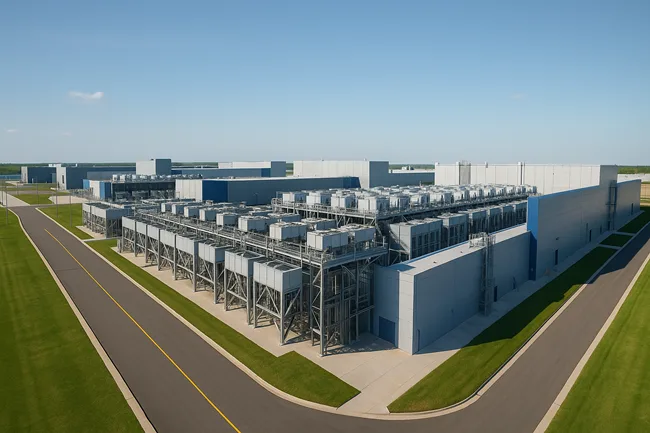
How does the current wave of hyperscale spending compare with Tennessee Valley Authority dams and the interstate highway system?
America’s 20th-century growth was anchored by massive public projects. The Tennessee Valley Authority in the 1930s and 1940s tied hydropower dams, steam plants, and transmission lines into a coordinated regional industrial engine, powering aluminum smelters, chemical plants, and eventually nuclear capacity. The Interstate Highway System, authorized in 1956, carried a price tag of USD 114 billion at completion and became the arteries of commerce.
Meta’s multi-hundred-billion-dollar signal now mirrors that scale—but with a critical difference. The hyperscale build-out is privately financed and guided by corporate strategy, not federal mandate. Yet the macro-effects are comparable: clusters of power-hungry assets, new jobs, and downstream supply chains. The Hyperion data center campus in Louisiana, projected to eventually scale toward 5 gigawatts, resembles the footprint of a large nuclear facility and spans thousands of acres—industrial geography of the type last seen in mid-century refinery belts.
Which regions are emerging as the epicenters of America’s AI infrastructure build-out, and why?
Northern Virginia remains the global epicenter of data center activity, hosting roughly 13% of worldwide operational capacity. Industry watchers estimate that up to 70% of global internet traffic can pass through its fiber hubs on peak days. Yet the concentration has created permitting bottlenecks, transmission congestion, and local pushback. Regional grid operator PJM has already attributed about 30 gigawatts of future peak demand growth to data centers.
Louisiana represents the new wave. Meta’s Hyperion complex near Monroe sits on a 2,250-acre site with room for nine massive halls, offering cheap land, transmission access, and political incentives. Local leaders tout multi-billion-dollar construction and energy projects tied to the buildout, while analysts caution about execution challenges and water demand.
Can US energy grids realistically keep pace with hyperscale electricity demand from AI workloads?
The U.S. Energy Information Administration forecasts record electricity use in 2025 and 2026, with data centers and crypto mining among the largest drivers. Independent projections show national electricity demand rising 25% by 2030 compared with 2023. In PJM, higher demand has already driven capacity auction prices sharply upward, a boon for generators able to supply firm load.
Globally, the International Energy Agency projects data center demand more than doubling by 2030 to roughly 945 terawatt-hours, with AI-specific campuses quadrupling usage. Without rapid efficiency gains in GPUs, cooling systems, and software, the growth risks colliding with climate targets. Institutional investors now scrutinize hyperscaler capex plans not just for financial return but for grid and emissions impacts.
What role does water play in the scaling of America’s AI industrial backbone?
Cooling demands have emerged as one of the most contested dimensions of hyperscale growth. A medium-sized facility can consume around 110 million gallons of water annually, while the largest sites may use several million gallons per day. Some operators report far lower figures by using closed-loop chillers or recycled water, but in water-scarce regions the optics have turned political. Business Insider reported that 40% of U.S. data centers operate in high or extreme water stress zones, intensifying scrutiny of corporate “water positive” pledges.
The industry response has been to highlight innovation. New refrigerant-based cooling, dry air systems, and commitments to recycle wastewater are being rolled out to blunt criticism. Analysts emphasize that water demand is profoundly local—an Arizona data center cannot be evaluated against the same metrics as a Virginia site.
How are state incentives shaping the geography of AI infrastructure, and what are the risks?
Unlike TVA dams or federal highway spending, today’s hyperscale backbone depends heavily on state and local incentives. Good Jobs First estimated that ten states now forgo more than USD 100 million annually in tax breaks for data centers, with Texas above USD 1 billion and Virginia close behind.
Recent deals illustrate the intensity of competition. In Abilene, Texas, Crusoe Energy’s proposed “Stargate” AI campus was linked to an 85% property tax abatement, while national coverage compared the bidding wars for AI campuses to the 2018 Amazon HQ2 contest. Critics argue the subsidies trade away tax bases for relatively few permanent jobs, while backers counter that indirect employment and infrastructure spillovers justify the outlays.
Which sectors and utilities are positioned to benefit most as server halls replace smokestacks?
Utilities with dispatchable fleets and nuclear assets are already benefitting from load growth. Firms like Vistra Corp. have seen share price rallies on investor bets that nuclear life extensions and gas-nuclear hybrids will capture AI-driven demand. Transmission developers, HVAC and cooling suppliers, and industrial construction firms are also building new supply chains that echo the refinery-rail-steel ecosystems of past decades.
Institutional sentiment suggests that capacity providers will see sustained earnings visibility, while hyperscalers will face short-term free cash flow compression. Investors now weigh Meta’s USD 600 billion ambition as a long-term moat, with average analyst targets suggesting 13% upside from current levels.
What execution risks could derail the rise of data centers as the new industrial backbone?
Transmission bottlenecks remain the primary constraint. Even where renewable capacity is abundant, interconnection queues slow buildouts. Utilities warn of “phantom” requests—projects that secure queue slots without financing—distorting forecasts. Water scarcity and community resistance also threaten to stall projects.
Institutional voices argue that reforms in permitting, interconnection, and forecasting discipline are prerequisites for turning headlines into hardware. Without them, the risk is that billions in announced capex will face multi-year delays, undermining the AI buildout narrative.
How should investors interpret Meta’s $600 billion pledge in the context of America’s AI industrial pivot?
Analysts widely view Zuckerberg’s figure as aspirational rather than binding—directional guidance meant to signal ambition. For investors, the relevant metrics will be actual procurement run-rates, site filings, power purchase agreements, and GPU allocation. Institutional funds remain overweight U.S. hyperscalers, expecting that while free cash flow will be pressured, long-term revenue growth in AI services will justify the capex intensity.
For energy equities, the message is clearer: demand growth is back. Utilities and independent power producers are again central to America’s industrial map, with AI data centers now playing the role refineries and mills once did.
Discover more from Business-News-Today.com
Subscribe to get the latest posts sent to your email.