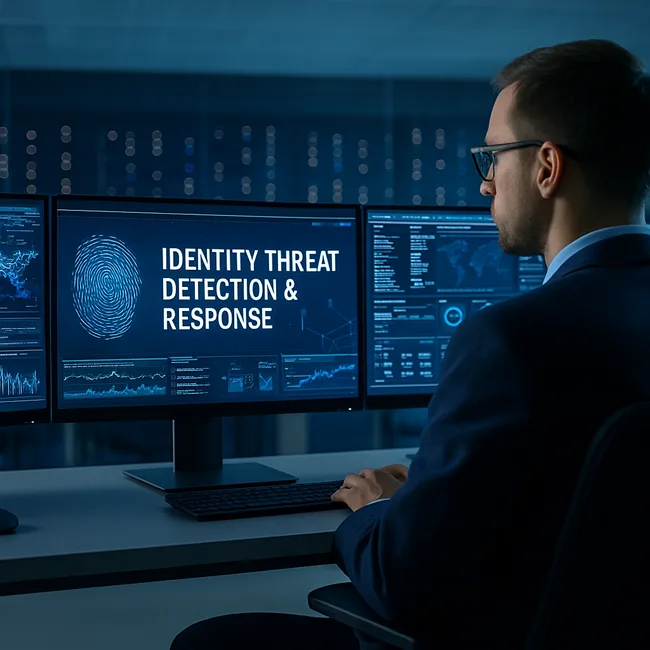
In 2025, identity threat detection and response (ITDR) platforms are emerging as the critical glue holding together modern SaaS zero-trust strategies. With attackers exploiting OAuth tokens, dormant service accounts, and over-privileged federated identities, traditional endpoint and network tools lack visibility into SaaS identity layers. Vendors such as Okta, Microsoft, CrowdStrike, and CyberArk are ramping up ITDR innovation to bridge this gap, offering behavioral analytics, continuous identity risk scoring, and automated remediation.
The urgency is driven by a surge in identity-based breaches. The Commvault Metallic SaaS breach and Microsoft Entra ID’s nOAuth flaw revealed how misconfigured OAuth trust relationships can bypass multifactor authentication and conditional access. Analysts describe ITDR as the “runtime brain” of zero trust—turning static policies into adaptive defenses that continuously verify every session, every token, and every credential in real time.
Why are ITDR tools gaining traction in SaaS security in 2025?
Identity-focused attacks now dominate SaaS security incidents. Research from leading cybersecurity conferences in 2025 indicates that over 60 % of SaaS breaches are caused by compromised credentials, stale OAuth tokens, or excessive application privileges. Traditional IAM and CASB solutions enforce policies but cannot detect when legitimate accounts behave suspiciously.
ITDR platforms fill this detection gap. By continuously monitoring logins, token behaviors, and API calls, they establish baselines of normal identity activity. When anomalies occur—such as impossible travel logins, privileged service accounts creating new OAuth apps, or dormant users suddenly initiating bulk data exports—ITDR tools trigger alerts or automated responses. CrowdStrike Falcon Identity Threat Protection, for example, can terminate sessions within seconds, while Okta ThreatInsight forces immediate multifactor reauthentication for suspicious identities.
Enterprises adopting ITDR report significant reductions in dwell time. Institutional analysts highlight case studies where detection windows shrank from weeks to hours, dramatically reducing the scope and cost of incident response.
What makes ITDR a critical component of zero-trust architectures for SaaS ecosystems?
Zero-trust strategies are built on the principle of “never trust, always verify,” yet most zero-trust deployments stop after authentication. Once a user passes initial checks, session validity often persists for hours, even if behavioral risk changes mid-session.
ITDR solves this gap by enforcing continuous, risk-based session validation. For instance, if a financial analyst logs into Salesforce legitimately but then downloads hundreds of records at odd hours while accessing SharePoint via an unfamiliar IP, ITDR platforms can dynamically adjust privileges or terminate the session outright. This active enforcement transforms zero trust from a static checklist into a live defense system.
Integration trends underscore ITDR’s growing importance. Microsoft Entra ID now shares continuous access evaluation (CAE) signals with ITDR partners, while Okta uses the Shared Signals Framework to synchronize identity risk scoring with downstream SaaS apps. CyberArk’s Identity Security Intelligence adds lateral movement detection across hybrid SaaS and on-prem systems, bringing privileged account monitoring into zero-trust alignment.
How are leading vendors positioning ITDR offerings to secure SaaS applications?
Vendors are moving aggressively to capture the ITDR market. Okta has embedded advanced risk analytics into its Identity Cloud, correlating login anomalies with downstream SaaS app behaviors. CrowdStrike’s Falcon Identity now integrates natively with Google Workspace, Salesforce, and ServiceNow, giving security teams visibility into token misuse across business-critical SaaS tools.
CyberArk, once focused solely on privileged access management, has repositioned itself as a broader identity security player. Its latest update detects abnormal access patterns in federated SaaS accounts, alerting teams to lateral movement attempts. SentinelOne’s Singularity Identity now extends behavioral detection to SaaS tokens, focusing on hybrid deployments where legacy Active Directory and cloud identities intersect.
Analysts expect consolidation, with ITDR features merging into cloud-native application protection platforms (CNAPPs) and extended detection and response (XDR) stacks. Vendors that can unify ITDR with SaaS posture management and workload protection are likely to dominate the market.
How are institutional investors and cyber insurers influencing ITDR adoption in regulated sectors?
Investor and insurer pressure is accelerating ITDR adoption, especially in finance, healthcare, and government contracting. Private equity firms conducting SaaS due diligence now request ITDR-generated identity risk assessments as part of valuation checks. Weak identity hygiene—such as unmonitored service accounts or lack of behavioral anomaly detection—has been cited as a factor lowering valuations or delaying M&A deals.
Cyber insurers are adjusting underwriting models. Firms deploying ITDR alongside zero-trust policies receive lower premiums and expanded breach coverage, as automated identity detection significantly reduces investigation costs. Insurers also favor organizations providing real-time ITDR logs during incident response, which speed up forensic analysis and reduce claims.
Institutional sentiment suggests ITDR will soon be treated as a baseline requirement for organizations seeking to secure contracts in regulated markets, mirroring how endpoint detection became mandatory a decade ago.
What future developments are expected in ITDR and its role in SaaS zero-trust adoption through 2026?
By 2026, ITDR platforms are expected to evolve from reactive detection to predictive identity analytics. Machine learning models will analyze user behavior and integration trends to forecast which accounts or tokens are most likely to be exploited. Analysts predict that ITDR will merge with SaaS posture management (SSPM), enabling platforms to remediate risky configurations before attackers exploit them.
Regulatory frameworks are also aligning. Updates to NIST 800-207 and DORA are likely to mandate continuous identity risk scoring and automated attestation as part of SaaS compliance certifications. Vendors are already developing attestation dashboards that can provide regulators and procurement teams with live proof of identity risk monitoring.
Experts agree that ITDR will soon shift from being a specialized add-on to a core pillar of zero-trust security. As SaaS identity becomes the primary attack surface, organizations without ITDR will struggle to meet compliance demands and investor expectations.
Identity threat detection and response has transitioned from an emerging security trend to an operational necessity for SaaS-driven enterprises. In 2025, ITDR tools are no longer viewed as experimental add-ons; they are core components of mature zero-trust SaaS architectures. By providing dynamic, real-time enforcement, ITDR platforms transform static identity policies into adaptive defenses that continuously validate every credential, every session, and every privileged request. This ability to detect and respond to anomalies mid-session—rather than waiting for post-incident audits—has become critical as attackers increasingly exploit OAuth tokens, dormant service accounts, and over-privileged SaaS integrations.
For CISOs, compliance leaders, and procurement teams, integrating ITDR is now a strategic priority. Beyond mitigating credential-based breaches, ITDR adoption directly impacts regulatory compliance, cyber insurance underwriting, and investor confidence. Organizations demonstrating continuous identity risk scoring and automated remediation are gaining a measurable competitive advantage in regulated markets, where trust, transparency, and audit readiness are procurement deal-breakers. In this environment, delaying ITDR integration is no longer an option; it is the missing link that determines whether SaaS security strategies can withstand modern identity-driven attacks while meeting the rigorous demands of zero-trust compliance frameworks.
Discover more from Business-News-Today.com
Subscribe to get the latest posts sent to your email.