




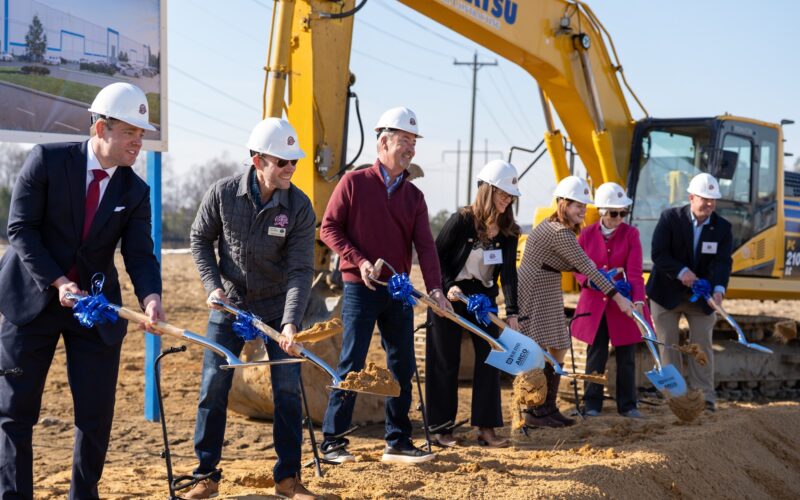
ARCO Design/Build has broken ground on Steel 70, a three-building industrial campus totaling approximately 346,000 square feet along the US-70 Business corridor in Clayton, North Carolina, with Blue Steel Development as developer. The project targets modern logistics, warehousing, and light industrial users and reflects the continued eastward expansion of the Raleigh-Durham industrial market as developers respond to capacity constraints closer to the urban core.
Why the Steel 70 groundbreaking matters for the evolving industrial geography of the Raleigh-Durham Triangle
The significance of Steel 70 extends well beyond the ceremonial start of construction. Industrial development in the Raleigh-Durham Triangle has increasingly shifted from infill locations near Raleigh and Durham toward peripheral corridors that can support modern building specifications, trailer storage, and expansion optionality. Clayton and the broader Johnston County area are emerging as beneficiaries of this spillover as occupiers look to balance access, cost discipline, and speed to market.
The US-70 Business corridor provides a connective spine between the Triangle and eastern North Carolina while remaining within practical commuting distance of the region’s labor base. For logistics and light manufacturing tenants, this positioning allows distribution efficiency without the escalating land and lease costs found closer to Interstate 40 and Interstate 540. Steel 70 fits squarely into this demand pattern by offering market-ready space in a location that still supports operational flexibility.

How ARCO Design/Build’s design-build model aligns with speculative industrial development cycles
ARCO Design/Build’s role in Steel 70 highlights why the design-build delivery model continues to gain traction in speculative industrial projects. Developers operating in fast-moving logistics markets are increasingly prioritizing speed, cost certainty, and execution reliability over bespoke architectural differentiation. Design-build structures compress timelines by integrating feasibility, design, and construction decisions under a single accountable team.
For Blue Steel Development, this approach reduces entitlement-to-delivery risk while enabling faster response if tenant requirements evolve mid-build. In a market where pre-leasing may lag initial construction starts, the ability to pivot layouts or loading configurations without resetting the entire project schedule can be a material competitive advantage.
What Steel 70 signals about speculative industrial appetite in secondary Triangle submarkets
Speculative industrial construction carries different risk dynamics in secondary submarkets than in core logistics hubs. Developers must balance confidence in regional demand growth against the possibility of slower lease-up if macroeconomic conditions soften. Steel 70’s three-building campus structure suggests a calibrated approach rather than an all-at-once bet.
Phased delivery allows Blue Steel Development to test tenant demand while preserving optionality for later stages. This structure aligns with current institutional preferences that favor flexibility over scale concentration, particularly as interest rates and financing conditions remain sensitive to broader economic signals.
How Johnston County is positioning itself within North Carolina’s industrial growth strategy
Johnston County has spent the past decade building a reputation as a pro-growth jurisdiction capable of absorbing industrial expansion without the zoning friction seen in more densely developed counties. Local governments have increasingly framed industrial projects not just as job creators but as anchors for long-term tax base diversification.
Steel 70 reinforces this positioning by aligning modern industrial capacity with infrastructure planning along established corridors. The county’s willingness to support logistics and light manufacturing contrasts with more restrictive approaches elsewhere in the Triangle, creating a relative advantage for projects that require scale and operational intensity.
Why modern logistics users are prioritizing flexibility over pure proximity in site selection
Tenant demand in 2026 is shaped less by absolute proximity to urban cores and more by operational resilience. Distribution and light manufacturing users increasingly value ceiling heights, dock ratios, trailer courts, and expansion potential over being within a few minutes of downtown markets. Steel 70’s design emphasis reflects this shift by targeting functionality rather than symbolic location prestige.
For regional distributors, Clayton offers a compromise between access and affordability. It supports last-mile and regional distribution strategies while preserving room for automation upgrades and incremental capacity growth as volumes scale.
Execution risks that could shape the commercial success of the Steel 70 industrial campus
Despite favorable market fundamentals, Steel 70 is not without execution risk. Lease-up velocity will depend on broader logistics demand trends, particularly among regional distributors that are sensitive to inventory cycles and consumer spending patterns. Construction cost volatility, while more stable than in prior years, remains a factor that could pressure returns if schedules slip.
Labor availability during construction and eventual tenant staffing also remains a variable. While Johnston County offers workforce depth relative to more rural markets, competition from adjacent projects could influence wage dynamics and hiring timelines for end users.
What ARCO Design/Build’s regional track record suggests about delivery confidence
ARCO Design/Build has completed more than 4.4 million square feet of industrial projects across Johnston County, including multiple developments in Clayton. This track record provides a degree of execution credibility that matters to both developers and prospective tenants. Repetition in a specific geography often translates into smoother permitting processes, stronger subcontractor relationships, and more predictable delivery outcomes.
For Steel 70, this experience reduces the probability of surprise delays and reinforces the project’s positioning as market-ready rather than speculative in name only.
How Steel 70 fits into Blue Steel Development’s broader Southeastern growth thesis
Blue Steel Development has consistently focused on high-growth Southeastern markets where population inflows, infrastructure investment, and business-friendly policies intersect. Steel 70 aligns with this thesis by targeting a submarket that sits just outside a major metro while benefiting from its economic gravity.
The project reflects a preference for functional industrial assets over trophy developments. This strategy prioritizes durable occupancy and long-term asset management over short-term valuation spikes, an approach increasingly favored by capital partners seeking stability in industrial real estate portfolios.
What this development reveals about the next phase of Triangle industrial expansion
Steel 70 underscores a broader pattern in which the Triangle’s industrial growth is decentralizing rather than slowing. As core locations mature, demand migrates along corridors that preserve connectivity while unlocking new development capacity. Clayton and similar markets are no longer peripheral but integral to the region’s logistics ecosystem.
This shift suggests that future industrial competitiveness in North Carolina will depend less on city-center proximity and more on corridor-based planning that integrates transportation, workforce access, and scalable land use.
What are the key takeaways for developers, tenants, and regional planners watching Steel 70’s progression
- Steel 70 reflects the eastward expansion of Triangle industrial demand as land and cost pressures intensify closer to Raleigh and Durham.
- The US-70 Business corridor is emerging as a strategic logistics spine linking secondary markets to the broader Southeast.
- Design-build delivery continues to gain relevance for speculative industrial projects requiring speed and flexibility.
- Phased campus development structures help balance speculative risk with market responsiveness.
- Johnston County’s pro-growth posture strengthens its appeal as an industrial alternative to more constrained jurisdictions.
- Tenant priorities are shifting toward functional flexibility rather than pure proximity to urban cores.
- Execution risk remains tied to lease-up timing, construction costs, and labor availability.
- ARCO Design/Build’s regional track record enhances delivery confidence for both developers and tenants.
- Blue Steel Development’s focus on scalable, functional assets aligns with institutional preferences for durable industrial exposure.
Discover more from Business-News-Today.com
Subscribe to get the latest posts sent to your email.



