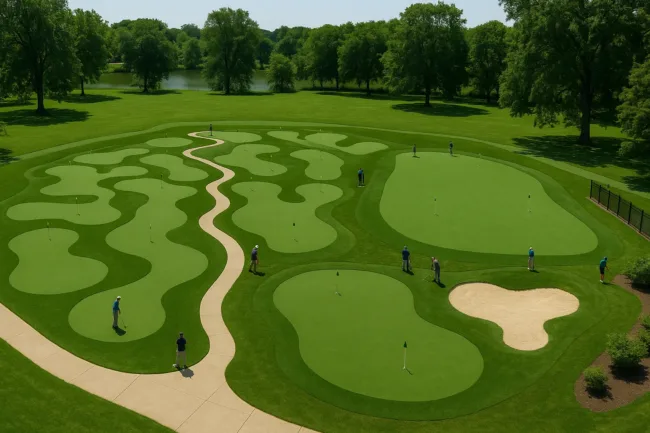
American Greens, a leading U.S. synthetic turf provider, has completed a landmark project in Chicago’s Austin neighborhood: a 22,000-square-foot public golf amenity at Columbus Park. The short-game facility, designed in partnership with the Chicago Park District and golf management company Troon, is being hailed as one of the most innovative community golf projects in the Midwest.
The new installation, which opened this week, blends four practice experiences into one location: a nine-hole mini putting course, a full-size practice putting green, a chipping green with specialized turf, and an authentic sand bunker. What sets it apart is not just the design, but the fact that it is free to the public—a deliberate effort to lower barriers to golf participation in a city where affordability has long been a challenge.
Troon funded the $450,000 project as part of its wider capital improvement commitments across Chicago’s park golf facilities. For American Greens, which has built a reputation over 25 years for synthetic turf installations, the course is a showcase of how artificial surfaces can be deployed to improve access, durability, and cost efficiency in recreational sport.
Why is the new Columbus Park facility seen as a breakthrough for golf access and community inclusion in Chicago?
The project arrives at a time when golf’s participation demographics are evolving. According to the National Golf Foundation, U.S. golf has seen an uptick in youth and beginner players over the last three years, but urban access remains uneven. In neighborhoods like Austin on Chicago’s West Side, where public sports infrastructure is underfunded, a free facility can be a game-changer.

By offering high-quality synthetic turf putting and chipping greens, American Greens and Troon are addressing two long-standing challenges in public golf amenities: maintenance costs and accessibility. Unlike natural grass facilities, synthetic surfaces require less water, mowing, and fertilizer, allowing year-round usability and reduced upkeep burden on the Chicago Park District.
The inclusion of a real sand bunker adds authenticity to practice sessions, something rarely offered outside private clubs. This makes the facility attractive not just for youth programs but also for amateur golfers who want to sharpen their short game without paying for private range time.
Community organizations have already woven the facility into their programming. The “Play Like A Champion” initiative, which brings together local youth and the Chicago Police Department, is now using the putting course to build community trust through sport. Similarly, the Chicago Road Kings Junior Golf Program—which has mentored young golfers for nearly four decades—has adopted the new greens as part of its coaching framework.
How does this investment reflect broader trends in synthetic turf and recreational golf development?
American Greens, headquartered in Bettendorf, Iowa, has positioned itself as one of the longest-tenured artificial turf companies in the United States. With over 1,000 projects completed and more than one million square feet of turf installed, the family-owned business has developed a niche in golf-specific surfaces.
Industry observers note that synthetic turf is gaining traction beyond professional sports stadiums, where it has long been used, into community recreational projects. The driver is a combination of rising water costs, municipal budget constraints, and growing demand for multipurpose, low-maintenance facilities.
In golf, the use of artificial greens is not new, but the concept of combining multiple short-game elements into a public-access park is unusual. Analysts see the Chicago project as part of a shift toward “urban golf accessibility,” where the sport’s barriers of cost, space, and exclusivity are being dismantled through innovative facility design.
Troon’s willingness to underwrite the $450,000 capital cost signals institutional confidence in the model. As the world’s largest golf management company, Troon has a vested interest in expanding participation pipelines. Making golf more inclusive in cities like Chicago aligns with its long-term strategy of cultivating future golfers while fulfilling public recreation mandates.
What is the institutional and investor sentiment around community-focused sports infrastructure projects like this?
While American Greens is privately held and does not have a public stock listing, institutional investors have increasingly scrutinized sports infrastructure as an asset class. Pension funds and real estate investment trusts (REITs) have invested in stadiums, arenas, and even minor league facilities, betting on long-term demand for recreational experiences.
In the context of synthetic turf and community golf, analysts say the financial upside is less about direct monetization and more about brand equity, urban revitalization, and public-private partnerships. Troon’s investment is viewed as both a corporate social responsibility gesture and a strategic bet that broader golf participation will sustain course usage and related revenue streams in the long run.
Institutional sentiment generally favors models where public amenities align with inclusivity and sustainability. The use of artificial turf, with its lower environmental footprint compared to heavily watered natural greens, is seen as consistent with ESG (environmental, social, governance) priorities.
Can the Columbus Park project serve as a model for scaling synthetic turf golf facilities across U.S. cities?
Industry experts believe so. Chicago’s Columbus Park project combines multiple elements that could be replicated elsewhere: an underserved urban location, a no-cost access model, public-private funding, and a durable synthetic turf solution.
If successful in driving sustained participation, the model could be expanded in cities like Detroit, Cleveland, and Philadelphia, which also face disparities in recreational infrastructure. For American Greens, which has completed projects across the U.S., scaling the concept offers both brand visibility and potential revenue growth.
The challenge, however, lies in ensuring continuous community engagement. Without active programming and integration into local schools or youth initiatives, such facilities risk underutilization. That is why partnerships with programs like “Play Like A Champion” and the Road Kings Junior Golf Program are considered critical.
Looking ahead, analysts expect more municipalities to explore synthetic turf golf parks as part of urban renewal strategies. For American Greens, this represents a potential growth avenue at the intersection of sport, community development, and sustainability.
What does this mean for the future of American Greens as a synthetic turf leader in the golf industry?
Founded in 1999, American Greens has carved out a reputation as a niche expert in golf-related synthetic installations. With a portfolio spanning more than 1,000 projects, the company has proven its technical know-how in creating lifelike practice surfaces.
The Chicago project strengthens its positioning as an innovator in public-access golf design. Institutional observers suggest that projects like Columbus Park could differentiate American Greens in a crowded synthetic turf market, which also includes providers focusing on residential landscaping, sports fields, and playgrounds.
While not publicly traded, the company’s strategy of partnering with major golf management players like Troon enhances credibility. It also demonstrates an ability to handle large-scale, community-impact projects—a capability that could attract further contracts from municipalities and private operators alike.
For the Chicago Park District, the installation marks a milestone in expanding amenities on the West Side. For Troon, it aligns with its broader investment in public golf infrastructure. And for American Greens, it serves as a high-visibility case study in how synthetic turf can reshape access to traditionally exclusive sports.
Discover more from Business-News-Today.com
Subscribe to get the latest posts sent to your email.