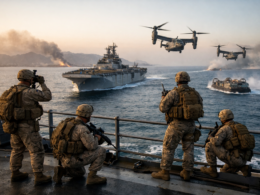


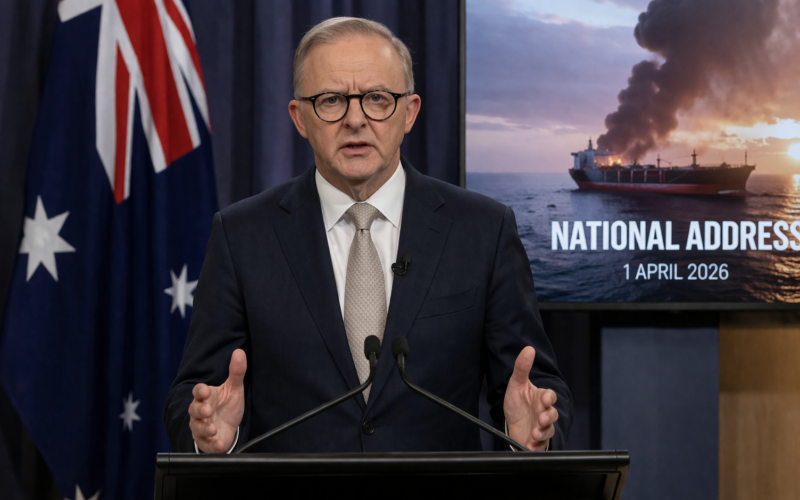
Australian Prime Minister Anthony Albanese delivered a rare national televised address on Wednesday, April 1, 2026, warning citizens that the economic shocks resulting from the war in the Middle East will be felt for months and urging them to switch to public transport to ease pressure on Australia’s strained fuel supplies.
The address was broadcast simultaneously across major Australian television and radio networks at 7:00 pm local time. The format is rarely used in Australia, with comparable addresses made by previous prime ministers only during the COVID-19 pandemic and the 2008 global financial crisis, signalling the severity of the current situation from the perspective of the federal government.
The conflict, which began on February 28, 2026 with United States and Israeli strikes on Iran, has expanded across the region, killing thousands, disrupting critical energy infrastructure, and threatening to send the global economy into a severe downturn. One of the most consequential consequences of the conflict has been Iran’s effective blockade of the Strait of Hormuz, a narrow waterway connecting the Persian Gulf to the Gulf of Oman through which approximately 20 to 25 per cent of the world’s seaborne crude oil and liquefied natural gas ordinarily transits.
Prime Minister Albanese told the nation that the war in the Middle East has caused the biggest spike in petrol and diesel prices in recorded history. He acknowledged that the months ahead may not be easy but stated the government would do everything within its power to support Australian households and businesses through the disruption. Albanese said Australia is not an active participant in the war but that all Australians are paying higher prices because of it.
In direct terms, Albanese urged citizens to avoid stockpiling fuel ahead of the Easter holiday period, which begins this week. He specifically called on those who can use trains, buses, or trams to commute to do so in coming weeks, freeing up petrol and diesel supplies for nurses, shift workers, tradespeople, miners, and communities in regional and rural Australia who have no viable alternative to private vehicles.
What is the Australian government’s fuel excise cut and what does it cost taxpayers?
Earlier this week, the Albanese government announced a package of emergency economic measures to cushion the impact of rising fuel costs on Australian households and businesses. The fuel excise on petrol and diesel was halved, reducing the price at the pump by 26.3 Australian cents per litre from Wednesday, April 1, 2026. For a standard 65-litre fuel tank, Treasury estimates the saving at approximately A$19 per fill. The government simultaneously suspended the heavy vehicle road user charge for three months, providing direct relief to the trucking and freight industries.
The combined cost of the fuel excise reduction and the suspension of the heavy vehicle charge to the federal budget is approximately A$2.55 billion over three months, with the heavy vehicle road user charge suspension accounting for an additional A$53 million in revenue forgone. Treasury estimates the measures will reduce headline inflation by approximately half a percentage point through the year to June 2026.
Treasurer Jim Chalmers, appearing alongside Albanese at a joint press conference at Parliament House in Canberra earlier this week, said small businesses affected by the war and the resulting fuel crisis would be given easier access to credit. The Australian Taxation Office has agreed to provide temporary relief for businesses unable to meet their tax obligations because of fuel supply issues, including more flexible payment plans, remission of interest and penalties, and support with Pay As You Go instalment arrangements where businesses have experienced a downturn in tax income. Chalmers stated the government knows the fallout is affecting everyone but believes that by working together, the nation can get through the difficult period.

How has the Strait of Hormuz blockade exposed Australia’s structural fuel vulnerability?
Australia’s exposure to the current fuel crisis reflects structural vulnerabilities that predate the conflict. The country is geographically isolated, imports approximately 90 per cent of its fuel, and operates only two working oil refineries. Its strategic fuel reserves, which stand at roughly 37 days of supply for petrol and between 29 and 32 days for jet fuel and diesel respectively, are far below the 90-day minimum stockholding obligations mandated by the International Energy Agency for member nations.
Despite holding its highest fuel stocks in 15 years, Australia remains acutely exposed to prolonged disruptions in global shipping lanes. The chief executive of the International Energy Agency, Fatih Birol, told the National Press Club in Canberra that the current war in the Middle East is worse than the two oil shocks of the 1970s and more damaging than the impact of the Russia-Ukraine war on European gas markets. Birol said the world is short of approximately 11 million barrels of oil per day from global supply as a result of the Strait of Hormuz blockade.
Prior to the conflict, approximately 20 to 25 per cent of the world’s seaborne oil and a comparable share of global liquefied natural gas exports transited the Strait of Hormuz. Countries including Saudi Arabia, the United Arab Emirates, Kuwait, Iraq, and Qatar are among the major producers whose exports have been disrupted. QatarEnergy, a major global liquefied natural gas supplier, declared force majeure on all exports following the closure of the waterway in early March 2026. The loss of Qatari liquefied natural gas supplies has compounded pressure on European energy markets already at historically low storage levels.
From Australia’s perspective, six fuel shipments bound for the country in April were cancelled due to the conflict, though the government has confirmed all six were replaced by alternative suppliers from alternative countries. Energy Minister Chris Bowen told Parliament that none of the 81 shiploads of fuel scheduled to arrive in Australia during April had been permanently cancelled. The minister also confirmed the government had secured at least three additional spot cargoes in transit to Australia and was working with Singapore and South Korea to shore up supply lines.
What emergency legislation and reserve release measures has the Australian government activated?
The Albanese government introduced emergency legislation to the Australian Parliament allowing the government to take on the financial risk of importing additional fuel, described by Energy Minister Chris Bowen as a vital intervention to help Australians secure petrol, diesel, and crude oil shipments. On March 13, 2026, the government authorised the release of up to 20 per cent of Australia’s baseline Minimum Stockholding Obligation, equivalent to approximately 762 million litres of petrol and diesel from domestic reserves. The release was made as part of a coordinated International Energy Agency response releasing 400 million barrels of oil globally.
The government also temporarily relaxed fuel quality standards to widen the range of importable fuel products. Petrol sulphur limits were eased from 10 parts per million to 50 parts per million, and diesel flashpoint requirements were reduced from 61.5 degrees Celsius to 60.5 degrees Celsius for a six-month period, enabling Australia’s two domestic refiners to sell previously non-compliant products and broadening the pool of overseas suppliers.
Prime Minister Albanese convened a National Cabinet session on Monday, March 30, 2026, a 2.5-hour virtual meeting with state and territory leaders to coordinate the national response. State and territory governments indicated they were prepared to forgo windfall Goods and Services Tax revenue arising from higher petrol prices as part of the overall relief effort.
Is Australia at risk of recession and how is the government approaching mandatory fuel restrictions?
Treasurer Jim Chalmers did not rule out the possibility of an Australian recession when questioned by reporters on Wednesday. He acknowledged that Treasury is modelling multiple scenarios to assess the economic impact of the oil shock, noting that the quicker the war is resolved, the sooner the global economy can recover. Chalmers said the longer the shock drags out, the harsher the consequences for the Australian economy, whether measured by inflation, employment, or growth.
Both Albanese and Chalmers have been explicit in their preference to avoid COVID-19-style compulsory interventions. Chalmers confirmed the government is not considering mandating work-from-home arrangements or imposing fuel rationing at this time, though the government has not categorically excluded rationing if conditions deteriorate. Polling cited in Australian media indicates that 61 per cent of Victorians surveyed would support fuel rationing if shortages worsen. Privately, government ministers are reported to be particularly concerned about conditions towards the end of April, even in a scenario where the Strait of Hormuz reopens, given the disruptions already flowing through global fuel supply chains.
Opposition Leader Angus Taylor challenged the government to meet four key tests in managing the fuel crisis, including moving fuel to areas where petrol stations have run dry, ensuring transparency in the fuel supply chain, and outlining clear contingency plans. The Coalition supported the fuel excise cut, which it had advocated for in the days prior to the government’s announcement. The Opposition’s Shadow Resources Minister Susan McDonald criticised the initial reserve release, which applied only to petrol, for doing nothing to address the diesel shortages affecting farmers, truck drivers, and regional industries.
What is the broader global economic impact of the US-Israel war on Iran and the Hormuz blockade?
The conflict’s economic consequences extend well beyond Australia. Brent crude oil prices surged by approximately 59 per cent in March 2026, the steepest single-month gain in the history of global oil markets, reaching above US$115 per barrel. The collective oil production of Kuwait, Iraq, Saudi Arabia, and the United Arab Emirates fell by a reported 6.7 million barrels per day by mid-March, and by at least 10 million barrels per day by March 12, 2026.
European energy markets have been destabilised by the suspension of Qatari liquefied natural gas exports. Dutch TTF gas benchmarks nearly doubled to above 60 euros per megawatt-hour by mid-March, compounding the pressure from historically low European gas storage levels following a harsh 2025 to 2026 winter estimated at only 30 per cent capacity. The European Central Bank postponed planned interest rate reductions on March 19, 2026, raising its 2026 inflation forecast and lowering its gross domestic product growth projections. Economists have warned that energy-intensive economies in Europe face elevated risks of technical recession if the maritime blockade persists through the summer gas refill season.
Global aviation has also been significantly disrupted. The closure of airspace on key flight corridors between Africa, Asia, and Europe has forced airlines to reroute along longer paths circumnavigating the Middle East, increasing both journey times and fuel costs. Multiple major airports in the Middle East have been closed, collectively handling approximately 15 per cent of global air traffic. Several airlines have increased ticket prices or cancelled flights to manage deteriorating cash flow positions.
The humanitarian dimensions of the conflict have further complicated the geopolitical picture. Gulf Cooperation Council member states, which rely on the Strait of Hormuz for more than 80 per cent of their food imports, experienced disruption to approximately 70 per cent of those imports by mid-March 2026. The blocking of desalination plant infrastructure in parts of the region has prompted warnings of a humanitarian crisis in Kuwait and Qatar, both of which rely on desalination for virtually all of their drinking water.
What measures are alternative supply routes and regional partners providing for Australian fuel needs?
With the Strait of Hormuz effectively closed, global attention has turned to alternative oil transit routes. Saudi Arabia’s East-West Crude Oil Pipeline, constructed during the Iran-Iraq War of the 1980s, and the United Arab Emirates’ Habshan-Fujairah Pipeline, completed in 2012, have both been activated to route oil supplies to the Red Sea and the Gulf of Oman respectively, bypassing the strait. However, those pipelines collectively cannot replace the volume ordinarily transiting through the Strait of Hormuz.
Australia has been working directly with regional partners including Singapore and South Korea to secure alternative fuel shipments. South Korea alone ordinarily supplies approximately 220,000 barrels per day of refined products to Australia, accounting for roughly a quarter of Australia’s fuel imports. The Australian Institute of Petroleum has warned that Asian refineries supplying petrol and diesel could potentially curtail or cut off exports to Australia if the conflict continues, and China has reportedly halted all fuel exports that customs have not yet cleared.
Albanese has previously sought to reassure motorists that shipments of fuel continue to arrive in Australia and that petrol shortages in regional towns are the result of panic buying and distribution bottlenecks rather than an absolute supply deficit. Petrol prices around Australia began to fall on Wednesday, April 1, 2026, as the 26-cent per litre excise cut came into effect, though government ministers cautioned that the price reduction may take up to a week to flow fully through to consumers at the bowser.
Key takeaways: What Albanese’s national address means for Australia and the global economy
- Australian Prime Minister Anthony Albanese warned in a rare national address on April 1, 2026, that the economic shocks from the Middle East war will persist for months, making it only the third such address in Australia’s recent history alongside COVID-19 and the 2008 global financial crisis.
- The Albanese government halved the fuel excise on petrol and diesel and suspended the heavy vehicle road user charge for three months at a combined budget cost of approximately A$2.55 billion, reducing pump prices by 26.3 cents per litre and providing Australian Tax Office payment relief for small businesses.
- Australia’s structural fuel vulnerability is acute: with only two operating oil refineries, reserves of approximately 37 days or less across fuel types, and imports accounting for roughly 90 per cent of consumption, the country sits well below the International Energy Agency’s 90-day minimum stockholding requirement.
- Treasurer Jim Chalmers did not rule out an Australian recession, with Treasury modelling multiple scenarios; the government has maintained a preference for voluntary rather than compulsory interventions, resisting fuel rationing mandates while declining to categorically exclude them.
- The broader conflict has produced the steepest single-month rise in Brent crude oil prices in recorded history, disrupted global liquefied natural gas trade, triggered a European Central Bank hold on rate cuts, destabilised food and water security in Gulf Cooperation Council states, and prompted the International Energy Agency chief to describe it as the greatest global energy security challenge in history.
Discover more from Business-News-Today.com
Subscribe to get the latest posts sent to your email.