




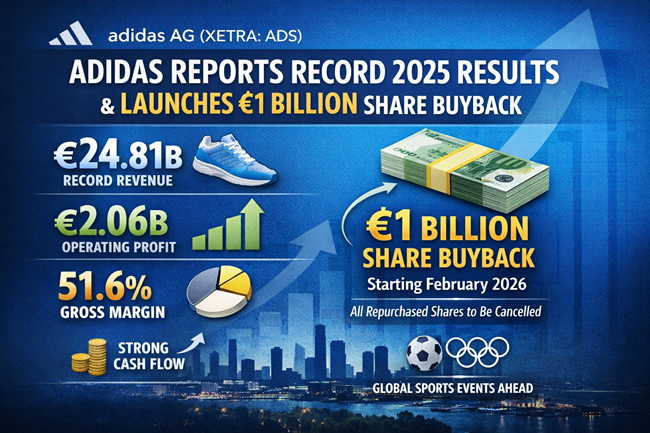
adidas AG (XETRA: ADS) reported preliminary full-year and fourth-quarter 2025 results showing record revenue and a sharp turnaround in profitability, prompting the company to authorize a €1 billion share buyback set to begin in February 2026. The announcement reflects the German sportswear giant’s renewed confidence in its brand strength, cash flow generation, and capital discipline as it prepares for a pivotal year marked by the Olympic and FIFA World Cup cycles.
Currency-neutral revenues for the adidas brand rose 13 percent year-on-year, or 10 percent when excluding the prior year’s Yeezy sales base. Operating profit surged by more than €700 million to reach €2.06 billion, while gross margin climbed to 51.6 percent in 2025, up 80 basis points despite currency and tariff headwinds. The company plans to cancel all repurchased shares, reinforcing the buyback as a structural capital return rather than a short-term market signal.
How adidas rebuilt margin strength and operating leverage ahead of 2026 sports cycles
The financial turnaround adidas achieved in 2025 was underpinned by disciplined execution across product allocation, pricing, and inventory management. In the fourth quarter alone, the company posted an 11 percent increase in currency-neutral sales, or 10 percent when adjusted for the prior year’s €50 million contribution from Yeezy. Revenue for the quarter reached €6.08 billion in reported terms, up from €5.97 billion in the same period last year. Operating profit for the quarter more than doubled to €164 million, and the gross margin expanded to 50.8 percent.
Full-year revenue reached €24.81 billion, a record for the company despite a negative currency translation impact of more than €1 billion. The company emphasized that this growth was broad-based, with all major markets and sales channels contributing double-digit gains. Even without the Yeezy portfolio, which accounted for approximately €650 million in 2024 sales, adidas managed to grow currency-neutral revenue by a full 10 percent.
The real story, however, lies in the company’s margin recovery. The full-year gross margin rose to 51.6 percent, while the operating margin improved from 5.6 percent in 2024 to 8.3 percent in 2025. adidas attributed this expansion to its success in maintaining high full-price sell-through rates and limiting discounting activity. The brand’s ability to manage inventory allocation at the market level was cited as a critical driver of this performance, along with tighter alignment between product supply and regional demand.
Why adidas is launching a €1 billion buyback and cancelling the repurchased shares
The decision to initiate a €1 billion share buyback beginning in early February reflects a shift toward proactive capital allocation at adidas. The company has not only returned to growth but has also restored enough balance-sheet resilience to deploy capital through shareholder returns without compromising internal investment capacity. The Executive Board, with approval from the Supervisory Board, stated that the repurchase will be financed from 2026 operating cash flows and all repurchased shares will be retired.
By framing the buyback as a vote of confidence in long-term performance rather than a temporary arbitrage or dilution management strategy, adidas is signaling a durable outlook for free cash flow generation. The timing is also strategic. With the Olympic and Paralympic Winter Games in Italy and the FIFA World Cup approaching, adidas is preparing for a global marketing surge. The buyback positions the company to simultaneously showcase brand strength and reinforce financial credibility.
This move follows two years of operational recalibration under Chief Executive Officer Bjørn Gulden, who emphasized that adidas is now pursuing “quality growth” driven by close-to-market execution, athlete and consumer relevance, and a multi-category product approach spanning performance, lifestyle, comfort, and fashion. The cancellation of shares ensures that the capital return has a lasting impact on shareholder value metrics such as earnings per share and return on equity.
How adidas is reshaping its competitive posture against Nike and other global rivals
adidas enters 2026 with renewed momentum that challenges long-standing market perceptions of its positioning versus NIKE Inc. In recent years, NIKE Inc. has enjoyed margin and pricing leadership across global markets, supported by its dominant U.S. business and digital-first model. adidas, by contrast, had been viewed as more vulnerable to disruptions in specific product lines and markets, particularly following the discontinuation of the Yeezy line.
The 2025 results help adidas rebalance that narrative. With a gross margin exceeding 51 percent in a Yeezy-free year, adidas demonstrated that it can deliver premium-level profitability from a diversified product mix. The company’s ability to grow in all regions and channels points to operational flexibility and brand resonance beyond any single endorsement or collection. Moreover, its margin recovery trajectory brings it closer to rival profitability benchmarks, especially as competitors grapple with inventory normalization and uneven demand recovery in China and North America.
adidas is also benefiting from a broader recalibration in global consumer behavior. Its hybrid identity—straddling sport performance, streetwear, and casual lifestyle—allows it to tap into multiple growth pockets across Gen Z, urban consumers, and emerging middle classes in Asia-Pacific and Latin America. With upcoming global events serving as brand amplification platforms, adidas has the opportunity to gain further share in both performance categories like football and track and lifestyle segments such as Originals.
What risks and variables could complicate adidas’ path in 2026 despite strong fundamentals
Despite the strong headline performance, several execution and macroeconomic risks could challenge adidas in 2026. Chief among them is foreign exchange volatility. The €1 billion negative currency translation impact in 2025 underscores the degree to which reported results remain exposed to euro valuation swings, particularly against the U.S. dollar and emerging market currencies.
Another risk lies in the operational complexity of managing major global sporting event cycles. While the Olympics and FIFA World Cup create visibility and sales potential, they also require aggressive inventory commitments, elevated marketing spend, and precise demand forecasting. If sell-through rates underperform expectations, margin dilution is a real concern.
Adidas’ strategy of tightly controlling discounting and maintaining high full-price sell-throughs could also come under pressure if global consumer demand weakens or if inflationary pressures resurge. Any deviation from this margin-protective pricing discipline would compromise the performance credibility that the 2025 numbers have begun to reestablish.
Finally, while the €1 billion buyback is backed by expected cash flow, it constrains near-term flexibility for other forms of capital deployment such as vertical integration initiatives, supply chain digitization, or market expansion through acquisition. adidas must now carefully balance shareholder expectations with reinvestment imperatives, especially in light of changing consumer channel preferences and rising sustainability-related operating costs.
What to watch as adidas prepares its March 2026 update on guidance and capital strategy
adidas will release its final audited 2025 financial results, issue formal 2026 guidance, and update investors on its capital allocation strategy on March 4, 2026. Analysts and institutional investors will be watching closely to determine whether the company’s margin trajectory has structural staying power or if it benefited disproportionately from a cyclical rebound and disciplined product rationing.
The composition and duration of the buyback program will also be under scrutiny. While management has stated a €1 billion ceiling for 2026, the market will want clarity on whether this forms part of a recurring capital return framework or a one-off signal. Investors will also look for disclosures around investment priorities, including digital platforms, local market innovation hubs, and supply chain resilience enhancements.
Additionally, adidas’ positioning for the Olympic and FIFA events will be a major focus, especially in terms of sell-through metrics, marketing return on investment, and channel performance in host and satellite markets. The results of these efforts could determine whether adidas sustains its new profitability level or sees margin compression as it absorbs marketing and event-related costs.
Institutional sentiment toward adidas will likely hinge on management’s ability to translate this year’s brand momentum into operating consistency. With performance delivery now catching up to aspiration, the question is whether adidas can use 2026 to consolidate gains and structurally rival its largest competitor not just in image, but in financial durability.
Key takeaways on what adidas’ 2025 performance and €1 billion share buyback mean for the company, competitors, and the industry
- adidas AG closed 2025 with record reported revenue of €24.81 billion, demonstrating that the brand can deliver double-digit growth even after fully exiting the Yeezy business.
- Currency-neutral revenue growth of 13 percent across all regions and channels signals broad-based demand strength rather than reliance on a single market or product cycle.
- Operating profit rose to €2.06 billion, more than €700 million higher than in 2024, confirming that adidas has restored operating leverage through pricing discipline and inventory control.
- A gross margin of 51.6 percent in a non-Yeezy year establishes a higher structural profitability baseline for adidas compared with recent history.
- The €1 billion share buyback, financed from expected 2026 cash flows with all shares to be cancelled, reflects management’s confidence in sustained free cash flow generation.
- By returning capital while maintaining investment capacity, adidas is signaling a shift from turnaround mode to balanced growth and shareholder return mode.
- The improved margin profile narrows the profitability gap with NIKE Inc., potentially intensifying competitive pressure across global footwear and apparel categories.
- Execution risk in 2026 will rise as adidas ramps up marketing and inventory ahead of the Olympic and FIFA World Cup cycles, where demand forecasting accuracy will be critical.
- Foreign exchange exposure remains a key variable, with more than €1 billion in negative currency impact in 2025 highlighting ongoing sensitivity to macro conditions.
- The March 4, 2026 guidance update will be pivotal in determining whether investors view 2025 as a one-off rebound or the start of a structurally stronger earnings phase for adidas.
Discover more from Business-News-Today.com
Subscribe to get the latest posts sent to your email.


