



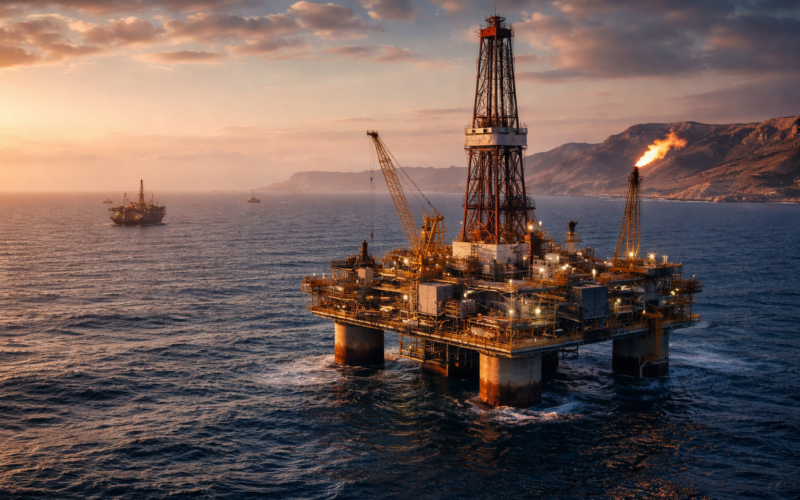
Eni S.p.A. (BIT: ENI) has announced two new offshore gas discoveries in Libya totaling more than 1 trillion cubic feet of gas in place, marking one of the most significant exploration results in the Mediterranean region in recent years. The discoveries were made at the Bahr Essalam South 2 and Bahr Essalam South 3 structures roughly 85 kilometers off Libya’s coast in around 650 feet of water. Early testing confirmed high reservoir quality in the Metlaoui Formation, the region’s primary productive gas reservoir. The proximity of the new discoveries to the producing Bahr Essalam field creates a clear development pathway through existing infrastructure, allowing the Italian energy group to potentially bring volumes online faster than typical offshore projects.
The announcement highlights a strategic trend that has become increasingly visible across Europe’s energy landscape. Companies are prioritizing gas resources that can be connected quickly to existing infrastructure rather than pursuing large greenfield megaprojects that require decade-long timelines.
Why does the Bahr Essalam South discovery strengthen Eni’s Mediterranean gas supply strategy?
The location of the new reservoirs is arguably as important as their size. The Bahr Essalam South structures lie just 16 kilometers from the existing Bahr Essalam gas field, Libya’s largest offshore producing field and a key component of the West Libya Gas Project.
Because the reservoirs sit near established offshore platforms and pipelines, Eni S.p.A. can potentially develop the discoveries through a tie-back approach. In offshore petroleum engineering terms, this means connecting new wells to existing facilities rather than building a standalone processing hub. The difference is significant. Tie-backs can reduce capital costs dramatically while shortening the time between discovery and first production.
For Eni S.p.A., the discovery therefore fits into a broader portfolio strategy that emphasizes fast-cycle upstream projects capable of generating cash flow relatively quickly.
The gas produced is expected to serve both Libya’s domestic market and export flows to Italy through the Green Stream pipeline, a subsea pipeline system that has historically transported North African gas to southern Europe.
How important is Libya to Eni’s long-term upstream portfolio and production outlook?
Eni S.p.A. has been active in Libya since 1959 and remains the country’s largest international energy operator. The company’s equity production from the country reached roughly 162,000 barrels of oil equivalent per day in 2025, making Libya one of the most material contributors to its upstream portfolio.
The country’s importance extends beyond simple production volumes. Libya sits geographically close to European markets and offers relatively low transportation costs compared with LNG imports from distant suppliers.
From a portfolio perspective, that proximity provides Eni S.p.A. with something European policymakers increasingly value: regional gas supply resilience. Gas delivered from North Africa through pipeline infrastructure can be dispatched more predictably than liquefied cargoes moving through global spot markets.
The Bahr Essalam South discoveries therefore reinforce a geographic advantage that Eni S.p.A. has cultivated for decades.
What geological signals does the Metlaoui Formation discovery send to Mediterranean exploration players?
The discovery wells encountered gas-bearing intervals in the Metlaoui Formation, which is known to be the principal reservoir system in the region. Confirmation that the formation continues to deliver commercially viable gas volumes strengthens confidence in the broader geological model of the offshore Libyan basin.
For exploration geologists, such confirmation often triggers renewed interest in nearby prospects. When a productive reservoir system is proven in multiple structures within a basin, it increases the probability that adjacent traps may contain similar hydrocarbon accumulations. This is why discoveries like Bahr Essalam South 2 and South 3 sometimes lead to exploration “clusters,” where companies pursue follow-up drilling campaigns in surrounding structures.
In practical terms, that could mean additional appraisal wells in the coming years aimed at determining whether the discovery area contains more recoverable gas than the preliminary estimate of 1 trillion cubic feet currently suggests.
Could these discoveries accelerate gas development timelines in the Mediterranean region?
In many offshore basins, exploration success does not automatically translate into near-term production. Large deepwater discoveries often require complex subsea systems, floating production units, and extensive pipeline construction.
The Bahr Essalam South discoveries differ from that pattern because they sit in an area where infrastructure already exists. Existing offshore facilities and pipelines reduce the engineering complexity of bringing new wells online.
If development proceeds via subsea tie-backs, first production could theoretically arrive within a few years rather than a decade. That timeline would align with Eni S.p.A.’s strategy of focusing on projects with relatively rapid monetization potential. For European gas markets, the implication is subtle but meaningful. Additional pipeline-connected gas from North Africa may help moderate supply volatility, particularly during periods when global LNG markets tighten.
How are investors interpreting Eni’s exploration progress and current stock performance?
Eni S.p.A. shares trade on Euronext Milan under the ticker ENI and have delivered strong performance over the past year. The stock has traded within a 52-week range of roughly €11.01 to about €21.28, reflecting a significant rebound alongside improved upstream earnings and shareholder distribution policies. Recent trading data shows the stock fluctuating around the high-teens to low-twenties euro range, with the company also reporting positive monthly price momentum in recent periods.
Short-term price movements following exploration announcements are often muted because discoveries must pass through appraisal and development phases before contributing materially to revenue. Nevertheless, investors tend to view discoveries favorably when they reinforce an operator’s strategic resource base.
In the case of Eni S.p.A., the Libya discovery complements an upstream portfolio that already includes assets across Africa, the Mediterranean, and the Middle East. Institutional investors often assess discoveries through a simple lens: whether the new resource can be monetized efficiently. The tie-back potential near Bahr Essalam suggests development costs may remain manageable compared with many offshore projects.
What geopolitical and regulatory factors could shape development of Libya’s new gas resources?
While the geology appears promising, Libya’s political environment remains a variable that energy companies must continuously monitor. The country’s oil and gas sector has historically been affected by political instability, infrastructure disruptions, and competing governmental authorities. Even when offshore operations remain relatively insulated from onshore conflict, regulatory uncertainty can affect investment decisions.
That said, Libya’s National Oil Corporation has consistently supported offshore development projects, particularly those that boost domestic energy supply and export revenue. For Eni S.p.A., the long-standing partnership with Libya’s state energy institutions provides a degree of operational continuity that new entrants might struggle to achieve.
If political conditions remain stable enough to support offshore investment, the Bahr Essalam South discoveries could strengthen Libya’s position as a Mediterranean gas supplier.
What does the discovery reveal about the future direction of Mediterranean gas exploration?
The Mediterranean basin has experienced renewed exploration interest in the past decade following major discoveries in Egypt, Israel, and Cyprus. These finds collectively shifted the region from a marginal gas province to a strategically relevant supply corridor for Europe. The latest discovery by Eni S.p.A. adds another piece to that puzzle.
Unlike giant discoveries that create entirely new production hubs, the Bahr Essalam South structures represent a more incremental but potentially efficient expansion of existing infrastructure. That approach may define the next phase of Mediterranean exploration. Companies are increasingly targeting discoveries that can be tied into established fields rather than pursuing isolated frontier prospects.
In an era when capital discipline has become a central theme in the energy industry, the appeal of lower-risk, faster-cycle projects is difficult to ignore.
What are the key strategic implications of Eni’s Libya discovery for investors and the energy industry?
- The discovery of more than 1 trillion cubic feet of gas reinforces Eni S.p.A.’s position as the dominant international operator in Libya’s upstream sector.
- Proximity to the Bahr Essalam field creates the possibility of rapid development through infrastructure tie-backs rather than expensive new offshore platforms.
- Additional gas supply could strengthen Italy’s energy import portfolio through the Green Stream pipeline connecting Libya to southern Europe.
- The success of the Metlaoui Formation wells reinforces confidence in the geological potential of the offshore Libyan basin.
- Investors typically favor discoveries located near existing infrastructure because they carry lower capital intensity and faster payback timelines.
- Libya’s political stability remains a key execution risk, even for offshore projects that are geographically removed from onshore tensions.
- The discovery reflects a broader industry shift toward smaller but faster-to-develop offshore gas resources.
- Mediterranean gas exploration is increasingly focused on infrastructure-linked discoveries rather than remote frontier basins.
- For European energy security, incremental North African pipeline supply provides diversification alongside LNG imports.
- If appraisal drilling confirms additional reserves nearby, the Bahr Essalam South area could evolve into a multi-field development cluster in the coming decade.
Discover more from Business-News-Today.com
Subscribe to get the latest posts sent to your email.
